

Experience the atmospheric townscape and cultural treasures of Takayama on a half-day private tour with a licensed guide. Customize your itinerary and make the most of your time in this charming city!
Experience the atmospheric townscape and cultural treasures of Takayama on a half-day private tour with a licensed guide. Customize your itinerary and make the most of your time in this charming city!
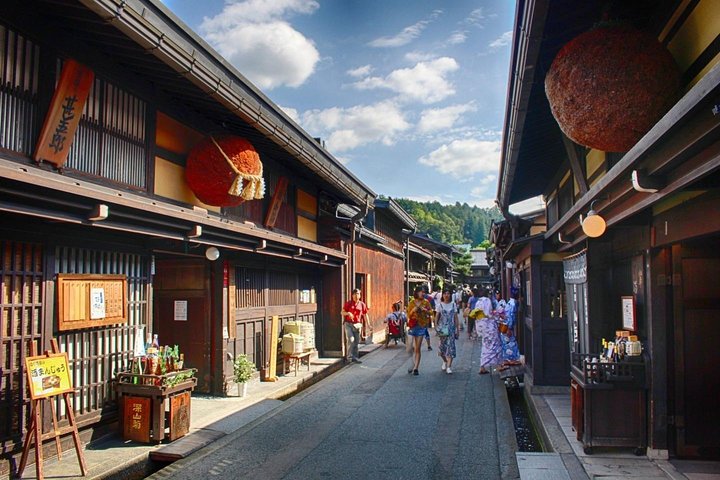
- Sanmachi Suji - Sanmachi Street is a well-known tourist spot in Hida-Takayama. This historic area features houses and shops from the Edo period (1603 - 1868). Visitors can find stores offering local specialties like Japanese sake, senbei (rice crackers), grilled yakiniku Hida beef, and croquettes. The street is bustling with people shopping and…
- Sanmachi Suji - Sanmachi Street is a well-known tourist spot in Hida-Takayama. This historic area features houses and shops from the Edo period (1603 - 1868). Visitors can find stores offering local specialties like Japanese sake, senbei (rice crackers), grilled yakiniku Hida beef, and croquettes. The street is bustling with people shopping and dining.
Sanmachi Street is just a five-minute walk from JR Takayama Station. It’s a must-visit when in Takayama.
- Takayama Jinya - Due to its rich timber resources, the Hida Region around Takayama was placed under the direct control of the Tokugawa Shogunate in 1692. The Takayama Jinya (高山陣屋) served as the local government office, led by officials sent from Edo (modern-day Tokyo).
The building complex was used officially until 1969 and is now open to the public as a museum. It features well-preserved tatami mat rooms that once served as offices, conference rooms, guest rooms, and living quarters. There is also a fascinating interrogation room.
Next to the main building is a large storehouse from the 1600s. Known as Japan’s largest traditional rice storehouse, it now serves as a museum, displaying belongings and official documents of past feudal lords, old maps of the Hida Region, and historic town plans.
Admission
440 yen
-
Hida Takayama Art and Festa Forest - ■Hida Takayama Art and Festa Forest
Matsuri no Mori (Festival Forest Museum) offers insight into the vibrant world of Takayama’s renowned festivals. The museum showcases full-sized replica floats (yatai), adorned with gold leaf and lacquer, as well as mechanical karakuri dolls performing traditional dances in a dramatic underground hall.
In addition to the festival exhibits, visitors can explore a nature museum with a global insect collection and meet adorable animals like squirrels and rabbits. There is also a tranquil tea house and a small art gallery on-site (10-minute walk from Matsuri no Mori).
Blending culture, nature, and local charm, Matsuri no Mori is a delightful stop for visitors of all ages.
- Higashiyama Walking Course - The Higashiyama Walking Course (東山遊歩道, Higashiyama Yūhodō) is a pleasant walking route through Takayama’s temple town (Teramachi), the city’s rural “suburbs,” and Shiroyama Park, a wooded hill and former site of Takayama Castle.
Along the 3.5-kilometer-long course, you will pass more than a dozen common temples and shrines, the ruins of Takayama’s former castle, and typical scenes of a rural Japanese town. While the Higashiyama Walking Course is not a breathtaking sightseeing experience, it offers a pleasant way to spend one or two hours and discover Takayama’s quieter side.
-
Takayama Festival Floats Exhibition Hall - Takayama Festival Floats Exhibition Hall (高山祭屋台会館).
The Takayama Festival, held in spring (April 14 and 15) and autumn (October 9 and 10), is considered one of Japan’s three most beautiful festivals (the other two are Kyoto’s Gion Matsuri and the Chichibu Matsuri).
Four of the autumn festival’s eleven floats (yatai) are displayed at the Takayama Matsuri Yatai Kaikan (高山祭屋台会館), a hall next to Sakurayama Hachiman Shrine. The intricately decorated floats are several hundred years old and are stunning examples of Takayama’s legendary craftsmanship.
Adjacent to the Matsuri Yatai Kaikan is the Nikkokan, a spacious hall featuring impressive models of the different precincts of Toshogu Shrine in Nikko, one of the most ornate and celebrated shrines in the country. The miniature models are beautifully detailed and come with brief explanations in Japanese and English. Photography is allowed inside both halls.
- Hida-Takayama Miyagawa Morning Market - Two morning markets (朝市, Asaichi) are held in Takayama daily from around 7:00 (8:00 in winter) to noon: the Miyagawa Market along the Miyagawa River in the old town, and the Jinya-mae Market in front of the Takayama Jinya.
The stalls offer local crafts, snacks, and farm products such as vegetables, pickles, and flowers. The markets typically have a pleasant atmosphere, with tourists and locals alike strolling from stall to stall, purchasing goods and food, and chatting.
- Hida Kokubun-ji Temple - Hida Kokubunji Temple, about a five-minute walk from JR Takayama Station, is a renowned Buddhist temple in Takayama. Its iconic three-storied pagoda was built in 1820. A Buddhist statue believed to have been made in the Heian period is enshrined in the main building. Be sure to notice the massive gingko tree on the grounds, which is over 1,260 years old.
- Sakurayama Hachimangu Shrine - Sakurayama Hachimangu Shrine in Takayama is the venue for the Takayama Festival in the autumn. Next to the shrine is the Takayama Festival Floats Exhibition Hall, or Yatai Kaikan, where four of the actual floats used in the festival are on display. The shrine is 15 minutes by Machinami Bus (clockwise) or a 20-minute walk from JR Takayama Station.
- Kusakabe Folk Museum - The Kusakabe Folk Museum is a historic private residence that has been opened to the public. The building was constructed during the Meiji period in the Edo architectural style. Due to its splendid architectural technique, the entire building is designated as an Important Cultural Property of Japan. The museum is thirteen minutes by Machinami Bus (counterclockwise) or a fifteen-minute walk from JR Takayama Station.
- Yoshijima Heritage House - Yoshijima Heritage House was built in Meiji 41 (1908). As it has been a sake brewery since olden times, a large sakabayashi (a sign of a shop dealing in sake, made of Japanese cedar leaves) is hung under the eaves. In contrast to the masculine style of the Kusakabe house, the Yoshijima house is said to possess subtlety and feminine beauty.
- Takayama Showa Museum - Takayama Showa-kan Museum, The retro streets of the 1950s are recreated inside the museum, and the lifestyle and culture of that era are nostalgically revived. There is Midget Alley, a barbershop, a photo studio, and a general store. Many nostalgic items are on display, allowing visitors to see and feel the charm of the past.
- Hida Takayama Retro Museum - The Hida Takayama Retro Museum offers a nostalgic atmosphere with a collection of Showa-era movies. Visitors can “See it,” “Snap it,” and “Play it” with figures, magazines, posters, toys, games, and Showa retro pachinko. It is an interactive museum where visitors can experience the life and culture of the Showa period.
- Hida Minzoka Mura Folk Village (Hida no Sato) - Hida Folk Village (飛騨の里, Hida no Sato) is an open-air museum showcasing over 30 traditional houses from the Hida region, the mountainous district of Gifu Prefecture around Takayama. The houses were built during the Edo Period (1603 - 1867) and were relocated from their original locations to create the museum in 1971.
In a village-like setting, the museum features buildings such as the former village head’s house, logging huts, storehouses, and several gassho-zukuri farmhouses. These large farmhouses are named after their steep thatched roofs, which resemble a pair of hands joined in prayer (“gassho”). They were moved here from nearby Shirakawago, where gassho-zukuri houses are the reason for the region’s World Heritage status.
Admission
700 yen (parking: 300 yen)

- Meet up with guide on foot within designated area of Takayama
- Licensed Local English Speaking Guide
- Customizable Tour of your choice of 2-3 sites from ‘What to expect’ list
- Meet up with guide on foot within designated area of Takayama
- Licensed Local English Speaking Guide
- Customizable Tour of your choice of 2-3 sites from ‘What to expect’ list
- Transportation fees, Entrance fees, Lunch, and Other personal expenses
- Private transportation
- You cannot combine multiple tour groups.
- Guide Entry fees are only covered for sights listed under What to Expect.
- Transportation fees, Entrance fees, Lunch, and Other personal expenses
- Private transportation
- You cannot combine multiple tour groups.
- Guide Entry fees are only covered for sights listed under What to Expect.
This value-packed trip with a government-licensed and experienced multilingual tour guide is a fantastic and efficient way to explore Takayama!
Takayama features an atmospheric townscape, with Meiji-era inns and hillside shrines in a riverside setting. In addition, many museums, galleries and temples make their home in the city’s 17th century layout. Be…
This value-packed trip with a government-licensed and experienced multilingual tour guide is a fantastic and efficient way to explore Takayama!
Takayama features an atmospheric townscape, with Meiji-era inns and hillside shrines in a riverside setting. In addition, many museums, galleries and temples make their home in the city’s 17th century layout. Be sure to come see the Takayama Festival, held once in spring and once in autumn, but be prepared for the crowds as the festivals attract hundreds of thousands of visitors each year.
Let us know what you would like to experience and we will customize a four-hour tour that’s best for you!
Note1: Please select your must-see spots from a list in the tour information to create your customized itinerary.
Note2: National Government Licensed Guide Interpreter certification is issued by the Japanese government requires a good knowledge and understanding of Japanese culture and history.
- This is a walking tour. Pick up is on foot.
For a full refund, cancel at least 24 hours before the scheduled departure time.
For a full refund, cancel at least 24 hours before the scheduled departure time.