



Embark on an 11-day cultural exploration in Sparkling Korea. Stay in 4-star hotels, enjoy the expertise of licensed English-speaking guides, and immerse yourself in the rich heritage and customs of Korea.
Embark on an 11-day cultural exploration in Sparkling Korea. Stay in 4-star hotels, enjoy the expertise of licensed English-speaking guides, and immerse yourself in the rich heritage and customs of Korea.
Arrival at ICN Airport ➜ Hotel
Incheon International Airport - A local guide will greet and transfer guests from the airport to their hotel.
Seoul, Embrace Traditional Korean Culture
Gyeongbokgung Palace - Established in 1395, Gyeongbokgung Palace is often called the Northern Palace due to its location being the furthest north compared to…
Arrival at ICN Airport ➜ Hotel
Incheon International Airport - A local guide will greet and transfer guests from the airport to their hotel.
Seoul, Embrace Traditional Korean Culture
Gyeongbokgung Palace - Established in 1395, Gyeongbokgung Palace is often called the Northern Palace due to its location being the furthest north compared to the nearby Changdeokgung (Eastern Palace) and Gyeonghuigung (Western Palace) Palaces. It is considered the most beautiful and remains the largest of the five palaces.
The palace was once destroyed by fire during the Imjin War (Japanese Invasions, 1592-1598) but was later restored under Heungseondaewongun during King Gojong’s reign (1852-1919).
Remarkably, the most iconic structures of the Joseon Dynasty, Gyeonghoeru Pavilion and Hyangwonjeong Pond, have remained largely intact. Woldae and the sculptures of Geunjeongjeon (The Royal Audience Chamber) are examples of past contemporary art.
The National Palace Museum of Korea is located south of Heungnyemun Gate, and the National Folk Museum is situated on the eastern side within Hyangwonjeong.
Current Status
Historic Site No.117 (Designated on January 21, 1963)
Closed
Tuesdays
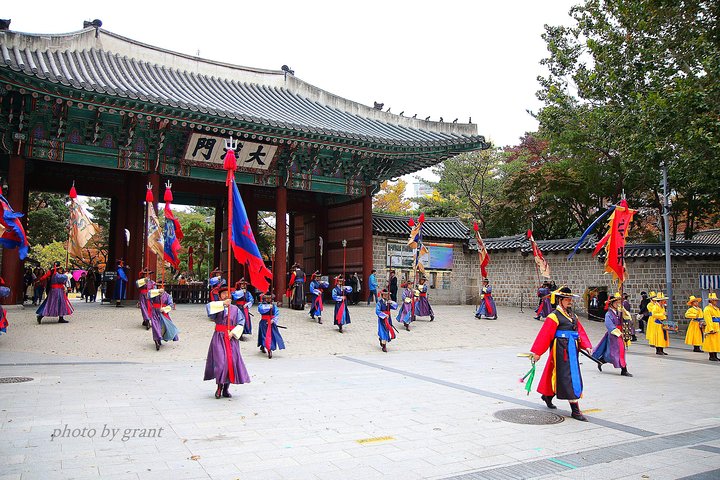
Gyeongbokgung Palace - Historically, the royal guards of the Joseon Dynasty performed their duties by guarding the Gwanghwamun Gate, the entrance to Gyeongbokgung Palace where the king governed. Since 1469, the ceremony has been held, with the current reenactment based on historical records for authenticity.
The reenactment of the original ceremony began in 1996. The gate guardsmen perform their sentry duties, change of the guards, and hold a parade. The guards’ uniforms, weapons, and accessories, along with their strict ceremonial procedures, captivate passersby, especially foreign tourists. Since traditional events are rare in a large city like Seoul, the changing of the guards ceremony is a wonderful opportunity. It occurs daily except Tuesday.
National Folk Museum of Korea - Situated inside Gyeongbokgung Palace, the National Folk Museum of Korea showcases historical artifacts used in the daily lives of Korean people in the past. Through the exhibits, visitors can learn about domestic and agricultural lifestyles, as well as Korea’s cultural beliefs.
The museum features three permanent exhibitions, two special exhibitions, a library, a souvenir shop, and other facilities.
Bukchon Hanok Village - Nestled between Gyeongbokgung Palace, Changdeokgung Palace, and Jongmyo Shrine, Bukchon Hanok Village is home to hundreds of traditional houses, known as hanok, dating back to the Joseon Dynasty. The name Bukchon, meaning “northern village,” originates from its location north of two significant Seoul landmarks, Cheonggyecheon Stream and Jongno. Today, many hanoks serve as cultural centers, guesthouses, restaurants, and tea houses, offering visitors a chance to experience and immerse themselves in traditional Korean culture.
Kwangjang Market - Gwangjang Market was Korea’s first permanent market and remains a popular tourist destination. The second floor is filled with silk, satin, and linen bed-sheet stores, which are the largest and most renowned in Seoul.
Many stores in the area have their own factories supplying fabrics to Namdaemun Market, Pyoung Hwa Market, and some department stores. Although the goods are not brand-name products, the wide selection of high-quality items at affordable prices makes for an enjoyable shopping experience.
Dongdaemun Market - Dongdaemun offers every fashion item imaginable: fabric, clothes, accessories, and wedding goods. The latest fashion trends and fabrics often debut here. It is home to Korea’s largest clothing suppliers, and aspiring designers come here to hone and test their skills. Affordable and diverse clothing attracts not only fashion leaders but also the average consumer. It has become a popular spot for major Korean and international buyers.
DMZ, Korean Paradox ➜ Andong
DMZ - A visit to the Demilitarized Zone (DMZ) requires business casual attire and comfortable walking shoes due to extensive walking. A passport is necessary for entry. The Korean DMZ is considered one of the most dangerous places on earth, yet visitors are captivated by the tranquility, lush green hillsides, and rare birds in untouched marshland.
Andong Hahoe Folk Village - Located in Gyeongsangbuk-do province, Andong is the heartland of Korean Confucianism and is considered Korea’s spiritual and cultural capital. The first stop is Dosan Seowon Confucian Academy, where Yangban (noble gentleman) students prepared for critical civil service examinations during the Joseon Dynasty (1392-1897).
Andong, Academic Center of Traditional Korean School
Andong Hahoe Folk Village - Hahoe Village is home to descendants of the Ryu clan of Pungsan and is renowned for its traditional houses. Birthplace of notable scholars of the Joseon Period such as Gyeomam Ryu Un-ryong and Seoae Ryu Seong-ryong, the village gained fame after Queen Elizabeth of England visited on April 21, 1999.
Hahoe Village, meaning “Village Enveloped by Water,” is named after the Nakdong River, which flows around the town’s perimeter. The village is located at the foothills of Hwasan Mountain, an offshoot of Taebaek Mountain rising to the east. The center of the village is populated by large tile-roofed houses belonging to the Ryu clan, adding unique charm to the surrounding thatched roofs.
Hahoe Village boasts exquisite scenic sights: the elegant Nakdong River flowing around the village, the magnificent Buyongdae Cliff, endless sandy beaches, and lush, ancient pine trees. Visitors can take a boat to Buyongdae Cliff for a panoramic view of the village.
In addition to breathtaking scenery, Hahoe Village offers delectable local delicacies. Try the Andong Soju (distilled alcoholic beverage), Heotjesabap (a type of Bibimbap eaten by the nobles), Andong Gangodeungeo (salted mackerel), and Andong Guksu (a kind of noodle dish).
Nearby attractions include Bongjeongsa Temple (built during the Silla Period), Gosan Seowon (Confucian Academy), Gwiraejeong, Gyemyeongsan Mountain Recreational Forest, Hakgasan Mountain Recreational Forest, and Waryongsan Mountain.
Hahoe Village, along with Yangdong Village in Gyeongju, was added to the UNESCO World Heritage List under the category of “Historic Villages in Korea” on July 31, 2010.
Hahoe Mask Museum - Located in Andong Hahoe Village, a UNESCO World Heritage Site and Important Folklore Material No. 122, the Hahoe Mask Museum is a representative traditional Korean folk town and home to the Hahoe Mask (National Treasure No. 121) and the Byeolsin Gut Mask Dance (Important Intangible Cultural Properties No. 69). The museum displays Hahoe masks and other traditional masks from around the world.
The museum consists of five permanent exhibition halls and one special exhibition hall, housing a wide range of masks from around the world along with Hahoe masks. The museum also offers activity programs such as wearing a mask, mask trick art, photo zone, and more.
Gyeongju, Known as ‘the museum without walls, World Heritages designated by UNESCO
Bulguksa Temple - Bulguksa Temple is the representative relic of Gyeongju and was designated as a World Cultural Asset by UNESCO in 1995. The beauty of the temple itself and the artistic touch of the stone relics are renowned worldwide.
Bulguksa Temple was built in 528 during the Silla Kingdom, in the 15th year of King Beop-Heung’s reign (514-540). Originally called ‘Hwaeom Bulguksa Temple’ or ‘Beopryusa Temple,’ it was rebuilt by Kim Dae-Seong (700-774), who began rebuilding the temple in 751 during King Gyeong-Deok’s reign (742-765) and completed it in 774 during King Hye-Gong’s reign (765-780). Upon completion, the temple’s name was changed to Bulguksa.
Bulguksa Temple underwent numerous renovations from the Goryeo Dynasty (918-1392) to the Joseon Dynasty (1392-1910) but was burned down during the Imjin War (Japanese Invasions, 1592-1598).
Reconstruction began again in 1604 during the 37th year of King Seon-jo’s reign (Joseon Dynasty) and was renovated about 40 times until 1805 (during King Sun-Jo’s reign, 1790-1834). After this time, the temple suffered serious damage and was often targeted by robbers.
In 1969, the Bulguksa Temple Restoration Committee was formed, and in 1973, Mulseoljeon, Gwaneumjeon, Birojeon, Gyeongru, and Hoerang (all previously demolished) were rebuilt. Other old or broken sites (such as Daeungjeon, Geungnakjeon, Beomyeongnu, and Jahamun) were repaired.
Even today, Bulguksa Temple is home to many important cultural relics such as Dabotap Pagoda (National Treasure No. 20), Seokgatap Pagoda (National Treasure No. 21), Yeonhwa-gyo & Chilbo-gyo Bridges (National Treasure No. 22), Cheongun-gyo & Baegun-gyo Bridges (National Treasure No. 23), Seokguram Grotto (National Treasure No. 24), the Golden Seated Vairocana Buddhist Figure (National Treasure No. 26), the Golden Seated Amita Figure (National Treasure No. 27), and Saritap Pagoda (Treasure No. 61).
Current Status
UNESCO World Heritage / Historic Site No. 502 (Designated on December 21, 2009)
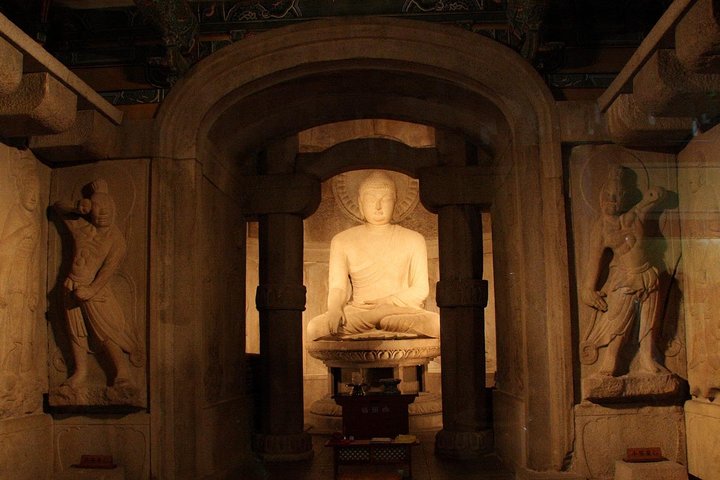
Seokguram - Seokguram, located on Tohamsan Mountain, is Korea’s representative stone temple. The official name of Seokguram, National Treasure No. 24, is Seokguram Seokgul. Designated as a World Cultural Heritage Site by UNESCO in 1995, it is an artificial stone temple made of granite. Construction was started by Kim Dae-Seong (700-774) in 751 during King Gyeong-Deok’s reign (742-765) of the Silla Kingdom (57 BC - AD 935) and finished twenty-four years later in 774, during King Hye-Gong’s reign (765-780).
Seokguram is known to have been built simultaneously with Bulguksa Temple. According to the history book Samgukyusa of the Goryeo Dynasty (the country that unified the Korean peninsula at the end of the Silla Kingdom, 918-1392), Kim Dae-Seong had Bulguksa Temple built for his parents in his current life, and Seokguram Grotto for the parents of his former life.
Inside the round-shaped main hall are the Bonjon Statue, Bodhi-sattva, and his disciples. The Bonjon figure, wearing a generous smile, is seated on the stage engraved with a lotus flower design. The rounded ceiling resembles a half-moon or a bow and has a lotus flower decorated cover on it. The view of the sunrise is quite beautiful, and many people hike the mountain at daybreak.
Current Status
National Treasure No. 24 (designated on December 20, 1962)
Daereungwon Tomb Complex - Within Daereungwon Tomb Complex is Cheonmachong Tomb (Ancient Tomb No. 155), excavated in 1973. Cheonmachong Tomb consists of a wooden coffin placed inside an underground chamber mounded with boulders and earth, characterized as a typical upper-class tomb of the Silla period. The mound has a height of 12.7 m with a diameter of 50 m and consists of a layer of rocks collected from streams. Below the rock layer is a wooden chamber with a length of 6.5 m and a width of 2.1, reaching 2.1 m in height, with the wooden coffin at its center. A total of 11,526 artifacts were discovered within the tomb, including Cheonmado, an artwork considered highly valuable as it is Korea’s first artwork to be excavated from an ancient tomb.
Current Status
[Daereungwon Ancient Tomb Complex, Gyeongju]
Historic Site No. 512 (Designated on July 28, 2011)
Busan, Hub of Asia
Jagalchi Market - Jagalchi Market, located on the shoreside road in Busan’s Jung-gu, is Korea’s largest seafood market, selling both live and dried fish. After the Korean War, the market established itself as a fish market. Most of the vendors are women, known as Jagalchi Ajumma, “ajumma” meaning middle-aged or married woman in Korean.
This market represents Busan and is famous throughout the country. Visitors can enjoy fresh raw fish right at the market. Even today, visitors can see women selling mackerel, sea squirts (ascidians), and whale meat on wooden boxes along the road outside the market and along the shore.
Every October, the Jagalchi Cultural Tourism Festival is held, and it is easily accessible due to convenient subway transportation. Jagalchi Market is where you can experience the lifestyle of Busan locals.
Taejongdae - Designated as a Busan monument, along with Oryukdo Island, Taejongdae represents Busan and is especially famous for its rock beach. Featuring its highest peak at 250 meters, there are forests of pine trees and 200 other varieties of trees. Taejongdae was named after the 29th king of the Silla Kingdom (57 BC-AD 935), King Taejong Mu-Yeol (604-661). King Taejong traveled to many places, but this was his favorite spot for shooting arrows.
Under the lighthouse of this resort is a rock called Sinseon Rock, named after the myth that gods and goddesses came down here to relax. At this rock is a figure called Mangbuseok, named after the story of a woman who waited for her husband who had been taken to Japan. Taejongdae is also famous for the ritual of praying for rain, performed during droughts, and rain on the 10th day of the fifth lunar month is called the “Taejong Rain.” On clear days, you can see Japan’s Tsushima Island from the observatory.
Current Status
Scenic Spot No.17 (Designated November 1, 2005)
Gamcheon Culture Village, Busan - Gamcheon Culture Village is formed by houses built in a staircase-fashion on the foothills of a coastal mountain, earning this village the nickname “Machu Picchu of Busan.” Many alleys that cut through this community are vibrantly decorated with murals and sculptures created by the residents.
Haeundae Beach - Haeundae Beach is the most famous beach in Busan. The white sand beach is roughly 1.5km long, over a 30~50m wide area, creating a beautiful coastline before a shallow bay, making Haeundae Beach perfect for swimming.
People flock to Haeundae Beach every summer. All kinds of accommodations from luxury hotels to private guesthouses have developed in the area around the beach, making this the perfect summer vacation spot. Haeundae Beach is also famous for various cultural events and festivals held throughout the year. Other facilities in the area include Dongbaek Island, Busan Aquarium, a yachting dock, BEXCO, driving courses, and more.
Tongyoung, Naples of the Orient
Tongyeong Daegyo - Situated in Tongyeong (Gyeongsangnam-do), Mireuksan Mountain (461m) is considered one of the 100 best mountains in Korea. While not as high as other mountains, it is home to a lush forest, valleys with pure water, odd-shaped rocks, rock caves, and ancient temples. Upon climbing to the top of the mountain, visitors can see the breathtaking view of the sea enveloping Tongyeong. Near Tongyeong are a number of large and small islands including Mireukdo.
Hiking used to be the only option to climb up the mountain, but a cable car (covering over 2km, the longest in Korea) now carries visitors to a stop that leads to the top of the mountain through wooden decks (400m in length). In clear weather, visitors can even see Tsushima Island (in Japan), Cheongwangbong Peak in Jirisan, and Dolsando in Yeosu. The top of the mountain boasts a dazzling array of flowers in spring and exquisite fall foliage, attracting visitors in droves year-round. At the outskirts of the mountain are two ancient temples, Yonghwasa and Miraesa.
Jeonju, Discovery of Korean Artistry
Jeonju Hanok Village - Jeonju Hanok Village is located in the city of Jeonju and overlaps Pungnam-dong and Gyo-dong. There are 735 traditional Korean hanok houses. While the rest of the city has been industrialized, Hanok Village retains its historical charms and traditions.
Jeonju Hanok Village is especially beautiful for its unique roof edges, which are slightly raised to the sky. Hanok houses are generally divided into two sections, Anchae and Sarangchae. Sarangchae is where the men dwell, and is referred to as the Seonbi room. Because men and women had to remain separate, Anchae is situated deep inside the house so that it is secretive and quiet.
Another trait of Hanok is that all the houses are heated with ondol, a unique sub-floor heating system. Since Koreans enjoy sitting, eating, and sleeping on the floor, it needs to remain heated. A part of Hanok has been set aside so that tourists can experience traditional Korean life, called Hanok Life Experience Hall. You can enter the rooms to experience the warm floor first-hand. An advantage of this system is that it is warm in the winter and cool in the summer.
The food provided is very traditional, which adds to the traditional ambiance. At Jeonju Hanok Village, visitors can enjoy traditional Korean life and traditional foods like bibimbap, the most well-known dish from the Jeonju region.
Current Status
Designated as Slow City in 2010
Hanji Museum - Originally named the Hansol Paper Museum in 1997, it was changed to the Pan-Asia Paper Museum in 2001. Again, in 2005, it was renamed the Jeonju Hanji Museum. It’s located in Jeonju, Jeollabuk-do. As Korea’s first museum specializing in paper, it has an extensive collection of 3,000 artifacts and a database documenting the long history and superiority of Hanji (Korean paper). The museum also hosts two special exhibitions every year with diverse paper-related themes.
Program Information
Themes: Paper crafts, archives, old books, 100 types of paper, and paper-manufacturing tools
Hanji experience: Visitors can make Hanji themselves with the help of a jijang (paper-making expert).
Day of Korean Martial Arts, Taekwondo & Temple Stay
Taekwondowon - Taekwondowon is a place for practicing “change” with the aim of cultivating the spirit of taekwondo through physical training and the endless quest for mastery of this martial arts form. Some 45 training and hands-on experience programs are offered under the themes of experience, training, rest, and interest. The programs are open to anyone interested in training the mind and body through taekwondo, including local and international taekwondo practitioners, business groups, students, and the general public.
Gangnam Style
Dragon Hill Spa - THE SPA
Welcome to Seoul, Korea! Introducing Dragon Hill Spa, a perfect getaway and healing paradise in Yongsan, the heart of Seoul, for those seeking a healthy lifestyle.
Naturalism in the heart of the city
Gangnam Underground Shopping Area - Consumers in their 20s to 30s frequently visit Gangnam Station Underground Shopping Center.
The mall is located in Gangnam Station of Seoul Subway Line 2 and consists of all the latest fashion trends. It is also an ideal place to browse the shops to keep up with the so-called “Gangnam Style.”
The mall also has a rest area called Herb Plaza, where shoppers can take a break from their shopping.
Seoul ➜ ICN Airport for Departure ✈
Incheon International Airport - After breakfast, enjoy last-minute shopping near the hotel, one of the main shopping and tourism districts in Seoul. If nothing was found during the journey, this is the best place to purchase souvenirs. In the evening, transfer to the airport for the return flight, with unforgettable experiences in Korea, concluding a fantastic journey.

- Breakfast
- Lunch
- Dinner
- Other
- Breakfast
- Lunch
- Dinner
- Other
- Lunch and Dinner
- Lunch and Dinner
Accommodation: Top-rated 4-star hotels conveniently situated in the heart of downtown.
Tour Guide: Expertly chosen licensed English-speaking guides, who are enthusiastic, highly trained, and knowledgeable, ensuring a truly memorable experience.
Tour condition: High-quality service, comfort, stress-free travel, and a relaxed pace.
Discover the wonders of…
Accommodation: Top-rated 4-star hotels conveniently situated in the heart of downtown.
Tour Guide: Expertly chosen licensed English-speaking guides, who are enthusiastic, highly trained, and knowledgeable, ensuring a truly memorable experience.
Tour condition: High-quality service, comfort, stress-free travel, and a relaxed pace.
Discover the wonders of Sparkling Korea, from its breathtaking landscapes and rich cultural heritage to its distinctive customs and traditions. Let this incredible Korean journey inspire you!
As Korean culture gains global popularity, an increasing number of visitors are drawn to Korea to experience it firsthand.
- Tour itinerary can be switched by flight schedule or situation caused.
For a full refund, cancel at least 24 hours before the scheduled departure time.
For a full refund, cancel at least 24 hours before the scheduled departure time.


