Pamukkale: A Journey Through Time and Nature’s Masterpiece
Drawn by the allure of Pamukkale’s travertine terraces and the ancient city of Hierapolis, I embarked on a journey that promised both natural beauty and historical intrigue. Join me as I explore this UNESCO World Heritage site, guided by the knowledgeable Liza, and discover the stories etched into its stones.


The Journey to Pamukkale: A Historical Prelude
As a former professor of European history, my travels often lead me to places where the past whispers through ancient stones and echoes in the architecture. Pamukkale, with its ethereal white terraces and the ancient city of Hierapolis, was a destination that promised both natural beauty and historical intrigue. My wife and I embarked on this journey from Kusadasi, a drive that stretched across the Turkish landscape, offering glimpses of the region’s rich tapestry of history and culture.
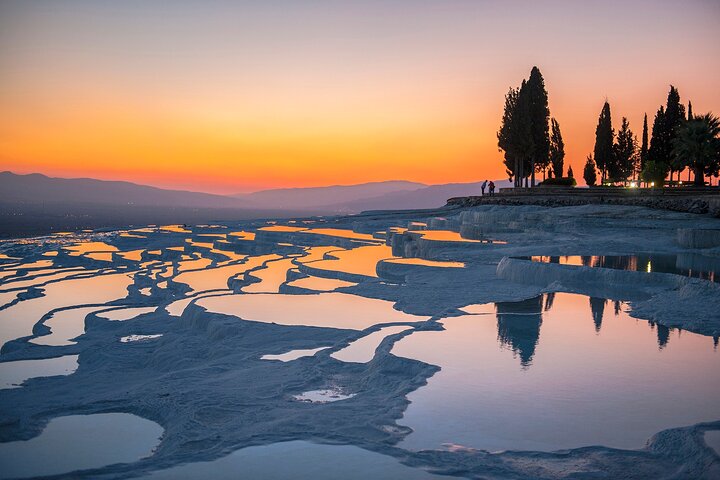
Our guide, Liza, was a beacon of knowledge and warmth, her passion for the area evident in every story she shared. The drive, though lengthy, was punctuated by her engaging tales of the ancient world, setting the stage for the wonders that awaited us. As we approached Pamukkale, the sight of the travertine terraces, gleaming like a cascade of frozen waterfalls, was nothing short of breathtaking.
Exploring the Ancient City of Hierapolis
Upon arrival, we were greeted by the sprawling ruins of Hierapolis, a city that once thrived under Roman rule. The name “Hierapolis” translates to “Holy City,” a testament to its historical significance. Walking through the ancient streets, I could almost hear the echoes of Roman citizens going about their daily lives. The Odeon, with its semi-circular seating, spoke of gatherings and performances that once entertained the city’s elite.
The Roman Baths, a testament to the engineering prowess of the time, were a highlight. These baths were not just places of leisure but also centers of social interaction and political discourse. As we wandered through the remnants of these grand structures, Liza’s insights brought the ancient world to life, painting vivid pictures of a bygone era.
The theatre, perched on a hillside, offered a panoramic view of the surrounding landscape. It was here that the Apostle Philip is said to have lived and preached, adding a layer of spiritual significance to the site. The sense of history was palpable, each stone a silent witness to centuries of human endeavor.
The Enchanting Terraces of Pamukkale
After exploring Hierapolis, we turned our attention to the natural wonder of Pamukkale itself. The terraces, formed by calcium deposits from hot springs, are a marvel of nature’s artistry. Walking barefoot on the terraces, as is customary, was a unique experience. The texture of the stone, smooth in some places and rough in others, was a reminder of the forces that shaped this landscape over millennia.
For those with tender feet, like myself, a pair of socks can provide comfort without detracting from the experience. The pools, filled with warm, mineral-rich water, offered a chance to relax and reflect on the day’s discoveries. My wife and I took the opportunity to capture the moment with photographs, the azure pools providing a stunning backdrop.
As the day drew to a close, we made a brief stop at an onyx factory and a textile outlet. The craftsmanship on display was impressive, and I couldn’t resist purchasing a few Turkish towels as souvenirs. The journey back to Kusadasi was a time for reflection, the memories of Pamukkale and Hierapolis lingering in our minds.
In conclusion, the Pamukkale Tour was a journey through time, a blend of natural beauty and historical depth that left a lasting impression. Despite the minor hiccup with lunch, the experience was enriched by the knowledge and enthusiasm of our guide, Liza. For those who share my passion for history and architecture, Pamukkale is a destination that should not be missed.