


Embark on a thrilling 6-day Golden Triangle Tour, exploring the iconic cities of Agra, Delhi, and Jaipur. Discover the wonders of India, from the Taj Mahal to the vibrant streets of Jaipur.
Embark on a thrilling 6-day Golden Triangle Tour, exploring the iconic cities of Agra, Delhi, and Jaipur. Discover the wonders of India, from the Taj Mahal to the vibrant streets of Jaipur.
- New Delhi - Welcome to Incredible India! A company representative will greet you at Delhi Airport and transfer you to the hotel for an overnight stay.
- India Gate - India Gate is a war memorial located along the Rajpath, on the eastern edge of New Delhi’s “ceremonial axis,” formerly known as Kingsway.
- Chandni Chowk - Situated in the…
- New Delhi - Welcome to Incredible India! A company representative will greet you at Delhi Airport and transfer you to the hotel for an overnight stay.
- India Gate - India Gate is a war memorial located along the Rajpath, on the eastern edge of New Delhi’s “ceremonial axis,” formerly known as Kingsway.
- Chandni Chowk - Situated in the heart of Old Delhi, Chandni Chowk is a bustling shopping area with markets offering spices, dried fruits, silver jewelry, and vibrant saris. The narrow side streets are filled with small shops selling essential oils, stationery, and traditional Indian sweets. Nearby, the expansive Mughal-era Red Fort now houses a museum complex, and the 17th-century Jama Masjid is a grand red-sandstone mosque with towering minarets.
- Friday Mosque (Jama Masjid) - The Masjid e Jahan Numa, commonly referred to as the Jama Masjid of Delhi, is one of India’s largest mosques. Constructed by Mughal Emperor Shah Jahan between 1650 and 1656 at a cost of one million rupees, it was inaugurated by Imam Syed Abdul Ghafoor Shah Bukhari from Bukhara, present-day Uzbekistan.
- Lotus Temple - The Lotus Temple, located in Delhi, India, is a Bahá’í House of Worship dedicated in December 1986. Renowned for its flower-like design, it has become a prominent city attraction. Like all Bahá’í Houses of Worship, the Lotus Temple welcomes everyone, regardless of religion or any other qualification.
- Qutub Minar - The Qutb Minar, also spelled as Qutab Minar or Qutub Minar, is a minaret that is part of the Qutb complex, a UNESCO World Heritage Site in Delhi’s Mehrauli area. Qutb Minar is a 73-meter tall tapering tower with five stories, starting with a base diameter of 14.3 meters and narrowing to 2.7 meters at the top.
- Parliament House - The Parliament of India is the supreme legislative body of the Republic of India. It is a bicameral legislature consisting of the President of India and two houses: the Rajya Sabha and the Lok Sabha.
- Rashtrapati Bhavan - Rashtrapati Bhavan is the official residence of the President of India, located at the western end. When Prasad became the first President of India and occupied this building, it was renamed Rashtrapati Bhavan – the President’s House.
- Jaipur - Amer Fort is a fort located in Amer, Rajasthan, India. Amer is a town covering an area of 4 square kilometers, situated 11 kilometers from Jaipur, the capital of Rajasthan. Perched high on a hill, it is the main tourist attraction in Jaipur.
- Jal Mahal - Jal Mahal is a palace situated in the middle of Man Sagar Lake in Jaipur, the capital of Rajasthan, India. The palace and the surrounding lake were renovated and expanded in the 18th century by Maharaja Jai Singh II of Amber.
- Hawa Mahal - Palace of Wind - Hawa Mahal is a palace in Jaipur, India. Constructed with red and pink sandstone, the palace is located on the edge of the City Palace, Jaipur, and extends to the Zenana, or women’s chambers. Built in 1799 by Maharaja Sawai Pratap Singh, the grandson of Sawai Jai Singh, the founder of Jaipur.
- City Palace of Jaipur - The City Palace, Jaipur was established simultaneously with the city of Jaipur by Maharaja Sawai Jai Singh II, who relocated his court to Jaipur from Amber in 1727.
- Albert Hall Museum - Albert Hall Museum is situated in Rajasthan, India. It is the state’s oldest museum and serves as the state museum of Rajasthan. The building is located in Ram Niwas Garden outside the city wall opposite New Gate and is a fine example of Indo-Saracenic architecture.
- Jantar Mantar - Jaipur - Jantar Mantar is a collection of nineteen architectural astronomical instruments built by Rajput king Sawai Jai Singh II, the founder of Jaipur, Rajasthan. Completed in 1734, it features the world’s largest stone sundial and is a UNESCO World Heritage site.
- Fatehpur Sikri - Fatehpur Sikri is a small city in northern India, just west of Agra, founded by a 16th-century Mughal emperor. Red sandstone buildings are clustered at its center. The Buland Darwaza gate serves as the entrance to the Jama Masjid mosque. Nearby is the marble Tomb of Salim Chishti. Diwan-E-Khas hall features a carved central pillar. Jodha Bai’s Palace is a blend of Hindu and Mughal styles, adjacent to the 5-story Panch Mahal that overlooks the site.
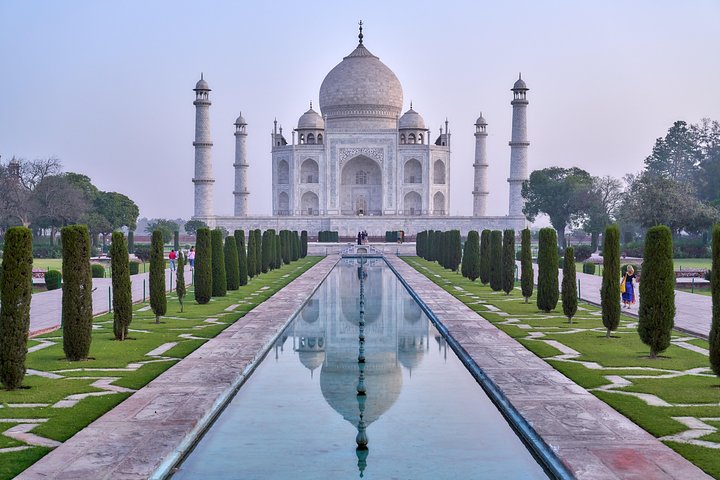
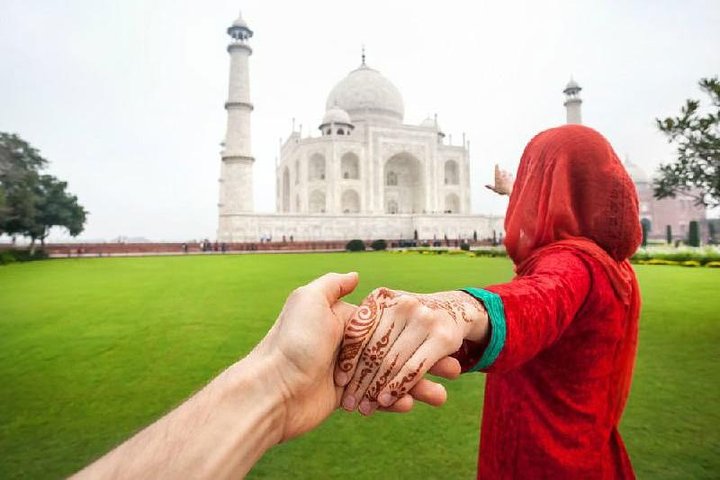
- Taj Mahal - The Taj Mahal is an ivory-white marble mausoleum on the south bank of the Yamuna River in Agra, India. Commissioned in 1632 by Mughal emperor Shah Jahan to house the tomb of his beloved wife, Mumtaz Mahal, it also contains the tomb of Shah Jahan, the builder.
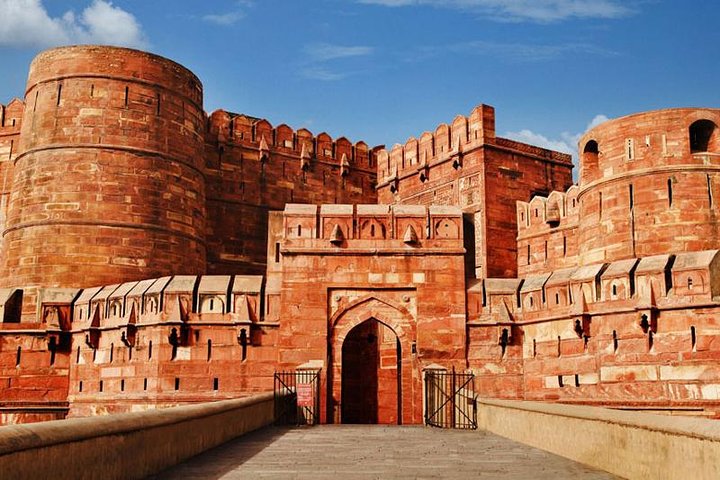
- Agra Fort - Agra Fort is a historic fort in Agra, India. It served as the main residence of the Mughal Dynasty emperors until 1638, when the capital was moved from Agra to Delhi. Before being captured by the British, the last Indian rulers to occupy it were the Marathas.

- Private transportation
- Bottled water
- 4-night accommodation in 4-star hotel
- All fees and taxes
- Breakfast
- In-vehicle air conditioning
- English-speaking guide
- Private transportation
- Bottled water
- 4-night accommodation in 4-star hotel
- All fees and taxes
- Breakfast
- In-vehicle air conditioning
- English-speaking guide
- any meal
- monument fees
- any meal
- monument fees
The Golden Triangle is India’s most frequented and renowned circuit, comprising of the cities of Agra, Delhi and Jaipur. Each city is approximately 250 kms apart from one another, creating a triangular formation on the map of India based on their geographic positions. This circuit benefits from excellent road, bus and rail connections, with rapid trains…
The Golden Triangle is India’s most frequented and renowned circuit, comprising of the cities of Agra, Delhi and Jaipur. Each city is approximately 250 kms apart from one another, creating a triangular formation on the map of India based on their geographic positions. This circuit benefits from excellent road, bus and rail connections, with rapid trains such as the Shatabdi Express available. The newly-built Express Highway between Delhi and Agra has reduced travel time to just 2-3 hours. Many international visitors prefer to arrive in Delhi, spend a few days exploring, then continue their journey to the south, towards the iconic Taj Mahal, followed by a westward trip to Jaipur, India’s ‘Pink City’.
For a full refund, cancel at least 24 hours before the scheduled departure time.
For a full refund, cancel at least 24 hours before the scheduled departure time.