Join us on an exploration of Portugal, a land rich in diverse local customs, traditions and mouth-watering cuisine paired with phenomenal wines. Embark on an itinerary-free journey, flexible to tailor with your travel partner daily, as you delve into our intriguing history evident in the timeless monuments that stand as witnesses of our bygone times!
Join us on an exploration of Portugal, a land rich in diverse local customs, traditions and mouth-watering cuisine paired with phenomenal wines. Embark on an itinerary-free journey, flexible to tailor with your travel partner daily, as you delve into our intriguing history evident in the timeless monuments that stand as witnesses of our bygone times!
Transfer to Lisbon Hotel - Lisbon City Private Tour
Lisbon Cathedral - Explore the exterior of this monument; entrance is optional and not included.
The Castelo de São Jorge is one of Lisbon’s iconic landmarks, perched on the city’s highest hill.
The earliest known fortification here dates back to the 2nd century BC, with some remains from as far…
Transfer to Lisbon Hotel - Lisbon City Private Tour
Lisbon Cathedral - Explore the exterior of this monument; entrance is optional and not included.
The Castelo de São Jorge is one of Lisbon’s iconic landmarks, perched on the city’s highest hill.
The earliest known fortification here dates back to the 2nd century BC, with some remains from as far back as the 6th century BC. Archaeological findings have revealed traces of Phoenicians, Greeks, Carthaginians, Romans, and Muslims, indicating human presence in this area since ancient times.
The castle was established in the 10th and 11th centuries when Lisbon was a significant Moorish port. In 1147, Portugal’s first king, Dom Afonso Henriques, seized the castle and city from the Moors. The castle’s most notable period was between the 13th and 14th centuries. In the 16th century, King Dom Manuel I welcomed Vasco da Gama here after his voyage to India, and the first Portuguese play by Gil Vicente was performed to celebrate the birth of King Dom João III.
Declared a National Monument in 1910, the castle underwent extensive restoration in the 20th century, resulting in its current appearance. It is a key site in the city and a popular leisure spot for locals. It is widely regarded as offering the best view over the city and the River Tagus.
Inside the walls, there is a museum presenting Lisbon’s history and the Torre de Ulisses (Tower of Ulysses). The city’s legendary founder lends his name to the former Torre do Tombo, now housing a camera obscura with a giant periscope for a 360º real-time panoramic view of the city.
Alfama - Alfama is Lisbon’s oldest and one of its most traditional neighborhoods. It spans parts of the Santa Maria Maior and São Vicente parishes. Its name comes from the Arabic al-hamma (الحمّة), meaning ‘hot water source, good water’.
The most stunning views of Alfama are from the public promenade formed by the viewpoints of Portas do Sol, the Tower of the Church of Santa Cruz do Castelo (the highest Tower in ancient Lisbon), and Santa Luzia. Surrounding Alfama are the hills of Castelo de São Jorge, a fortress and royal palace until the 16th century, and São Vicente. Key monuments in the area include the Cathedral, the Church of Santo Estêvão, and the Church of São Vicente de Fora.
Alfama is unique, resembling an old village not only in appearance but also due to its small, close-knit community. It is frequented daily by both Portuguese and international tourists and is considered the smallest neighborhood in Lisbon.
Lisbon Cathedral - Visit this 12th-century monument
Dedicated to the Mother of God since 1147.
Lisbon Cathedral, dedicated to the Mother of God, is a city treasure and one of the country’s most significant monuments due to its historical, religious, and artistic value. Construction began in 1147 when Portugal’s first king, D. Afonso Henriques, reclaimed the city from the Moors. It was built on a Muslim mosque, which archaeological excavations confirmed was built on a previous Visigothic Christian temple.
Although the city had been a bishopric since at least the fourth century, with a Christian bishop at the time of the 12th-century Christian Reconquest, English crusader Gilbert de Hastings was appointed bishop, and construction began under his guidance. The first architect was Mestre Roberto, likely of Norman origin, who also worked on Coimbra Cathedral and the Santa Cruz Monastery in the same city. At the time, D. Afonso Henriques ordered the relics of the martyr St. Vincent de Zaragoza to be brought from the Algarve and placed in the Cathedral.
The original building followed Romanesque style canons, but between the 13th and 14th centuries, it underwent its first changes. During D. Dinis’s reign, the Gothic-style cloister was built. Later, King D. Afonso IV ordered the construction of the ambulatory for his family pantheon, making the Cathedral more suitable for pilgrims visiting St. Vincent’s relics. The ambulatory led to ten chapels, some linked to the Virgin: the Chapel of Our Lady of Penha de França, the Chapel of Santa Ana, Saint Mary Major, and Our Lady of the Conception.
In the 17th and 18th centuries, Baroque-style work was done, particularly in altar and main chapel decoration. In the first half of the 20th century, the Cathedral’s medieval character was restored.
Inside, visit the chapel of Bartolomeu Joanes, a significant medieval Lisbon bourgeois; excavations of the cloister revealed successive occupations of this area. Although much of its former estate is preserved in museums (such as the Museum of Ancient Art), the Cathedral includes a collection called the Treasury of the Patriarchal See, which can be visited.
Rossio Square - Rebuilt after the 1755 earthquake, this charming Lisbon square marks the northern reach of the Pombaline Downtown. It forms a quadrilateral dominated by the neo-classical harmony of the D. Maria II Theatre, built on the site of the former House of the Inquisition.
According to the Marquis of Pombal, the Praça do Comércio would be the city’s center-point and symbol of the new social order he wished to create for the Nation. However, over time, Rossio, a bright and welcoming square, established itself as the bourgeois forum for Lisbon.
The square came to life with its hotels (now gone) filled with travelers, stores, and tobacconists. There was also no shortage of the quintessential Portuguese institution - the café. These were forums for talk, conspiracy, politics, and the arts.
Life has changed, but Café Nicola (on the western side) and the Pastelaria Suíça (the eastern) remain as testaments to times gone by. At the center is the 28-meter-high column erected in 1870. On top is King Pedro IV, holding the Constitution in his right hand. Two monumental fountains were added in 1889, where florists now display their wares.
To the south, observe how the gracious arc connects with Rua dos Sapateiros. It is a fine piece of Pombaline architecture from the late 18th century with ornamental embellishments, including a fine window with its veranda opening onto the Square. Its construction was funded by businessman Pires Bandeira and later became known as the Arch of Bandeira.
The entire square recently underwent a complete makeover, restoring the original Portuguese cobbling’s splendor, with the central area featuring a combination of blue and white stones tracing the sea’s waves.
Parque Eduardo VII - Stop at the top of Parque Eduardo VII for a fantastic view over Lisbon
Eduardo VII Park is located in the Parish of São Sebastião da Pedreira, north of Avenida da Liberdade, offering panoramic city views. Originally known as Parque da Liberdade, the gardens were renamed after British King Edward VII’s visit to Lisbon in 1903.
Since their inception, the gardens have hosted fairs, exhibitions, and various entertainment types. Their design, with a central lawn flanked by Portuguese cobblestone pavements, was by Keil do Amaral and is a landmark in Lisbon’s development.
Here, find a Sports Pavilion built in 1932 in the João V style, renamed the Carlos Lopes pavilion in tribute to the famous Portuguese athlete, a Greenhouse with a vast variety of plants from around the world, lakes, and various statues, including a bust of King Edward VII and a monument to the 25th April Revolution by João Cutileiro.
There is also a children’s playground, a viewpoint, a bandstand, a picnic area, the Club VII sports complex with tennis courts, a gymnasium, a swimming pool, and a restaurant.
Mosteiro dos Jeronimos - Visit the exterior of the monument; entrance is optional and not included
On the banks of the Tagus stands a pinnacle of Manueline architecture.
Where the Jerónimos Monastery stands today, next to the old Belém beach, was originally a small hermitage dedicated to Santa Maria, built by Infante D. Henrique in 1452. At the start of the 16th century, King Manuel I’s intention to erect a large monastery there was acknowledged by the Holy See and donated to the Order of the Friars of St. Jerome. The epitome of Manueline architecture and intrinsically linked to the Discoveries, this monastery is the most remarkable Portuguese monastic ensemble of its time and one of the main European churches.
Construction began in 1501, lasting a hundred years, led by a remarkable group of architects and master builders, both national and foreign. With an initial design by Frenchman Boytac, the work continued by other Masters, namely João de Castilho and, mid-century, Diogo de Torralva. After the Portuguese arrived in India, the crown funded the venture with trade money from the East. King D. Manuel I channeled much of the “Vintena da Pimenta” (a ‘Spice Tax’, approximately 5% of revenues from trade with Africa and the East, equivalent to 70kg of gold per year) to finance construction.
In this UNESCO World Heritage Site, note the facades, church, and cloisters. On the south facade, admire the portal painted by João de Castilho, where figures are arranged hierarchically: below, Infante D. Henrique guards the entrance, the Virgin of Bethlehem blesses the monument, and Archangel Saint Gabriel, Portugal’s protector, completes the arc. The western portal, through which one enters the sacred space, is by Nicolau Chanterenne. To the left, protected by St. Jerome, is King D. Manuel’s statue, said to be a realistic portrait, and to the right is Queen D. Maria, his wife, protected by St. John the Baptist.
Inside is the church-hall, a Manueline masterpiece by João de Castilho. Note how, in a remarkable architectural achievement, the beautiful vault of the transept is unsupported by columns. At the entrance, after the lower-choir, are the cenotaphs of poet Luís de Camões, author of the epic “Os Lusíadas,” and Vasco da Gama, commander of the armada that went to India in 1497. The kings, princes, and descendants of D. Manuel I are buried in the side chapels. In the main chapel, later reconstructed by Jerónimo de Ruão, are the tombs of D. Manuel I, his son D. João III, and their wives. Noteworthy is the solid silver tabernacle, a mid-17th-century Portuguese silversmith masterpiece.
The church visit is free.
Torre de Belem - Visit the exterior of the monument; entrance is optional and not included
The harmony and delicate ornamentation of the Tower of Belém suggest a finely cut jewel to all who see it. However, contemporaries viewed it differently: a formidable bastion defending the Tagus entrance, capable of combining firepower with the St Sebastian tower on the opposite riverbank. King Manuel I (1495-1521) ordered its construction, and Francisco de Arruda built it between 1514 and 1521. The tower was built on a basalt island near the Tagus’s right bank in front of Restelo beach. However, with the river’s gradual course change, the tower is now practically swallowed by the bank.
The tower’s quadrangular shape resembles medieval castles and has a polygon bulwark, a defensive feature allowing it to withstand heavy bombardment from the sea. The watch posts, with burgeoning cupolas at each corner, show Moroccan fortification influence. Apart from Moorish influences, the decoration otherwise takes on the Manueline style in the surrounding stone layouts, heraldic designs, and even the famous rhinoceros, the first stone statue of the animal in Europe.
The Tower’s most decorated side faces south, with its narrow balcony. On the cloistral wall above the bulwark, a sculptured image of the Virgin with Child from the 18th century forms the tower’s prow.
The interior is worth visiting to reach the top floor, with the effort rewarded by wonderful views over the Tagus estuary and the city’s western side, still evoking the Portuguese Discovery Era.
In 1983, UNESCO classified the Tower of Belém as World Heritage.
Padrao dos Descobrimentos - Visit the exterior of the monument; entrance is optional and not included
The imposing Monument to the Discoveries marks the riverside at Belém. It was designed in 1940 to commemorate the “Exposition of the Portuguese World,” promoted by the Salazar government to celebrate the eighth and third centenaries of the Portuguese nation’s founding and restoration (1140 and 1640, respectively). However, it was only built in 1960 for commemorations marking 500 years since Prince Henry the Navigator’s death. Designed by architect Cottinelli Telmo, it features sculptor Leopoldo de Almeida’s work.
Standing 52 meters high, the monument symbolizes a caravel, headed by Prince Henry the Navigator, followed by a cortege of 32 leading figures from the Discoveries Era, including King Afonso V (1432-81), the driving force behind the first discoveries, Vasco da Gama (1460-1524), who discovered the maritime route to India, Pedro Álvares Cabral (1467-1520), who discovered Brazil, and Fernando Magellan, who completed the globe’s circumnavigation in 1522, among others.
The façade facing the ground takes on a cross form decorated by the Sword of the Order of Aviz, the main financial sponsor of the voyages.
Praca do Comercio (Terreiro do Paco) - This is one of Europe’s most beautiful squares, opening southwards onto the vast Tagus estuary. Until the era of mass aviation, this was Lisbon’s grand reception hall for visitors arriving by sea, better able to enjoy its beauty from their vantage points on slowly docking vessels. It was at the dock here that Kings and Heads of State would disembark when visiting Portugal.
Before the 1755 earthquake, it was called Terreiro do Paço (Royal Yard). The Royal Palace had been on the square’s western side since the 16th century when King Manuel moved the court down from the Castle of São Jorge (St. George). In 1580, Filipe I of Portugal ordered a new square, with work by Filippo Terzi and Juan Herrera (the architect responsible for the Escorial).
Everything was destroyed by the earthquake. The name Praça do Comércio (Commercial Square) belongs to the Pombal era and represents the new social order that Minister to King José I wanted to favor and promote: the trading, financial, and bourgeois classes that contributed significantly to rebuilding the city.
In the Square’s geometric center, facing the river, is a statue of José I, mounted on his horse Gentil, sculpted by Machado de Castro. It was unveiled with pomp and circumstance on June 6, 1775, the king’s birthday. He discreetly viewed the event from one of the Customs building’s windows. The celebrations lasted three days and included a gigantic banquet for all Lisbon’s people.
On a pedestal by the riverside, there is a likeness of Pombal (removed when the minister fell into disgrace but replaced by the Liberals in 1834) raised onto the royal shield. The sculpted figures on either side represent Triumph, with a horse, and Fame, with an elephant, clearly alluding to Portugal’s overseas possessions. On the pedestal’s rear side, in low relief, there is an allegoric representation of royal generosity towards a city in ruins, with Commerce opening a chest full of money for this royal generosity.
Underneath the northern arcade, right by the Rua do Ouro entrance, make sure to peek into the Martinho da Arcada café-restaurant. This is a city reference and a cultured destination. Before heading up Rua Augusta, leading to Rossio, take a moment to admire the Triumphal Arch overlooking the thoroughfare.
Parque das Nacoes - Panoramic tour through Lisbon’s most modern district, Parque das Nações
Imagine a site offering some of the most daring contemporary architecture examples, the Oceanarium, one of Europe’s largest, delightful thematic gardens, exhibition centers, shows, and events. All located along a breathtaking 5 km stretch of the Tagus riverfront, in Lisbon’s heart, with easy access and parking, and benefiting from a wide array of shops, restaurants, and bars.
Only five minutes from Lisbon International Airport, Parque das Nações builds on the heritage of EXPO’98 - the last world exposition of the twentieth century. An invented city turned into reality.
Fátima, Batalha, Nazaré and Óbidos Private Tour
Sanctuary of Our Lady of Fátima - The Shrine of Fatima, formally titled by the Catholic Church as Shrine of Our Lady of the Rosary of Fatima, is a Marian shrine dedicated to Our Lady of Fatima, located in Cova da Iria, in the city of Fatima, municipality of Ourém, Portugal.
The Shrine of Fatima is a premier Christian pilgrimage and Catholic devotion site, preserving the memory of the events leading to its foundation, namely the apparitions of Our Lady to the three shepherds - Lucia dos Santos, Francisco, and Jacinta Marto - in 1917. Its religious significance is widely recognized, both nationally and internationally. By express will of the Holy Apostolic See, this is a National Shrine. It is also one of the most important Marian shrines in the world belonging to the Catholic Church and the largest international destination for religious tourism, receiving about six million visitors annually. It has been honored with three papal golden roses and visited by Pope Paul VI (1967), John Paul II (1982, 1991, and 2000), Benedict XVI (2010), and Francis (2017).
Construction began in 1919 with the Chapel of the Apparitions; over the years, the sanctuary expanded to include two basilicas, significantly increasing its capacity to shelter pilgrims indoors. However, various urban plans created to manage its growth have had little practical effect, and the complex seen today results more from timely interventions meeting immediate needs than unified, long-term planning. On the other hand, the powerful impetus generated by the Fatima Shrine was responsible for the exponential growth of a previously undeveloped area of the country.
Stylistically diverse, incorporating revivalist buildings alongside more modern ones, the Fátima Sanctuary mainly comprises the Chapel of the Apparitions, the Prayer Hall (outside), the Basilica of Our Lady of the Rosary and its Colonnade, the vast Basilica of the Most Holy Trinity, the retreat houses of Our Lady of Carmo and Our Lady of Sorrows, a Way of the Cross in the Valinhos, and the Paul VI Pastoral Center. It also has cultural spaces and several other buildings for administrative sectors, pilgrim reception, medical care, commerce, meetings, congresses, and other activities. The sanctuary also benefited from contributions by artists of various generations, national and international, who created numerous and diverse works there.
Basilica of the Holy Trinity - This Basilica is the latest construction of the Fatima Sanctuary complex and is dedicated to the worship of the Holy Trinity. The intention to build a new temple dates back to 1973, as it was found that the Basilica of Our Lady of the Rosary of Fatima was no longer large enough to accommodate all pilgrims, particularly on Sundays and other medium-affluence days. In 1997, through Monsignor Luciano Guerra, the Shrine of Fatima organized an international competition for a new building design next to Pius XII Square, with a scale appropriate to real needs. The first stone was laid on June 6, 2004, Solemnity of the Holy Trinity; three years later, the work was completed, and the church was dedicated on October 12, 2007, by Cardinal Tarcisio Bertone, then Vatican Secretary of State and Benedict XVI’s legacy to close the 90th anniversary of Our Lady’s apparitions. On August 13, 2012, the church was elevated to the category of Basilica.
The new church was dedicated to the Holy Trinity for several reasons, including the following: the apparitions of the Angel of Peace, with his insistent invitation to worship God, the Holy Trinity; the words of John Paul II in May 1982, spoken in the Chapel of Apparitions, by which he raised his thanksgiving to the Holy Trinity; the Great Jubilee of the Year 2000, also dedicated to the Holy Trinity.
Valinhos Sanctuary - The Valinhos correspond to the lands the three little shepherds of Fatima traveled from their houses in Aljustrel to Cova da Iria for grazing their herds. It was here that two apparitions of the Angel of Portugal (or Angel of Peace) occurred in 1916 (where the children even learned the Angel’s Prayers), and an apparition of the Virgin Mary on August 19, 1917.
Today, the Valinhos are visited by thousands of Portuguese and foreign pilgrims who travel along the Via Sacra to the Hungarian Calvary, visit the St. Stephen’s Chapel of Hungary, and from there visit the House of Lucia and the House of Francis and Jacinta Marto in Aljustrel village.
Batalha Monastery - Santa Maria da Vitória Monastery, better known as Batalha Monastery, is a Dominican monastery in Batalha village, Centro region, Beira Litoral province, Portugal, built in 1386 by King D. João I of Portugal to thank the Virgin Mary for victory against Castilian rivals in the battle of Aljubarrota. This monastery of the Order of Saint Dominic was built over two centuries until about 1563, during the reign of seven Portuguese kings, although the first Dominican friars lived there since 1388. An example of late Gothic Portuguese architecture, or Manueline style, it is a UNESCO World Heritage site, and on July 7, 2007, was elected as one of the Seven Wonders of Portugal. In Portugal, IPPAR classifies it as a National Monument since 1910. Since 2016, it has the status of National Pantheon.
Nazare - Nazaré beach, with a mild climate and natural beauty, has one of Portugal’s oldest traditions linked to fishing arts.
The long, crescent-shaped sandy beach, also the city’s seafront, is known for its grandeur and brightly colored awnings decorating the white sand beach in contrast to the blue water.
This is Portugal’s beach where fishing traditions are most colorful, and it is not uncommon to meet fishmongers who still wear the seven skirts, as tradition dictates. On a late Saturday afternoon in the summer months, it is essential to sit on the wall watching the interesting show of “Arte Xávega,” where nets loaded with fish come from the sea, and women shout their trading sessions. If the words are not understood exactly, it is nothing to worry about. These are codes that often only they know.
Facing the sea, on the right side, is an impressive promontory. This is Sítio, where one of the best-known panoramic views of the Portuguese coast is found. There are 318 meters of rock falling to the sea, which can be reached on foot, for the bravest, or by ascending by elevator. At the top, find the small Hermitage of Memory, which tells the legend of the miracle that Our Lady did by preventing a nobleman, D. Fuas Roupinho’s horse, from jumping on the precipice. True or not, at the Suberco Viewpoint, the sign left on the rock by the horseshoe is shown, on this foggy morning of 1182. At the Site, visit the Nossa Senhora da Nazaré Sanctuary and not far away, the Dr. Joaquim Manso Museum to learn more about Nazarene traditions.
From Sítio, with time for a walk, crossing Parque da Pedralva, arrive at Pederneira, a natural viewpoint with an unmissable view over Nazaré’s coast.
Currently, the city’s great attraction is the waves and surf, thanks to the “Canhão da Nazaré,” an underwater geomorphological phenomenon allowing the formation of giant and perfect waves. It is Europe’s largest submerged gorge, about 170 kilometers along the coast, reaching 5000 meters in depth.
Hawaiian surfer Garrett McNamara gave it world visibility when, in 2011, he rode the world’s biggest wave on a sandy bottom, about 30 meters, at Praia do Norte, winning the Billabong XXL Global BigWave Awards and breaking a Guinness Book record. Like him, surfers worldwide visit Nazaré annually to venture into the sea, especially during winter. Between November and March, the biggest waves are patiently awaited during a long stage of the world championship of giant waves, the Nazaré Tow Surfing Challenge. On the beach, sunbathing is also appreciated, and an excellent audience to appreciate these young people’s achievements.
To get to know Nazaré, take a relaxed walk through the narrow streets, perpendicular to the beach, and pause at one of the restaurants to enjoy a dish of fresh seafood, grilled fish, or an appetizing stew. In the evening, enjoy the setting sun on any terrace overlooking the sea, while the lights come on and it gets dark.
Obidos Village - Due to its excellent location by the sea and as the lagoon’s arms reached the hill, these lands have always been inhabited, confirmed by the Lower Paleolithic station of Outeiro da Assenta. Here, a Celtibero castro formed, facing west. The Phoenicians are known to have traded here, and today with more property than the Romans settled here, and it is likely that the south tower of the Facho originated from a Roman-built watchtower tower as the outpost of the city of Eburobrittium, a large urban city found and in the process of archaeological work.
On January 11, 1148, the first king, D. Afonso Henriques, supported by Gonçalo Mendes da Maia, took Obidos from the Arabs after the previous November siege. The Memory Cruise is a simple monument of the time, later restored. Obidos belonged to the defensive pentagon (of the five castles) of the kingdom’s center, idealized by the Templars.
With the offer of Óbidos as a wedding gift from D. Dinis to his wife D. Isabel, the village belonged to the House of Rainhas, only extinct in 1834, and here passed most of Portugal’s queens, leaving great benefits. D. Catarina orders the aqueduct and fountains to be built. The administrative reform of D. Manuel I gives Óbidos a new Foral in 1513, with this time very intense in urban requalifications.
The 1755 earthquake strongly affected the village, knocking down parts of the wall, some temples, and buildings, and altering some aspects of the Arab and medieval hull and layout. Óbidos was also the scene of the Peninsular War fights, with the great battle of Roliça, which belonged to the “term” of Óbidos.
More recently, the village was the scene of the preparatory meeting of the April 25 Revolt, thus becoming linked to the brave and heroic movement of the captains.
Sintra, Cabo da Roca, Cascais and Estoril
Park and National Palace of Pena - The fantastic Pena Palace is one of the greatest examples of the romantic revival of the 19th century in Portugal.
Located in Monte da Pena, the Palace was built on the site of an old convent of friars of the Order of São Jerónimo. It was the result of the imagination of D. Fernando de Saxe Coburgo-Gotha, who married Queen D. Maria II in 1836. In love with Sintra, he decided to acquire the convent and the surrounding lands to build the royal family’s summer palace.
The consort king adopted Portuguese architectural and decorative forms for the palace, in the revivalist style (neo-gothic, neo-manueline, neo-islamic, neo-renaissance) and in the surroundings, he decided to make a magnificent English-style park, with the most varied exotic tree species.
Inside, still decorated to the taste of the kings who lived there, the chapel stands out, where you can see a magnificent alabaster marble altarpiece attributed to Nicolau Chanterenne (one of the architects of the Jerónimos Monastery, in Lisbon). Also worthy of mention are the mural paintings in trompe l’oeil and the tile coverings.
Centro Historico de Sintra - Time to stroll through the narrow streets of Sintra village and taste its conventual confectionery.
The following are two options for viewing:
1 - National Palace;
2 - Quinta da Regaleira
A beautiful town at the foot of the mountain range of the same name, its unique characteristics led UNESCO to classify it as a World Heritage site. It was even necessary to create a special category for the purpose - that of “cultural landscape” - considering its natural riches and the historic buildings in the town and mountains. Endowed with luxuriant vegetation, the mountains are part of the Sintra-Cascais Natural Park.
From early times, Sintra has been the place of choice for various peoples who passed through the Iberian Peninsula and left traces of their presence, now displayed in the Archaeological Museum of Odrinhas, on the town’s outskirts.
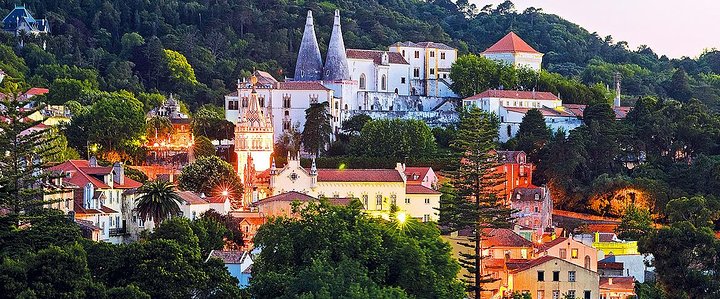
In the 12th century, Dom Afonso Henriques, the first King of Portugal, captured the Moorish Castle, and his successors later built their holiday residence. Their physiognomy is marked by the two enormous conical chimneys built in the Middle Ages.
Much appreciated by kings and nobles as a country resort, and praised by writers and poets like (inevitably) Lord Byron, who called it “glorious Eden,” Sintra has a wealth of cottages and manor houses, some now providing accommodation in the form of country-house tourism.
The palaces, too, are outstanding, such as the Pena Palace, built in the Romantic period on one of the mountain peaks, and the 18th-century Palace of Seteais, now converted into an elegant hotel, and the Palace of Monserrate, famous for its beautiful gardens with exotic species unique in the country.
Sintra’s confectionery deserves a special mention, particularly the travesseiros (puff pastries stuffed with a sweet eggy mixture) and the famous cheese-cakes, which according to ancient documents were already being made in the 12th century, and were part of the rent payments.
Near Sintra are the beaches (das Maças, Praia Grande, Praia da Adraga), Cabo da Roca (the westernmost point of mainland Europe), Colares (after which a demarcated wine-growing region is named), and the picturesque village of Azenhas do Mar, inset in a cliff.
Sintra National Palace - The ancient history of Paço da Vila de Sintra begins during the Muslim rule in the Iberian Peninsula. Already mentioned in the 11th century, the primitive Moorish palace - owned by the Portuguese crown after the conquest of Lisbon by D. Afonso Henriques (1147), 1st King of Portugal - is intervened for the first time in 1281, during the reign of D. Dinis. New construction bodies are added over time, under the reigns of D. Dinis, D. João I, and D. Manuel I, maintaining their silhouette since the middle of the 16th century.
The arrangement of spaces in height, adapting to the terrain; the intimate organization of the indoor open-air patios, where you can hear the water running; its windows with outdated arches; and the tile coverings of rich geometric patterns, show the Moorish connection of the craftsmen who built and embellished the Palace.
Quinta da Regaleira - Quinta da Regaleira is one of the most amazing monuments in the Serra de Sintra. Located at the end of the historic center of the village, it was built between 1904 and 1910, in the last period of the monarchy.
The romantic domains formerly belonging to Viscondessa da Regaleira were acquired and expanded by Dr. António Augusto Carvalho Monteiro (1848-1920) to found his place of choice. Holder of a prodigious fortune, which earned him the nickname Monteiro dos Milhões, he associated with his unique architecture and landscape project the creative genius of the Italian architect and scenographer Luigi Manini (1848-1936) as well as the mastery of sculptors, stonemasons, and carvers who had worked with him at the Palace Hotel in Buçaco.
A man of scientific spirit, vast culture, and rare sensitivity, a remarkable bibliophile, a discerning collector, and a great philanthropist, he left in this stone book the vision of a cosmology, a synthesis of the spiritual memory of humanity, whose roots immerse themselves in the Lusa and Universal Mythic Tradition. The architecture and art of the palace, chapel, and other buildings were designed in the context of an Edenic garden, highlighting the predominance of neo-Manueline and Renaissance styles.
The garden, a representation of the microcosm, is revealed by the succession of places imbued with magic and mystery. Paradise is materialized in coexistence with an inferius - a Dantesque underground world - to which the neophyte would be led by Ariadne’s thread of initiation.
With these scenarios, the representation of an initiatory journey, like vera peregrinatio mundi, through a symbolic garden where we can feel the Harmony of the Spheres and examine the alignment of an asceticism of consciousness that travels through the great epics, materializes. In it are glimpsed references to mythology, Olympus, Virgil, Dante, Camões, the Templar mission of the Order of Christ, great mystics and thaumaturges, the enigmas of Real Art, the Magical Work of Alchemy. In this stone symphony, the poetic and prophetic dimension of a Portuguese Philosopher’s Mansion is revealed. Here Heaven and Earth merge in a sensitive reality, the same that presided over the theory of the Beautiful, of Architecture, and of Music, that the acoustic shell of the Terrace of the Celestial Worlds allows to propagate for the infinite.
Cabo da Roca - Cabo da Roca is the westernmost point of the European continent or, as Luís Vaz de Camões wrote, the place “Where the Earth ends and the sea begins” (in Os Lusíadas, Canto VIII). A stone pattern with a headstone marks this geographical feature to all who visit this place.
Cabo da Roca is also called “Focinho da Roca” by people linked to things of the sea, and more poetically by “Promontório da Lua.” It is integrated into the Sintra Cascais Natural Park, which encompasses a vast area of natural interest and landscape beauty from Cascais Citadel to the mouth of the Falcão River. From Cabo da Roca, it is possible to follow several eco-trails.
In Cabo da Roca, the visitor is faced with a spectacular landscape, an imposing lighthouse, and various infrastructures. It is also in this place that one of the rarest plant species is found, the “armeria pseudoarmeria.”
Being located in an area with easy access and a large number of tourists, many people visit it.
Guincho Beach - In the vicinity of Cascais, the extensive sandy beach of Praia do Guincho is very popular with swimmers during the summer season and all year round for surfers and windsurfers, sports for which this beach offers excellent conditions.
Along the road by the sea, countless restaurants of excellent quality offer excellent dishes of fresh fish and seafood.
Cascais - Located by the sea and traditionally a fishing village, Cascais had significant development in the 14th century when it was a busy port of call for ships heading for Lisbon.
However, it was from the 2nd half of the 19th century, when sea baths began to be appreciated, that Cascais experienced a transformation into a fashionable summer resort. The main driver of this transformation was King of Portugal D. Luís I, who in 1870 converted the citadel fortress into the Portuguese monarchy’s summer residence. This example was followed by the nobility, who built mansions and beautiful houses where the hottest time of the year was spent, completely transforming the old fishing village.
Cascais also started to attract strollers, whose access was made easier by the inauguration of the Railway Line between Pedrouços and Cascais in 1889. Today, Cascais is a lively and cosmopolitan place, still retaining its aristocratic air.
It is recommended to stroll through its streets, which have excellent quality stores, or take a few moments of rest on one of the many terraces here. The beaches continue to be one of the biggest attractions, with options between those located in the sheltered bay of the village or those a little further away in the Guincho area (already integrated into the Sintra-Cascais Natural Park) that offer excellent conditions for surfing and windsurfing. Boca do Inferno, an indentation of the coast surrounded by steep cliffs and caves, remains a natural curiosity attracting many visitors to see the sea’s strength.
Highlight for gastronomy, especially fresh fish and seafood, which can be enjoyed in the many restaurants in the region.
Evora and Monsaraz
Centro Historico de Evora - Topped by an imposing cathedral, Évora is laid out over a gently sloping hill rising out of the vast Alentejo plain. It guards its historic center with a vast outer wall and represents a valuable cultural legacy that UNESCO has classified as World Heritage.
The city, with its narrow streets of Moorish origin contrasting with squares where the light floods in, holds two millennia of history. Conquered in 59 B.C. by the Romans, they named it “Liberalitas Julia.” In this period, Évora gained great importance, as can be witnessed from the remains of that time: the ruins of a fine temple dated towards the end of the second century, various parts of the wall and the gateway more recently called Dona Isabel, in addition to the remains of thermal baths below what is now the Municipal Council building.
Little remains of the Visigoth period (5th - 8th centuries). There then followed the Moorish period, begun with the city’s conquest by Tárique. This lasted through to the Christian reconquest in the 12th century. Yeborah, as it became known, had already received an indelible Moorish influence, most clearly seen in the Mouraria neighborhood.
After the Reconquest, in addition to between the inner and outer walls, urban development moved beyond the city’s walls. The city was home to the court of various Portuguese kings of the first and second dynasties. During this period, it was endowed with various palaces and monuments, particularly during the reigns of kings João II and Manuel (15th and 16th centuries).
Wander its streets and absorb the secret soul that a diverse range of cultural influences has laid down in this city of the World. There are also excellent restaurants and bars, esplanades, arts and handicraft stores, and the youthful nature of those attending its university all adding up to a dynamic of the present with its roots very firmly in the past.
Templo Romano de Evora (Templo de Diana) - The Roman Temple, over 2000 years old, is the ex-libris monument of Évora and is one of the most important historic ruins in the country.
The Roman temple in Évora was built in the first century, during the time of Caesar Augustus. It has a long history, serving as testimony to many transformations and different uses over the centuries. It was practically destroyed when the Barbarians occupied the Iberian peninsular in the fifth century, and served as a bank vault and butcher’s to Evora castle in the 14th century.
Its original Roman design was only recovered in the 19th century, in one of the first archaeological interventions in Portugal. It is a testimony to the Roman forum of the city of Évora, consecrated to the Imperial cult, thus clarifying a 17th-century tradition that claimed that the temple had been consecrated to the goddess Diana. For this reason, it was identified for many years as the Temple of Diana. Recent excavations have shown that it was surrounded by a portico and water mirror.
Cathedral of Evora (Se Catedral de Evora) - The largest medieval cathedral in Portugal.
A fortified church with Gothic features, Évora Cathedral is the largest cathedral in Portugal. Initiated in 1186, consecrated in 1204, and immediately used as one of the main temples of the Marian cult, it was only complete in 1250. It is a monument that showcases the transition from the Romanesque to the Gothic style, with Renaissance and Baroque additions introduced later.
The facade is flanked by two towers, both medieval, with the bells being placed in the south tower. The north tower houses a number of valuable treasures belonging to the Museum of the Sacred Art; some unique priceless pieces, such as the image of the Virgin of Paradise, a figurine of the Virgin and Child that opens up from the lap and portrays an altarpiece with various scenes of the Birth and Passion. The remarkable central dome, built at the end of the 13th century during the reign of King Dinis, is the Cathedral’s true showstopper. The main portico is one of the most impressive Portuguese gothic portals, with master sculptures of the Apostles made in the 14th century by Master Pêro, a leading name in national Gothic sculptures. Besides the main portico, there are two other entrances: the Porta do Sol, facing south, with Gothic arches; and the North Gate, rebuilt in the Baroque period.
The interior is divided into three naves about 80 meters long. In the central nave, you can see the altar of Our Lady of the Angel (locally known as Nossa Senhora do Ó), with polychrome marble images of the Virgin and the Angel Gabriel. The 18th-century altar and the marble chapel in Estremoz are Baroque works by J.F. Ludwig, known as Ludovice, who was the architect of the Palace of Mafra, at the service of King John V (1706-1750). In the chapel, a beautiful crucifix known as the “Father of the Christ” is displayed above the painting of Our Lady of the Assumption.
In the transept, see the ancient Chapels of Saint Lawrence and the Holy Christ, and the Chapels of the Relics and the Blessed Sacrament, decorated with gilded carvings. At the northern tip is the spectacular Renaissance portal of the Chapel of the Morgados do Esporão. And in the upper-choir is a very valuable renaissance chair carved in oak wood, and an organ of great proportions, also of the 18th century.
You can also visit the gothic cloister, dated 1325, and climb to the terrace, from where you can enjoy a beautiful panorama over the entire city of Évora, since the Cathedral is located at its highest point.
Igreja de Sao Francisco - Church of São Francisco - Évora
One of the striking features of the façade is a church porch with arches of different styles - a typical example of the “marriage” between Gothic and Moorish style found in so many monuments of this region in Portugal. Over the Manueline doorway, we can see the emblems of the kings that commissioned its construction - D. João II and D. Manuel I - whose emblems were the pelican and armillary sphere respectively.
One particularity of the Church is that it has a single nave, terminating in a ribbed vaulted ceiling, that has the largest span of all Portuguese Gothic architecture. On the sides, we can see twelve chapels, all covered in Baroque carved woodwork. The main chapel, dating from the early 16th century, still maintains important Renaissance features such as the pulpits. It’s well worth noting the harmonious decoration of stone, carved woodwork, and azulejo tiles in the chapel of the third order, on one of the arms of the transept.
Capela dos Ossos - Inside Church of São Francisco, visitors can see the strange Bones Chapel, built during the Filippine period (17th-century). The pillars and walls are completely covered by bones. It’s also worth noting the late Renaissance doorway where the capitals of the columns seem to be decorated in a different manner according to whether one is looking from the exterior or interior.
Monsaraz Castle and Walls - This extremely beautiful medieval town has succeeded in preserving its own distinctive characteristics over the centuries. Walking through the streets of Monsaraz is like going back in time, for it is a truly unique place where one can find all the peace and tranquility that have been forgotten by the modern era.
The most immediate visual impression in the town is that of the whitewash and schist of its houses and buildings. Every year, throughout July, Monsaraz becomes an open-air museum, affording visitors the opportunity to get to know more about the customs and habits used in the production of Alentejo handicraft, appreciate the delights of the regional cuisine, and enjoy the various cultural events held there, including music, theatre, dance, and art exhibitions.
As far as the town’s architectural heritage is concerned, the highlights are the medieval castle and keep, the former court building (built between the fourteenth and the sixteenth centuries), and the parish church of Nossa Senhora da Lagoa (dating from the sixteenth and seventeenth centuries).
Serra da Estrela
Covilha - Lying among rivers and mountains, the city of Covilhã is one of the gateways to the Serra da Estrela.
The original inhabitants of the land were Lusitanian shepherds. Covilhã was reconquered from the Moors by King Dom Sancho I, who built city walls to protect it. It became a strategic point in the Middle Ages, especially in the reign of Dom Dinis, who set about reinforcing the defense of the territory.
The town was granted royal status by Dom Manuel, who gave it a new charter in 1510, and it was also a land of discoverers. Prince Henry the Navigator was given the title Lord of Covilhã by his father, King Dom João I, after conquering Ceuta in 1415.
It was the birthplace of Pêro da Covilhã, the explorer sent to the Orient by King Dom João II, and whose information helped Vasco da Gama to discover the sea route to India.
One of Covilhã’s claims to fame is the art of making woolen goods. This began in the time of Dom Sancho I, and was developed by the Jewish community that settled here at that time, where they remained until the 15th century. The textile industry, which produced all the uniforms for the Portuguese army during the reign of Dom João V, was given a new boost when the Marquis of Pombal established the Royal Cloth Factory here, making it into the country’s largest center for the production of woolen goods. Due to economic growth that followed, Covilhã was raised to the status of a city in 1870.
A visit to Covilhã’s historic heritage should not omit the old Judiaria (Jewish Quarter), with its narrow streets and Manueline windows, the Chapel of São Martinho, the Chapel of Santa Cruz, and the Wool Museum.
In Covilhã and surrounding areas, discover the Land of Castles and Historical Villages, the Wool Route, the Old Judiarias Route, and the Serra da Estrela Nature Reserve, by taking one of the itineraries that show you the region’s natural and cultural heritage. Find us on the Covilhã Council website.
Serra da Estrela - In summer or winter, mainland Portugal’s highest mountain is the perfect scenery for a few relaxing days in contact with nature.
At 1,993 meters at its highest point in Torre, Serra da Estrela is an area of rare landscape beauty, with striking mountain drops, where you can have a deep experience of the silence of the heights. Take advantage of those moments of communion with nature to observe it, discovering the diversity of plants and birds and the flocks of sheep herded by Estrela dogs from the breed named after the Mountain.
You can also follow the course of some major Portuguese rivers from their sources: the Mondego at Mondeguinho, the Zêzere at Covão de Ametade, and the Alva at the Rossim Valley are breathtaking places. Or you can admire glacier valleys at Loriga, Manteigas, or Covão do Urso and Covão Grande. In the warmest months, the best suggestion will certainly be the 25 Lagoon Itinerary, leading you to some refreshing locations.
In cold weather, Serra da Estrela is the only place in Portugal where you can try skiing, or go sledging, snowboarding, or ride a snowmobile. There are several pistes with support infrastructure, as well as synthetic snow pistes for skiing at any time of the year.
This natural park is excellent for trekking, horse-riding, or mountain biking. It boasts some 375km of marked trails of varying degrees of difficulty, so you’ll no doubt find one fitting your physical condition. And who has not dreamed of flying like a bird? You can experience the sensation of paragliding in Linhares da Beira, soaring over this historical village - which you shouldn’t miss exploring on foot either.
Torre - The highest point of continental Portugal and where there is the only ski resort in Portugal
Lagoa Comprida - Dam at the top of Serra da Estrela
Porto - > Arrival in Porto;
Check-in;
Hotel not included in the cost of the program;
Porto City Tour
Porto - The Porto Baixa (Downtown) is laid out around the Avenida dos Aliados (Avenue of the Allies), the city’s focal point. At the top of this thoroughfare, there is the imposing Municipal Council building. At the other end, it opens onto the Praça da Liberdade (Liberty Square) where there is a statue of a mounted Pedro IV (19th c.), emperor of Brazil and, like much of Oporto, a supporter of the Liberalism movement. In a show of recognition, the king literally gave his heart to the city, now watched over in the Church of Lapa.
To the side of the square, take a look at the São Bento (Saint Benedict) railway station to see the pictured tiles in the entrance hall. Then head down the Rua das Flores (Street of Flowers), with its goldsmiths and the exuberant baroque façade of the Church of Misericórdia (Compassion), a masterpiece by architect Nicolau Nasoni.
Surrounding this center, there is a dense network of streets packed with stores and cafes. Of the latter, the magnificent Majestic and the cheerfully bustling Mercado do Bolhão are well worth a visit. On the streets 31 de Janeiro Galeria de Paris and Cândido dos Reis check out the facades with their Art Nouveau finishings.
Heading up Rua de São Filipe Néry, there is the Church and Tower dos Clérigos (Ecclesiastics), the centerpiece of the city and the most original design by Nicolau Nasoni. From 75 meters up in the tower, there is a wonderful panoramic view over the city of Porto and beyond. On the way, nip into the Lello bookshop and admire the lavish decoration bestowed on this temple to culture.
Cafe Majestic - O Café Majestic é um café histórico, localizado na Rua de Santa Catarina, na cidade do Porto, em Portugal.
A sua relevância advém tanto da ambiência cultural que o envolve, nomeadamente a tradição do café tertúlia, onde se encontravam várias personalidades da vida cultural e artística da cidade, como também da sua arquitectura de identidade Arte Nova. Em 2011, foi considerado o sexto café mais bonito do mundo.[1][2]
Livraria Lello - Livraria Lello, also known as Livraria Lello & Irmão or Livraria Chardron, is located at Rua das Carmelitas, 144, in the Historic Center of the city of Porto, in Portugal.
Due to its unique historical and artistic value, Lello has been recognized as one of the most beautiful bookstores in the world by several personalities and entities, such as the Spanish writer Enrique Vila-Matas, the British newspaper The Guardian, and the Australian publisher of travel guides. Lonely Planet travel.
Torre dos Clerigos - Genuine baroque work by Nicolau Nasoni, an ex-libris monument of the city of Porto.
The Church of Clérigos (Ecclesiastics) is a genuine baroque masterpiece dating from the mid-18th century. It was designed by Nicolau Nasoni, an architect of Italian origin. He stamped his mark on many monuments around Oporto and the north of Portugal. Nasoni, on his request, was buried here in a small chapel with its gateway at the same level as the top of the double bolster stairway.
The front of the church shows off its highly interesting and beautiful baroque finishing with its contours, domes, and spires worthy of closer inspection. The interior has but a single nave in granite and marble and covered in baroque carvings again demonstrating the skill of the architect. In the main chapel, attention is drawn to the polychromatic altarpiece by Manuel Porto.
However, what sets this construction apart is the Tower; constructed in granite protruding out of the top of the western side of the church. This is the highly distinctive landmark of Oporto. The tower extends upwards through 75 meters of elegance forming rhythmic stages before rising to its crowning glory, the spherical clock house. The baroque decoration is thoroughly delicate and off a wonderful lightness.
In 1917, the Tower of Clérigos was successfully climbed by two Spanish acrobats, the Puertullanos, a father and son team, in front of an enormous crowd. This is a feat that, on looking up at the Tower, would seem impossible.
An inner staircase (240 degrees) enables access to the top. For those wishing to avoid the feats of the Puertullanos, this is the best means to gain access to one of the most beautiful panoramic views over all of Oporto.
Sao Bento Railway Station - The cornerstone was unveiled in 1900 by King Carlos I on the site of the former convent S. Bento de Avé Maria (Saint Benedict of Hail Mary). The initial project was designed by architect Marques da Silva with its external lines demonstrating then contemporary French influences.
Well worth a visit is the huge entrance hall covered with some twenty thousand pictorial tiles. The work of Jorge Colaço, they feature historical and ethnographic images. The colored frieze running around the entire atrium details various forms of transport in chronological order from the earliest times through to the appearance of the train. Below, great panels depict scenes from the history of Portugal.
On the northern wall, the upper panel depicts a scene from the Valdevez Archery Tournament while below there is a greeting from Egas Moniz. On the southern wall, the upper panel features the royal entry of João I into Oporto, with his bride, Philippa of Lancaster, and the lower scenes from the Ceuta Chronicles. Other small panels show aspects of regional life.
Porto Cathedral (Se Catedral) - Sé Catedral do Porto
The many names of Marian Devotion.
Porto Cathedral, like the first band of city walls, was born in the 12th century by initiative of its first bishop, D. Hugo. The temple is also known as the church of Santa Maria do Porto, de Nossa Senhora do Porto da Eterna Salvação or Nossa Senhora da Vandoma – which attests to the importance the Marian cult has.
The building reached its present dimensions in the 13th century, and the following century the cloister was added on, built in Gothic style, as was the tomb of the Knight João Gordo in the chapel of St. John the Evangelist.
Kings D. João I and D. Filipa de Lencastre were married in Porto Cathedral, also in the 14th century, on February 14, 1387. The people of Porto dressed in their finery and the city was covered with flowers and fragrant herbs for the celebration feast.
Later, in the 17th and 18th centuries, the exterior and interior look of the cathedral was changed by baroque taste. The transformation of the portal (which still conserves the medieval rose window), the north facade, and several other sites, such as the main chapel and the chapel of the Blessed Sacrament, which has since housed a large silver altarpiece, executed by goldsmiths from Porto, stem from this period.
Various altarpieces and chapels show the Marian cult under different titles, such Nossa Senhora do Presépio, Nossa Senhora da Silva, Nossa Senhora da Piedade, Nossa Senhora da Esperança, Nossa Senhora da Expectação, Nossa Senhora da Conceição, and Nossa Senhora da Vandoma – with this latter being the most important, as the patron of the city and included in the municipal coat of arms since the 16th century.
Also part of this architectural trove is the grandiose building of the Episcopal Palace, whose construction dates back to the 12th century.
Ribeira - Ribeira is one of the oldest and most typical places in the city of Porto, in Portugal. Located in the parish of São Nicolau, next to the Douro River, it is part of the Historic Center of Porto, a UNESCO World Heritage Site. It is currently an area very frequented by tourists and a place of concentration of bars and restaurants.
In Ribeira, Praça da Ribeira, popularly also known as Praça do Cubo, is worth mentioning; Rua da Fonte Taurina, one of the oldest in the city; the Wall of Bacalhoeiros and the Casa do Infante, where Infante D. Henrique is believed to have been born in 1394. It was in this area of Porto that one of the most charismatic figures of the city lived, the so-called Duque da Ribeira, known for having saved several drowning people.
Lunch Time!
Igreja de Sao Francisco - The Church of São Francisco was built in the 14th century, during the reign of King D. Fernando, on the site of a modest church pertaining to the order of Franciscan Friars who had established a presence in the city of Oporto in 1223.
The layout of the Church follows the rules of the mendicant Gothic style - with three naves, a prominent transept, and a tripartite top section, with a main chapel inside. Several innovative elements were introduced, such as the decoration of balls in the window slits of the main chapel.
In the 16th century, João de Castilho designed the chapel of São João Baptista, but it was only in the 18th-century that the main works were carried out, resulting in this magnificent Baroque church that has been preserved to the present day, and which appears to be covered in gold, due to the abundance of gilt-edged woodcarvings.
The woodcarvings inside the church include the notable altarpiece of the main chapel, dedicated to the Tree of Jessé, reformulated between 1718 and 1721 by Filipe da Silva and António Gomes.
Palacio da Bolsa - The Palácio da Bolsa (Stock Exchange) is one of the most important historic monuments in Porto and one of the sights that must definitely be on the list of all visitors to the city.
It was built in the second half of the 19th century in the neoclassical style and was destined to become the headquarters of the Porto Commercial Association, which reflects the importance of this activity in the city’s history. The building began to be used as the Stock Exchange at the orders of the queen Dona Maria II in 1841, although it was handed back to the Association in 1911.
Designed by the Porto architect Joaquim da Costa Lima Júnior, the building is quite remarkable in architectural terms, making unmistakable references to English Palladianism and other buildings in the city, such as the Hospital de Santo António designed by John Carr, the Academia da Marinha e Comércio (Naval Academy) by Carlos Amarante (the present-day Science Faculty) and the Feitoria Inglesa (Factory House) by John Whitehead.
Inside, it is worth visiting the Pátio das Nações (the main courtyard) and the magnificent Salão Árabe (Arabian Hall). Neo-Moorish in style, this is a unique space of great decorative wealth created by Gonçalves e Sousa in 1862. It was here that the most important official ceremonies in the city were once held, with receptions being organized for many of the world’s leading statesmen. It is now used for cultural events.
Ferreira Cellars - Four unique locations in which to explore the different facets of Porto Wine in a relaxed yet informed way
Throughout the vineyard-rich Douro region and the aging cellars at Vila Nova de Gaia, the individuality of each estate and wine cellar presents visitors with a unique experience, steeped in the tradition, history, and identity of centuries-old Porto wine brands.
Porto - > Arrival at the hotel in Porto
Hotel not included in the cost of the program;
Douro River - Boat trip on the Douro River, called Passeio 6 Bridges
Transfer to Lisbon or Porto Airport
Lisbon - If the option is to take the flight to Lisbon, you can schedule the day to visit Aveiro on your return to Lisbon, if the flight schedule allows
Lisbon - If the option is to take the flight to Lisbon, if the flight schedule does not allow stopping in Aveiro, the trip will be direct
Porto - If the option is to take the flight in Porto, the transfer will be made directly from the hotel in Porto to Porto airport, in convenience with the flight schedule

- Private transportation
- On-board WiFi
- All Fees and Taxes
- Bottled water
- Private transportation
- On-board WiFi
- All Fees and Taxes
- Bottled water
- Hotel
- Entries to places to pay
- Food
- Tips
- Drinks
- Hotel
- Entries to places to pay
- Food
- Tips
- Drinks
For a full refund, cancel at least 24 hours before the scheduled departure time.
For a full refund, cancel at least 24 hours before the scheduled departure time.