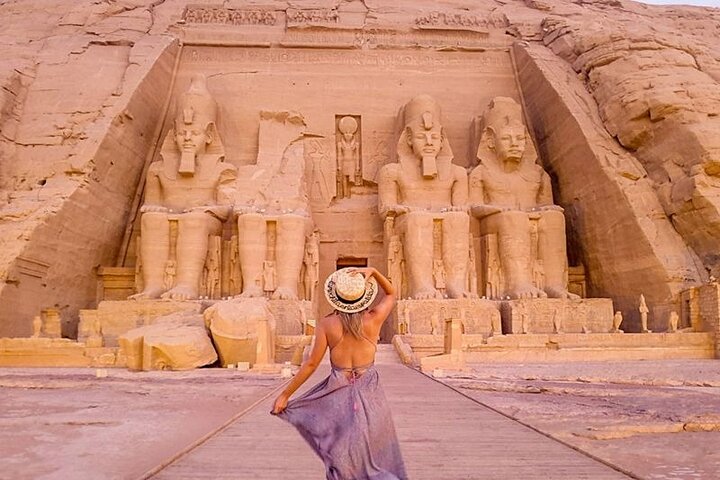
Embark on a thrilling day tour from Aswan to Luxor and uncover the mysteries of ancient Thebes with a knowledgeable Egyptologist guide. Discover the Valley of the Kings, Temple of Hatshepsut, Colossi of Memnon, Karnak, and Luxor Temple.
Embark on a thrilling day tour from Aswan to Luxor and uncover the mysteries of ancient Thebes with a knowledgeable Egyptologist guide. Discover the Valley of the Kings, Temple of Hatshepsut, Colossi of Memnon, Karnak, and Luxor Temple.
- Valley of the Kings - At 7:00 PM, a tour guide will pick you up from your hotel or Nile Cruise in Aswan. You will then be transported in a private air-conditioned vehicle to Luxor, located 280 km north of Aswan. Upon arrival in Luxor at 10:00 AM, begin your day tour by visiting the West Bank of the Nile, where you will explore the Valley of the…
-
Valley of the Kings - At 7:00 PM, a tour guide will pick you up from your hotel or Nile Cruise in Aswan. You will then be transported in a private air-conditioned vehicle to Luxor, located 280 km north of Aswan. Upon arrival in Luxor at 10:00 AM, begin your day tour by visiting the West Bank of the Nile, where you will explore the Valley of the Kings. This site is renowned for its magnificent architecture used for royal burials, with many kings interred here. Notable tombs include those of King Tutmosis I, Tutmosis III, Tutankhamun, King Ramesses VI, King Merenptah, and Amenhotep II.
-
Temple of Hatshepsut at Deir el Bahari - Next, visit the Temple of Queen Hatshepsut, known as El Deir El Bahari. This temple was constructed by Queen Hatshepsut, the daughter of Thutmosis I, who ruled Egypt for about 20 years during the 18th Dynasty (approximately 1490-1469 B.C.). She was the only female pharaoh to reign over ancient Egypt. Continue your tour to the Colossi of Memnon, which are the remnants of the mortuary temple of Amenhotep III.
-
Colossi of Memnon - The Colossi of Memnon (Arabic: el-Colossat or es-Salamat) are two enormous stone statues of Pharaoh Amenhotep III, positioned at the entrance of the ruined Mortuary Temple of Amenhotep III, the largest temple in the Theban Necropolis. These statues have stood since 1350 BC and were well-known to ancient Greeks and Romans, as well as early modern travelers and Egyptologists. The statues feature 107 Roman-era inscriptions in Greek and Latin, dating from AD 20 to 250. Many inscriptions on the northern statue reference the Greek mythological king Memnon, whom the statue was mistakenly believed to represent.
Scholars have debated the connection between the identification of the northern colossus as “Memnon” and the Greek name for the entire Theban Necropolis, the Memnonium.
-
Temple of Karnak - The Karnak Temple Complex, commonly referred to as Karnak (/ˈkɑːr.næk/), is a vast collection of temples, pylons, chapels, and other structures near Luxor, Egypt. Construction began during the reign of Senusret I (1971–1926 BCE) in the Middle Kingdom (c. 2000–1700 BCE) and continued into the Ptolemaic Kingdom (305–30 BCE), although most existing buildings date from the New Kingdom. The area around Karnak was known in ancient Egypt as Ipet-isut (“The Most Selected of Places”) and served as the main worship site for the 18th Dynastic Theban Triad, with the god Amun at its head. It is part of the monumental city of Thebes, which was added to the UNESCO World Heritage List in 1979 along with the rest of the city. The Karnak complex lends its name to the nearby modern village of El-Karnak, located 2.5 kilometers (1.6 miles) north of Luxor.
-
Luxor Temple - The Luxor Temple (Arabic: معبد الأقصر) is a large ancient Egyptian temple complex situated on the east bank of the Nile River in the city now known as Luxor (ancient Thebes). It was constructed around 1400 BCE. In the Egyptian language, it was called ipet resyt, “the southern sanctuary.” It was one of the two main temples on the east bank, the other being Karnak. Unlike other temples in Thebes, Luxor Temple is not dedicated to a cult god or a deified version of the pharaoh in death. Instead, it is dedicated to the rejuvenation of kingship and may have been the site where many Egyptian pharaohs were crowned, either in reality or conceptually (as in the case of Alexander the Great, who claimed he was crowned at Luxor but may never have traveled south of Memphis, near modern Cairo).
After the tour, you will be transferred back to your hotel.

- Tour guide
- Hotel pickup and drop-off
- All Transfers by Private A/C latest Model Vehicle
- Lunch at local restaurants (Local Egyptian Food) (If Option Selected)
- Entry Fees
- Bottle of water
- Tour guide
- Hotel pickup and drop-off
- All Transfers by Private A/C latest Model Vehicle
- Lunch at local restaurants (Local Egyptian Food) (If Option Selected)
- Entry Fees
- Bottle of water
- Tipping
- Personal Items
- Tipping
- Personal Items
Embark on a one-day guided excursion from Aswan that covers the best of Luxor. Journey through the verdant Nile Valley and discover the historical gems of ancient Thebes, with a certified Egyptologist sharing their tales and mysteries. Begin with a trip to the West Bank to explore the age-old pharaonic tombs within the Valley of the Kings, and marvel at…
Embark on a one-day guided excursion from Aswan that covers the best of Luxor. Journey through the verdant Nile Valley and discover the historical gems of ancient Thebes, with a certified Egyptologist sharing their tales and mysteries. Begin with a trip to the West Bank to explore the age-old pharaonic tombs within the Valley of the Kings, and marvel at the grand Temple of Hatshepsut and the Colossi of Memnon. After a lunch break, shift your attention to the East Bank where you’ll visit the magnificent Karnak and the picturesque Luxor Temple. The tour includes pick-ups and drop-offs at your hotel.
- Entry fees includes basic area only
For a full refund, cancel at least 24 hours before the scheduled departure time.
For a full refund, cancel at least 24 hours before the scheduled departure time.