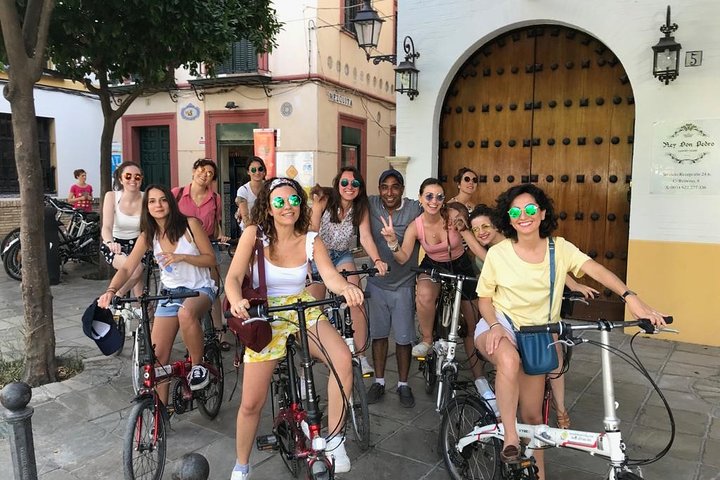
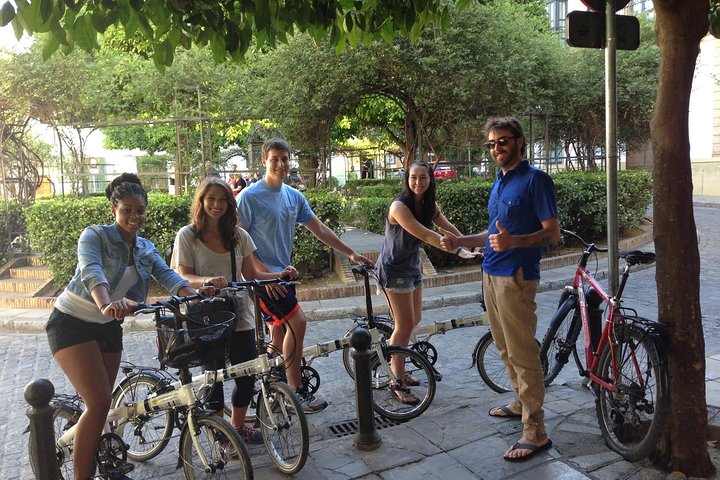

Embark on a 3-hour electric bike tour to discover Seville’s captivating landmarks, including the renowned Torre del Oro and the Santa Cruz neighbourhood. Choose from a regular tour with a set itinerary, or opt for a private tour to pick the places you wish to see.
Embark on a 3-hour electric bike tour to discover Seville’s captivating landmarks, including the renowned Torre del Oro and the Santa Cruz neighbourhood. Choose from a regular tour with a set itinerary, or opt for a private tour to pick the places you wish to see.
- Parque de Maria Luisa - The majority of the land used for this park was once the gardens of the Palace of San Telmo. In 1893, the Infanta Luisa Fernanda, Duchess of Montpensier, generously donated it to the city of Seville for public enjoyment. In 1914, architect Aníbal Gonzalez began work for the Ibero-American Exposition of 1929, which partially…
- Parque de Maria Luisa - The majority of the land used for this park was once the gardens of the Palace of San Telmo. In 1893, the Infanta Luisa Fernanda, Duchess of Montpensier, generously donated it to the city of Seville for public enjoyment. In 1914, architect Aníbal Gonzalez began work for the Ibero-American Exposition of 1929, which partially took place in the park. At its heart is Parque de María Luisa, a ‘Moorish paradisiacal style’ area featuring half a mile of tiled fountains, pavilions, walls, ponds, benches, and exhedras. The park is lush with palms, orange trees, Mediterranean pines, and stylized flower beds with vine-covered bowers. It also functions as a botanical garden, showcasing a variety of native and exotic plant species, complete with educational panels for visitors. The park is home to many birds, particularly known for its large dove population.
- Plaza de Espana - Plaza de España (“Spain Square” in English) is located within Parque de María Luisa in Seville, Spain. Constructed in 1928 for the Ibero-American Exposition of 1929, it is a notable example of Regionalism Architecture, blending Baroque Revival, Renaissance Revival, and Moorish Revival (Neo-Mudéjar) styles of Spanish architecture.
- Torre del Oro - The Torre del Oro (“Tower of Gold” in English) is a twelve-sided military watchtower in Seville. Built by the Almohad Caliphate to control access to Seville via the Guadalquivir River, it dates back to the early 13th century. The tower served as a prison during the Middle Ages, and its name derives from the golden glow it cast on the river, thanks to its construction materials (a mix of mortar, lime, and pressed hay).
The tower is divided into three levels. The first, dodecagonal level was constructed in 1220 by order of the Almohad governor of Seville, Abù l-Ulà. The second, also dodecagonal and only 8 meters high, was built by Peter of Castile in the 14th century, a fact confirmed by archaeological studies. The third and topmost level, circular in shape, was added after the previous third level, Almohad, was damaged by the 1755 Lisbon earthquake. The reconstruction of the third level was carried out by Brusselian Sebastian Van der Borcht in 1760.
- Puente de Isabel II (Puente de Triana) - The Puente de Isabel II, also known as Puente de Triana or Triana Bridge, is a metal arch bridge in Seville, Spain, connecting the Triana neighborhood with the city center. It spans the Canal de Alfonso XIII, one of the branches of the River Guadalquivir that nearly isolates Triana as an island.
Constructed during the reign of Isabella II of Spain and completed in 1852, it was the first solid bridge in Seville, replacing an earlier floating bridge made of boats (a pontoon bridge). Originally built by the Moors in the 12th century, the pontoon bridge survived for seven centuries due to subsequent repairs.
- Torre Giralda - The Giralda (Spanish: La Giralda [la xiˈɾalda]) is the bell tower of Seville Cathedral in Seville, Spain. Originally constructed as the minaret for the Great Mosque of Seville in al-Andalus, Moorish Spain, during the Almohad dynasty, it later received a Renaissance-style top added by the Catholics after the Muslims were expelled from the area. Dating from the Reconquest of 1248 to the 16th century and built by the Moors, the Giralda was designated a World Heritage Site by UNESCO in 1987, along with the Alcázar and the General Archive of the Indies. Standing at 104.1 meters (342 feet) tall, it remains one of the city’s most iconic symbols since the Middle Ages.
- Catedral de Sevilla - This Roman Catholic cathedral in Seville was recognized as a World Heritage Site by UNESCO in 1987, alongside the adjacent Alcázar palace complex and the General Archive of the Indies. It ranks as the fourth-largest church globally and the largest Gothic church.
The cathedral covers a total area of 11,520 square meters (124,000 square feet). Seville Cathedral was the site of the baptism of Infant Juan of Aragon in 1478, the only son of the Catholic Monarchs Ferdinand II of Aragon and Isabella I of Castile. Its royal chapel houses the remains of the city’s conqueror Ferdinand III of Castile, his son and heir Alfonso the Wise, and their descendant King Peter the Just. The funerary monuments for cardinals Juan de Cervantes and Pedro González de Mendoza are located among its chapels. Christopher Columbus and his son Diego are also interred in the cathedral.
- Real Alcazar de Sevilla - The Royal Alcázars of Seville (Spanish: Reales Alcázares de Sevilla), historically known as al-Qasr al-Muriq (Arabic: القصر المُورِق, The Verdant Palace) and commonly referred to as the Alcázar of Seville (pronounced [alˈkaθaɾ]), is a royal palace in Seville, Spain, constructed for the Christian king Peter of Castile. Built by Castilian Christians on the site of an Abbadid Muslim alcazar, or residential fortress, which was destroyed after the Christian conquest of Seville, the palace is a prime example of Mudéjar architecture in the Iberian Peninsula, featuring Gothic, Renaissance, and Romanesque design elements from earlier construction phases. The upper floors of the Alcázar are still used by the royal family when they are in Seville and are managed by the Patrimonio Nacional. It was designated a World Heritage Site by UNESCO in 1987, along with the adjoining Seville Cathedral and the General Archive of the Indies.
- Local guide
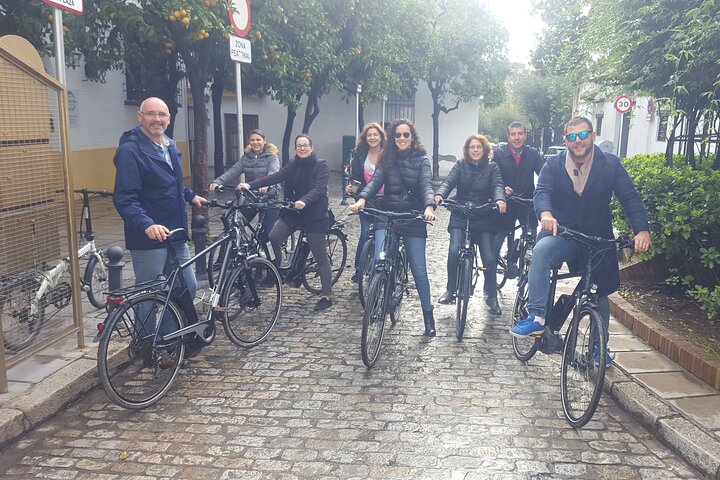
- Use of bicycle and helmet
- Local guide
- Use of bicycle and helmet
- Food and drinks
- Hotel pickup and drop-off
- Food and drinks
- Hotel pickup and drop-off
- Child rate applies only when sharing with 2 paying adults
- May be operated by a multi-lingual guide
- Operates in all weather conditions, please dress appropriately
- Child rate applies only when sharing with 2 paying adults
- May be operated by a multi-lingual guide
- Operates in all weather conditions, please dress appropriately
For a full refund, cancel at least 24 hours before the scheduled departure time.
For a full refund, cancel at least 24 hours before the scheduled departure time.


