




Uncover the secrets of Rome’s downtown on an exclusive half-day walking tour. Explore underground ruins, a 2000-year-old market, and cross the oldest bridge in Rome. Perfect for families!
Uncover the secrets of Rome’s downtown on an exclusive half-day walking tour. Explore underground ruins, a 2000-year-old market, and cross the oldest bridge in Rome. Perfect for families!
- Antico caffè del teatro di Marcello - Meeting point tour
- Teatro di Marcello - The Theater of Marcellus, largely preserved, is the only ancient theater remaining in Rome. Built in the southern area of the Campus Martius known as the Circus Flaminius, between the Tiber river and the Capitoline Hill, it was commissioned by Caesar and continued…
- Antico caffè del teatro di Marcello - Meeting point tour
-
Teatro di Marcello - The Theater of Marcellus, largely preserved, is the only ancient theater remaining in Rome. Built in the southern area of the Campus Martius known as the Circus Flaminius, between the Tiber river and the Capitoline Hill, it was commissioned by Caesar and continued by Augustus.
The building was erected in Campo Marzio, in the place that tradition had consecrated to stage performances, where the “Theatrum et proscenium ad Apollinis”, connected to the temple of Apollo, was already located. -
Basilica di San Nicola in Carcere - The medieval church of San Nicola in Carcere stands in the area of the ancient Forum Olitorio, in the place where, in the period of Republican Rome, three temples stood, transformed into a prison during the Middle Ages (hence the name “in prison”).
Built in 1128 (as the inscription on the façade recalls), it was dedicated to Saint Nicholas, since the Greek community lived in the area, particularly devoted to the saint. The small square of the Foro Olitorio, with the three temples of Janus, Speranza and Juno Sospita in the centre, was used as a market for herbs and vegetables. The church was built before the 11th century by Pope Pasquale II and was almost entirely rebuilt and enriched in 1599 by the architect Giacomo della Porta. -
Isola Tiberina - The Tiber Island, the only urban island on the Tiber, approximately 300 meters long and approximately 90 meters wide, is connected to the banks of the Tiber by two bridges: towards Trastevere by the Cestio bridge, dating back to 46 BC. C. and in the direction of the Ghetto with the Fabricio bridge, built in 62 BC. C., also called Quattro Capi bridge, for the Roman herms that decorate its parapets.
According to legend, the island was born in 509 BC. when, having ousted Lucius Tarquinius Superbus, the last king of Rome, the people, as a sign of hatred towards the tyrant, threw the king’s enormous grain deposit into the Tiber, which turned out to be so abundant that it formed a small island.
In reality, a compact bank of tuff, similar to that of the nearby Capitoline Hill, constitutes the basic geological element, on which the sands carried by the current have naturally settled. -
Basilique San Crisogono - Located along Viale Trastevere, in the district of the same name, San Crisogono stands in Piazza Sonnino and is one of the oldest basilicas in Rome. The church was built in the 4th century, under Pope Sylvester I, it was rebuilt in the 12th century and then again in 1626, designed by Giovanni Battista Soria, at the behest of Cardinal Scipione Borghese.
Currently the basilica has a monumental baroque tympanum façade, preceded by a large portico with four columns. The attic above houses eight sculptures, four vases decorated with dragons alternating with four eagles, symbol of the Borghese family. The 12th century Romanesque bell tower is crowned by a spire.
The interior of the church, decorated by Pietro Cavallini, is divided into three naves by two orders of granite columns; the apse mosaic can be attributed to the school of the same artist, while the floor was created in Cosmatesque style. - Via Portico d’Ottavia - The Portico d’Ottavia complex is the only one preserved of the large porticoes that limited, on the northern side, the square of the Circo Flaminio, an area that corresponds to the ancient Ghetto. It was rebuilt by Augustus, in place of the older Portico of Metello, between 27 and 23 BC. and dedicated to her sister Ottavia.
It was subsequently restored and partially rebuilt in 203 by Septimius Severus, after a fire in 191, a period to which the majority of the currently visible remains belong.
The complex, a quadriportico of 119 x 132 metres, included the most ancient Temple of Juno Regina, which was then joined by the Temple of Jupiter Stator, the first in Rome entirely made of marble, two libraries, Greek and Latin, and the Curia Octaviae , a large environment for public meetings.
-
Basilica di Santa Cecilia in Trastevere - The Basilica of S. Cecilia in Trastevere is located in the square of the same name and stands on the house of the Roman martyr Cecilia and her husband Valeriano.
The excavations under the church, carried out during the restoration of 1899, highlighted a group of ancient buildings from the Republican age with walls in opus quadratum of tuff and a Doric column.
At the bottom of a niche there is a tuff relief representing “Minerva” in front of an altar. The building shows restorations and renovations from a later period, from the 2nd to the 4th century AD, when it was unified with other existing buildings dating back to the Republican age.
In addition to various rooms built in brickwork and with remains of floor mosaics, there is also a large room characterized by the presence of seven cylindrical brick basins in the floor.

- Explore underground areas and sacred sites
- Guided by a professional for 3 hours
- Emergency assistance via WhatsApp
- Explore underground areas and sacred sites
- Guided by a professional for 3 hours
- Emergency assistance via WhatsApp
- Gratuities
- Tips
- Gratuities
- Tips
In this tour, you’ll explore underground passages three times, wander through ancient ruins and columns, enter a 2000-year-old market, and cross an island via Rome’s oldest bridge. It’s an adventure perfect for the whole family, including children! Is it true that every church in Rome is built over the ruins of pagan temples? You’ll find out when you…
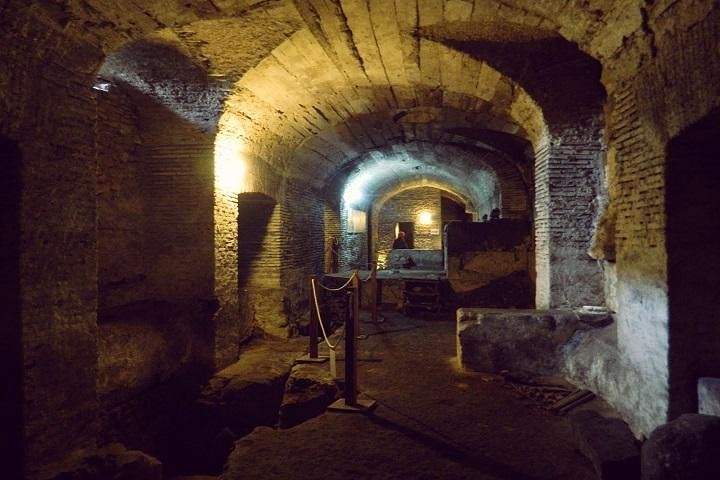
In this tour, you’ll explore underground passages three times, wander through ancient ruins and columns, enter a 2000-year-old market, and cross an island via Rome’s oldest bridge. It’s an adventure perfect for the whole family, including children! Is it true that every church in Rome is built over the ruins of pagan temples? You’ll find out when you visit Saint Nicholas in Carcere, which stands on ancient worship sites! Just a short distance away, near the Portico d’Ottavia and the ruins of the Marcellus Theatre, you’ll cross Rome’s oldest bridge, which is 2000 years old. This will bring you to Tiber Island. Next, you’ll explore the underground house of Santa Cecilia, adorned with ancient mosaics, mysterious inscriptions, and an ornately decorated crypt. Finally, you’ll visit the lesser-known church of San Crisogono, built over a vast underground house where archaeologists discovered a large frescoed wall. Don’t miss the chance to explore these ancient sites, hidden gems in the heart of Rome!
- This tour is intended as a walk which enters underground areas and places of worship: Should anyone feel uncomfortable in underground spaces, the guide can deal with it; those people will comfortably sit in the top church, while the rest of the group will visit the underground. It is advisable to wear confortable shoes such as sport trainers and to respect the churches dress code: trousers should touch the knee and shoulders should be covered; tourists may consider bringing a scarf to wear at necessity.
- Provide the Correct address of your accommodation , hotel, B&B
- Provide the correct phone number with international country code
- check that you provide all the details to the agency
- Without this information we can not guarantee the correct service
- Emergency number also operational via whatsapp
- One day before please call to confirm the meeting time point
For a full refund, cancel at least 24 hours before the scheduled departure time.
For a full refund, cancel at least 24 hours before the scheduled departure time.


