Journey Through Time: Exploring Azerbaijan’s Ancient Wonders
Drawn by the allure of ancient history and natural wonders, I embarked on a full-day tour from Baku to explore the Gobustan rock carvings, mud volcanoes, and the mystical Ateshgah Fire Temple. Join me as I delve into the cultural and historical tapestry of Azerbaijan.


The Ancient Echoes of Gobustan
As I embarked on the full-day tour from Baku, I was filled with anticipation. The allure of Gobustan, with its ancient rock carvings, was irresistible to someone like me, who has spent years delving into the cultural tapestries of the world. The journey began with a drive through the semi-desert landscape, where the horizon seemed to stretch infinitely, a canvas painted with the hues of history.
Gobustan is a place where time stands still. The rock art, etched into the boulders, tells stories of a bygone era. As I traced my fingers over the engravings, I felt a connection to the people who once roamed these lands. The carvings, depicting scenes of hunting and dancing, are a testament to the rich cultural heritage of Azerbaijan. It was a humbling experience to stand amidst these ancient relics, feeling the weight of history pressing gently upon my shoulders.
The Gobustan National Park, with its rugged terrain and whispering winds, is a sanctuary for those seeking to understand the past. The silence here is profound, broken only by the occasional call of a bird or the rustle of leaves. It is a place that invites reflection, urging visitors to ponder the lives of those who came before us.
The Mystical Mud Volcanoes
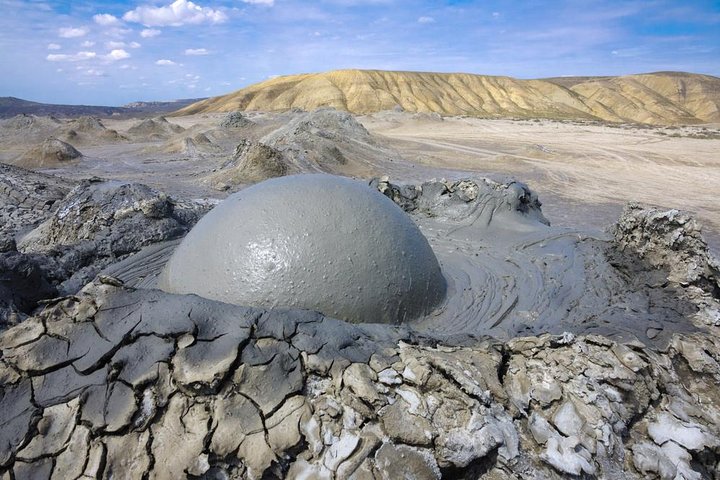
Our next destination was the mud volcanoes, a natural wonder that defies explanation. Azerbaijan is home to more than half of the world’s mud volcanoes, and witnessing them firsthand was a surreal experience. As we approached, the landscape transformed into a lunar-like expanse, dotted with bubbling craters and steaming vents.
The mud volcanoes are a reminder of the earth’s raw power, a force that shapes the land in mysterious ways. Standing at the edge of a crater, I watched as the mud bubbled and gurgled, a primordial soup that seemed to hold the secrets of the earth’s creation. The setting sun cast a golden glow over the landscape, adding to the otherworldly atmosphere.
Our guide, ever accommodating, ensured that we arrived at the mud volcanoes just in time for sunset. It was a moment of pure magic, as the sky blazed with colors and the earth seemed to come alive beneath our feet. The experience was both humbling and exhilarating, a reminder of the beauty and unpredictability of nature.
The Eternal Flames of Ateshgah
The final leg of our journey took us to the Ateshgah Fire Temple, a place steeped in mysticism and history. The temple, with its eternal flames, has been a site of pilgrimage for centuries, drawing visitors from all corners of the globe. As I entered the temple, I was struck by the sense of reverence that permeated the air.
The fire temple is a symbol of the Zoroastrian faith, a religion that venerates fire as a purifying force. The flames, fed by natural gas seeping from the earth, have burned continuously for centuries, a testament to the enduring power of nature. Standing before the flickering flames, I felt a deep sense of awe, as if I were in the presence of something sacred.
The Ateshgah Fire Temple is a place of reflection, where the past and present converge in a dance of light and shadow. It is a reminder of the spiritual connections that bind us to the earth and to each other. As I left the temple, I carried with me a sense of peace and a renewed appreciation for the rich cultural heritage of Azerbaijan.
This journey through the Absheron Peninsula was more than just a tour; it was a pilgrimage of the soul. Each site we visited offered a glimpse into the past, a chance to connect with the ancient traditions that continue to shape the world today. For those seeking a deeper understanding of Azerbaijan’s history and culture, this tour is an experience not to be missed.