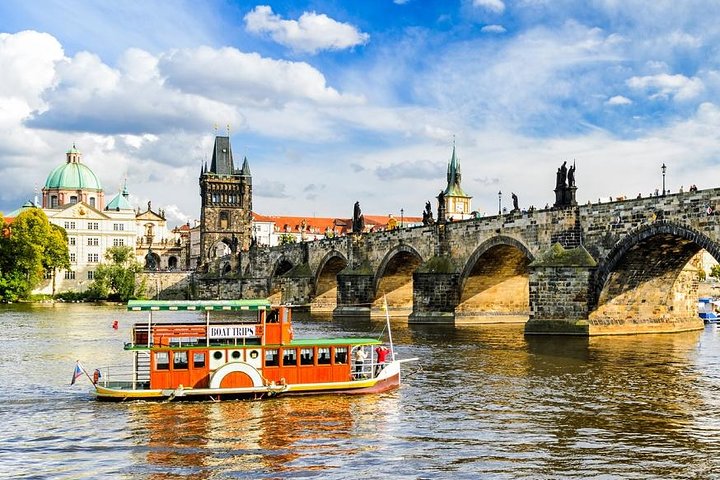
Discover Prague’s hidden gems with a private walking tour, exploring vibrant neighborhoods, local hangouts, and historical sites beyond the Old Town.
Discover Prague’s hidden gems with a private walking tour, exploring vibrant neighborhoods, local hangouts, and historical sites beyond the Old Town.
- Wenceslas Square (Václavské náměstí) - Wenceslas Square is one of Prague’s most renowned and historically important public areas. Named after Saint Wenceslas, the patron saint of Bohemia, the square is dominated by the impressive equestrian statue of Saint Wenceslas. This statue, surrounded by figures of other Czech saints and patrons, has long…
- Wenceslas Square (Václavské náměstí) - Wenceslas Square is one of Prague’s most renowned and historically important public areas. Named after Saint Wenceslas, the patron saint of Bohemia, the square is dominated by the impressive equestrian statue of Saint Wenceslas. This statue, surrounded by figures of other Czech saints and patrons, has long been a significant national emblem. Throughout history, Wenceslas Square has witnessed numerous key events in Czech history: the proclamation of Czechoslovak independence in 1918, the communist coup in 1948, the Soviet-led invasion in 1968, and various protests. Its most notable moment was during the Velvet Revolution in November–December 1989 — the peaceful movement that ended over four decades of communist rule in Czechoslovakia.
- Franz Kafka Statue - One of the most remarkable and surreal modern artworks in Prague is the Head of Franz Kafka, a massive kinetic sculpture by the renowned Czech artist David Černý. This sculpture is a 10.6-meter-tall (approximately 35 feet) mechanical wonder weighing around 39 tons (with 24 tons of stainless steel panels). It comprises 42 horizontal layers of polished stainless steel that rotate independently, powered by 21 motor modules and over a kilometer of cables. Each layer can spin at varying speeds, creating ever-changing patterns: sometimes the layers align to form a recognizable face of Franz Kafka, only to twist and distort moments later into abstract, fragmented shapes.
- Hands reaching out of the wall on Národní třída - One of the most poignant and understated memorials in Prague is the small bronze installation on Národní třída (National Avenue) depicting nine hands emerging from a wall. This subtle yet powerful artwork serves as a permanent reminder of the brutal police crackdown on November 17, 1989, that ignited the Velvet Revolution and ultimately led to the fall of communism in Czechoslovakia.
- National Theater - The National Theatre stands as one of Prague’s most iconic cultural landmarks and a powerful symbol of Czech national identity. Situated on the banks of the Vltava River, this magnificent Neo-Renaissance building faces Prague Castle and serves as the country’s premier venue for opera, ballet, and drama. Its story is deeply tied to the Czech National Revival in the 19th century, when Czechs sought to assert their language, culture, and independence under Austro-Hungarian rule. The idea of a truly national theatre emerged in the 1840s–1850s through public fundraising—ordinary people, nobility, and even Emperor Franz Joseph I contributed. The motto inscribed above the proscenium arch, “Národ sobě” (“A nation to itself”), reflects this grassroots effort and patriotic spirit.
- Dancing House - The Dancing House, often nicknamed “Ginger and Fred,” is one of Prague’s most famous and controversial modern architectural landmarks. Located on the embankment along the right bank of the Vltava River, this eye-catching building stands out dramatically amid the surrounding 19th- and early 20th-century Baroque, Gothic, and Art Nouveau structures.
- National Memorial to the Heroes of the Heydrich Terror - The National Memorial to the Heroes of the Heydrich Terror is a somber and deeply moving WWII site in Prague, dedicated to the Czechoslovak paratroopers who carried out Operation Anthropoid—the only successful government-sponsored assassination of a top Nazi official during the war: Reinhard Heydrich, the acting Reich Protector of Bohemia and Moravia, architect of the Holocaust’s “Final Solution,” and one of the most feared figures in the Nazi regime.
- Náplavka Rašínovo nábřeží - Náplavka is Prague’s beloved riverside promenade along the right bank of the Vltava River in the New Town district. Stretching roughly from the Jiráskův Bridge near the Dancing House down toward Vyšehrad, it’s a vibrant, laid-back spot where locals escape the tourist crowds of the Old Town. Here, people walk, bike, jog, feed swans, or just sit with a drink watching the river flow and Prague Castle in the distance. The real draw for locals is the weekend energy, especially on Saturdays when the famous Farmers’ Market takes over the embankment. Running every Saturday from 8:00 a.m. to 2:00 p.m. (year-round, though smaller in winter), it’s one of Prague’s largest and most popular farmers’ markets, with 80–100+ stalls from verified Czech growers, breeders, and artisans.
- Vyšehrad National Cultural Monument - Vyšehrad is a historic fortified hilltop complex perched on a rocky promontory above the right bank of the Vltava River. It’s a National Cultural Monument steeped in legend and Czech national pride, offering a peaceful, green escape with some of the city’s best panoramic views—far less crowded than the main tourist sites. According to Czech legends, Vyšehrad was the original seat of the princes and the mythical birthplace of Prague—Princess Libuše supposedly prophesied the city’s future glory from here. In reality, settlement began in the mid-10th century, slightly later than Prague Castle. After periods of decline, destruction, and rebuilding (including Baroque fortifications under the Habsburgs in the 17th–18th centuries), it was revitalized in the 19th–20th centuries as a symbol of Czech identity during the National Revival.
- Vyšehrad - You can either end the tour at Vyšehrad, enjoying the local parks and the views from the fortifications, or the guide will take you back to Wenceslas Square, where the tour began.

- Recommendations for restaurants, shops, hidden gems and photo spots
- Pick up at your hotel reception or other location in the city center on foot (not by car).
- Local, licensed, experienced and fun tour guide
- Charity: We regularly support local children’s homes
- Recommendations for restaurants, shops, hidden gems and photo spots
- Pick up at your hotel reception or other location in the city center on foot (not by car).
- Local, licensed, experienced and fun tour guide
- Charity: We regularly support local children’s homes
- Gratuities
- Snacks
- Gratuities
- Snacks
Have you already visited all the renowned attractions in Prague’s historic Old Town and are now keen to explore further? If you’re interested in discovering the lively New Town, finding spots where locals gather, and learning about Czech resistance during World War II and the dramatic fall of communism in 1989, this tour is ideal for you.
Experience the…
Have you already visited all the renowned attractions in Prague’s historic Old Town and are now keen to explore further? If you’re interested in discovering the lively New Town, finding spots where locals gather, and learning about Czech resistance during World War II and the dramatic fall of communism in 1989, this tour is ideal for you.
Experience the Prague that locals cherish. You’ll wander through vibrant areas where residents truly live and socialize: the laid-back riverside promenade of Naplavka with its farmers’ market (open Saturdays, 8 a.m.–2 p.m.), craft beer venues, and picturesque views of the Vltava; or the tranquil hilltop of Vysehrad, with its stunning parks and panoramic views from the fortifications.
You can choose to conclude the tour at Vysehrad, enjoying the local parks and the views from the fortifications, or our guide can escort you back to Wenceslas Square, where the tour commenced.
- Child rate applies only when sharing with 1 paying adult
For a full refund, cancel at least 24 hours before the scheduled departure time.
For a full refund, cancel at least 24 hours before the scheduled departure time.