

Embark on a full day historic tour of Nagasaki with a licensed guide and private vehicle. Discover the captivating history and cultural charm of this enchanting city!
Embark on a full day historic tour of Nagasaki with a licensed guide and private vehicle. Discover the captivating history and cultural charm of this enchanting city!
-
Inasayama Observation Deck - Mount Inasa (稲佐山, Inasayama) is a 333-meter-high mountain near Nagasaki’s city center.
The summit is accessible by ropeway, bus, or car and provides stunning views of the city. Notably, the night views from Mount Inasa are considered among Japan’s top three night views, alongside those from Mount Hakodate and Mount…
- Inasayama Observation Deck - Mount Inasa (稲佐山, Inasayama) is a 333-meter-high mountain near Nagasaki’s city center.
The summit is accessible by ropeway, bus, or car and provides stunning views of the city. Notably, the night views from Mount Inasa are considered among Japan’s top three night views, alongside those from Mount Hakodate and Mount Rokko. The summit hosts several television and radio antennas and an observation deck with a restaurant.
- Glover Garden - Glover Garden (グラバー園, Glover-en) is an open-air museum in Nagasaki showcasing the mansions of several former foreign residents and related buildings. It is situated on the hill where Western merchants settled after Japan’s era of seclusion ended in the late 19th century.
The garden’s main attraction is the Former Glover House, the oldest Western-style wooden building in Japan. Thomas Glover (1838-1911), a Scottish merchant, moved to Nagasaki after the port opened to foreign trade in 1859. He later supported revolutionaries who overthrew the Tokugawa Shogunate during the Meiji Restoration. Glover played a significant role in Japan’s early industrialization, being active in shipbuilding and mining.
- Sofukuji Temple - Sofukuji Temple (崇福寺, Sōfukuji) is a temple in Nagasaki affiliated with the Obaku school of Zen Buddhism. Built in 1629 for Nagasaki’s Chinese residents, the temple features Chinese architectural style, offering a unique experience compared to other Japanese temples.
Sofukuji is constructed along a hillside. At the base stands the temple’s two-story entrance gate, Ryugumon (meaning Gate of the Dragon Palace), painted bright red like the rest of the temple. Originally built in 1673, the gate was destroyed multiple times by fire and storms before its latest reconstruction in 1849.
- Dejima - Dejima (出島) was an artificial island in Nagasaki’s port, created in 1636 to separate Portuguese residents from the Japanese population and control their missionary activities.
A few years later, the Portuguese were expelled, and the Dutch Trading Station, previously in Hirado, was relocated to Dejima. During Japan’s two centuries of isolation, the Dutch were confined to Dejima as the only Westerners allowed in the country.
Today, Dejima is no longer an island, as the surrounding area was reclaimed in the 20th century. However, many of Dejima’s historical structures remain or have been reconstructed, including residences, warehouses, walls, and gates. The ultimate goal is to restore Dejima to an island by digging canals around its four sides.
- Urakami Cathedral - Urakami Cathedral (浦上天主堂, Urakami Tenshudō) is a Catholic church in Nagasaki with a poignant history. Now a functioning church housed in a large, European-style red brick building, the cathedral contains various relics that survived the atomic bombing.
The atomic bomb dropped on Nagasaki on August 9, 1945, nearly destroyed the church, which was only 500 meters from the hypocenter. A group of charred stone saints remains in place, standing before a ruined wall in front of the cathedral. Inside, there are other relics, including the surviving head of a Saint Mary statue and one of the church’s original bells. The modern cathedral was completed in 1959.
- Nagasaki Museum of History and Culture - Nagasaki Museum of History and Culture (長崎歴史文化博物館, Nagasaki Rekishi Bunka Hakubutsukan) is a well-designed, modern museum dedicated to Nagasaki’s history as one of Japan’s major international trading ports. The extensive permanent exhibition spans two floors, with various sections focusing on different aspects of Nagasaki’s rich history.
During the Edo Period, the Japanese government adopted isolationism, effectively cutting the country off from the rest of the world. At this time, Nagasaki became one of the only ports where international trade was permitted, primarily with the Chinese and Dutch. This made the city Japan’s main window to the outside world, allowing a rich economy, culture, and history to flourish.
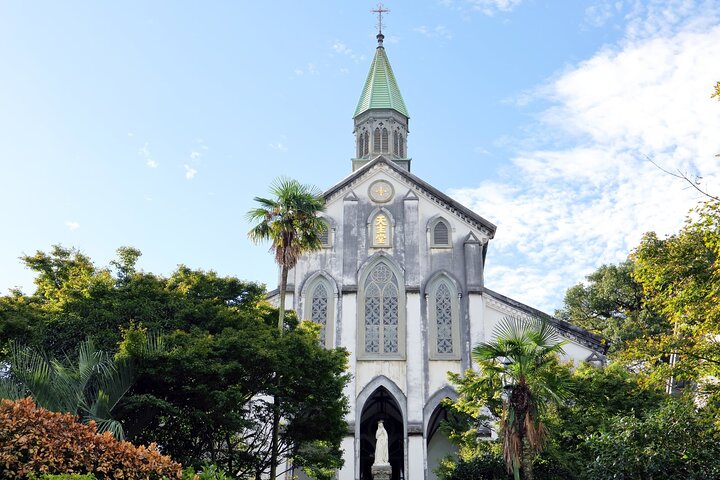
- Catholic Oura Church - Oura Church (大浦天主堂, Ōura Tenshudō) is a Catholic church in Nagasaki. Built towards the end of the Edo Period in 1864 by a French missionary for the growing community of foreign merchants, it is considered the oldest standing Christian church in Japan.
Oura Church is dedicated to the memory of the 26 Christians executed in the city in 1597. Today, the working church stands as an attractive example of contemporary European architecture, drawing many visitors. The church was the first Western-style building in Japan to be designated as a national treasure. The admission fee includes entrance to a museum about the history of Christianity in Japan.
- Kofukuji Temple - Kofukuji Temple (興福寺, Kōfukuji) is the oldest and one of the most significant Chinese-founded temples in Nagasaki. Located in the city’s Teramachi (“Temple Town”) district, it is the birthplace of the Obaku school of Zen Buddhism in Japan and has many fascinating features.
The temple was established around 1620 by a Chinese monk when large numbers of Chinese merchants were coming to Nagasaki to trade. The complex was initially set up as a place to pray for safe sea travel for the merchants, and its construction is heavily influenced by Chinese architectural styles, making it feel distinct from other temples in Japan.
- The Confucian Temple, the Chinese Museum of Successive Generations - Nagasaki Confucius Shrine (孔子廟, Kōshi-byō) is one of the few shrines dedicated to the revered Chinese philosopher Confucius in Japan. Built in 1893 by Nagasaki’s Chinese community, the colorful, atmospheric shrine also contains a museum at the rear of the grounds.
A small garden with a bridge and pond greets visitors at the entrance. The ornate Chinese-style buildings are adorned with yellow roofs. Flanking the shrine’s courtyard are the 72 sages, life-size stone statues weighing around two tons each, depicting Confucius’ disciples. The shrine encourages visitors to find among the statues one that resembles a relative.
- Twenty-Six Christian Martyrs Monument - The Twenty-Six Martyrs Monument and adjacent museum (二十六聖人記念館, Nijūroku Seijin Kinenkan) in Nagasaki are dedicated to the twenty-six Christians executed here on February 5, 1597. They included both foreign missionaries and Japanese laymen. Missionary activities were prohibited at the time, and Japan’s ruler Toyotomi Hideyoshi staged the execution as a warning.
The monument is located in a small park on a hill not far from Nagasaki Station and offers pleasant views over the city. A straight red line runs from the monument across the park’s plaza towards the Oura Church on the opposite side of the city. Oura Church is also dedicated to the 26 martyrs.
- Dutch Slope - The Dutch Slope (オランダ坂, Oranda-zaka) is a stone-paved street ascending a hillside in Nagasaki where many foreign traders resided after the city’s port opened to foreign trade in 1859. Since the Dutch were the only Westerners allowed in the country for the preceding two centuries, “Dutch” referred to everything Western for a time.
A few former residences remain in the area today. Among them, the Higashi Yamate 13 is open to the public. Once home to a prosperous European family, this old Western-style house has been well preserved, with much of the old furniture and room layouts intact. There is a balcony upstairs offering nice views of the surrounding area. A cafe is located on the ground floor.
- Spectacles Bridge (Meganebashi) - Meganebashi (眼鏡橋, lit. Spectacles Bridge) is the most notable of several stone bridges spanning the Nakashima River in downtown Nagasaki. The bridge, named for its resemblance to a pair of spectacles when reflected in the river water, is a popular tourist attraction and is designated as an important cultural property.
The bridge was originally built in 1634, its construction overseen by the Chinese monk who later became the resident priest of Kofukuji Temple, located a short walk away. The bridge, along with many others along the river, was severely damaged by floodwaters in 1982 but has since been repaired with recovered stones.
There is a stone walkway along the riverbank that makes for a pleasant stroll with nice views of the water and bridges. The walkway has a tranquil atmosphere and is accessed by steps from street level positioned at various points along the river.
- Nagasaki Prefectural Art Museum - The Nagasaki Prefectural Art Museum (長崎県美術館, Nagasaki-ken Bijutsukan) is a modern and spacious complex attractively located by the port of Nagasaki. Designed by renowned architect Kuma Kengo, the museum opened in 2005 and contains permanent collections of art related to Nagasaki as well as a large collection of Spanish art. It also hosts temporary exhibitions.
- Nagasaki Peace Park - Nagasaki Peace Park (平和記念公園), built near the atomic bomb’s hypocenter, commemorates the victims of the 1945 bombing and promotes global peace. Its central Peace Statue symbolizes hope and remembrance. The park features international peace monuments, the Fountain of Peace, and is located near the Atomic Bomb Museum and Hypocenter Park.
- Nagasaki Atomic Bomb Museum - The Nagasaki Atomic Bomb Museum (長崎原爆資料館), located near the hypocenter of the August 9, 1945 bombing, documents the devastation caused by the atomic bomb and the city’s recovery. The museum features artifacts such as a melted rosary, a clock stopped at 11:02 a.m., and personal belongings of victims. Through photographs, survivor testimonies, and exhibits, it conveys the horrors of nuclear warfare and promotes peace. Facilities include audio guides, a library, a video room, and barrier-free access. The museum serves as a powerful reminder of the consequences of war and the urgent need for nuclear disarmament and lasting global peace.

- Private vehicle
- Customizable Tour of your choice of 3-4 sites from ‘What to expect’ list’
- Licensed Local English Speaking Guide
- Private vehicle
- Customizable Tour of your choice of 3-4 sites from ‘What to expect’ list’
- Licensed Local English Speaking Guide
- Entrance fees, Lunch, and Other personal expenses
- You cannot combine multiple tour groups.
- Guide Entry fees are only covered for sights listed under What to Expect.
- Entrance fees, Lunch, and Other personal expenses
- You cannot combine multiple tour groups.
- Guide Entry fees are only covered for sights listed under What to Expect.
Explore the rich history of Nagasaki on a personalized tour led by a government-licensed, English-speaking guide. Enjoy peace of mind with private transportation provided throughout the tour.
Nagasaki boasts a wealth of historic events that have significantly influenced Japan. The city offers stunning views and a captivating culture that is sure to charm…
Explore the rich history of Nagasaki on a personalized tour led by a government-licensed, English-speaking guide. Enjoy peace of mind with private transportation provided throughout the tour.
Nagasaki boasts a wealth of historic events that have significantly influenced Japan. The city offers stunning views and a captivating culture that is sure to charm visitors.
- Only one reservation per group allowed. You cannot combine multiple reservations into one group.
- There are only a limited number of car seats and booster seats. Rear-facing car seats are not available. You must contact us directly if you need them.
For a full refund, cancel at least 24 hours before the scheduled departure time.
For a full refund, cancel at least 24 hours before the scheduled departure time.