

Embark on a full-day private tour of Malacca City, exploring its UNESCO World Heritage-listed sites and historical landmarks. Discover the stories of Malaysia through iconic buildings like A Famosa Fortress and St. Paul’s Church ruins.
Embark on a full-day private tour of Malacca City, exploring its UNESCO World Heritage-listed sites and historical landmarks. Discover the stories of Malaysia through iconic buildings like A Famosa Fortress and St. Paul’s Church ruins.
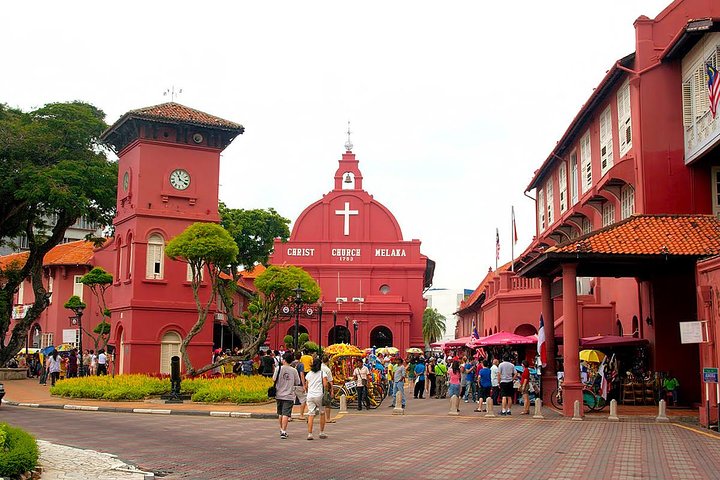
- Stadthuys - The Stadthuys is a historic building located in the center of Malacca City, the administrative capital of Malacca, Malaysia, in an area known as the Red Square. Renowned for its red exterior and nearby red clocktower, the Stadthuys (an old Dutch spelling meaning city hall) was constructed by the Dutch in 1650 to serve as the office for…
- Stadthuys - The Stadthuys is a historic building located in the center of Malacca City, the administrative capital of Malacca, Malaysia, in an area known as the Red Square. Renowned for its red exterior and nearby red clocktower, the Stadthuys (an old Dutch spelling meaning city hall) was constructed by the Dutch in 1650 to serve as the office for the Dutch Governor and Deputy Governor.
When Malacca was transferred to British control in the 19th century, the Malacca Free School was established near the Stadthuys on December 7, 1826, by missionaries in response to a letter dated April 19, 1825, signed by J. Humprey, J. W. Overee, and A. W. Baumgarten, advocating for an English educational institution in Malacca. The school, which offered free education, was later renamed Malacca High School in 1871 after a British government takeover and relocated to its current site on Chan Koon Cheng Road in 1931.
Located on Laksamana Road, next to Christ Church, the Stadthuys is considered the oldest remaining Dutch historical building in the Orient and now houses the History and Ethnography Museum. The museum features traditional costumes and artifacts from Malacca’s history, making it the city’s premier museum.
- A Famosa Fort - “Porta de Santiago” redirects here. For the gate in Segovia, Spain, see Puerta de Santiago (Segovia).
A Famosa (Malay: Kota A Famosa; “The Famous” in Portuguese) is a former Portuguese fortress in Malacca, Malaysia. It is one of the oldest surviving European architectural remains in Southeast Asia and the Far East. The Porta de Santiago, a small gatehouse, is the only part of the fortress that remains today.
The name is often mispronounced /eɪ/ Famosa, even among Malaysians, as if the Portuguese definite article “a” were the English letter “A.” A more authentic pronunciation would be /ɑː/ Famosa.
In 1511, a Portuguese fleet led by Afonso de Albuquerque arrived and defeated the Malacca Sultanate’s armies. Albuquerque quickly consolidated his gains by constructing the fortress around a natural hill near the sea, believing Malacca would become a crucial port linking Portugal to the Spice Route in China. At this time, other Portuguese were establishing outposts in places like Macau, China, and Goa, India, to create a network of friendly ports for ships traveling to Ming China and returning to Portugal.
The fortress originally had long ramparts and four major towers, including a four-story keep, an ammunition storage room, the captain’s residence, and officers’ quarters. Most of the village was housed in townhouses within the fortress walls. As Malacca’s population grew, the fort was expanded around 1586.
The fort changed hands in 1641 when the Dutch ousted the Portuguese from Malacca. The Dutch renovated the gate in 1670, which is why “ANNO 1670” is inscribed on the gate’s arch. Above the arch is a bas-relief logo of the Dutch East India Company.
The fortress changed hands again in the late 18th century when the Dutch handed it over to the British to prevent it from falling into Napoleon’s expansionist France’s hands. The British were cautious about maintaining the fortification and ordered its destruction in 1806. The fort was nearly demolished, but Sir Stamford Raffles, the founder of modern Singapore, intervened in 1807 while on sick leave from Penang to Malacca. Captain William Farquhar, tasked with demolishing the fort and town, decided to save two gateways to the fort, including the Santiago Gate, as well as the Stadthuys, church, and jail.
- St. Paul’s Hill & Church (Bukit St. Paul) - St. Paul’s Church is a historic church building in Malacca City, Malaysia, originally built in 1521, making it the oldest church building in Malaysia and Southeast Asia. It is located at the summit of St. Paul’s Hill and is now part of the Malacca Museum Complex, which includes the A Famosa ruins, the Stadthuys, and other historical buildings.
The original structure was a simple chapel built in 1521, dedicated to the Virgin Mary and known as Nossa Senhora da Annunciada (Our Lady of the Annunciation). The chapel was constructed by a Portuguese nobleman, Duarte Coelho, as an act of gratitude after surviving a storm in the South China Sea.
In 1548, the chapel was deeded to the Society of Jesus by the Bishop of Goa, João Afonso de Albuquerque, with the title deeds received by St. Francis Xavier. The chapel was further enlarged in 1556 with the addition of a second floor, and a belfry tower was added in 1590. It was then renamed Igreja de Madre de Deus (Church of the Mother of God).
A burial vault was opened in 1592, and many distinguished individuals were buried there, including Pedro Martins, the second Bishop of Funay, Japan.
- Jonker Street - Jonker Walk is the Chinatown street of Melaka, Malaysia, located along Jonker Street (Malay: Jalan Hang Jebat).
During Dutch Malacca, servants and subordinates of Dutch colonialists lived on nearby Heeren Street. However, as the Dutch departed, it became a street for noblemen. Wealthy Peranakans began residing and conducting business in the area, giving the street a rich ethnic and cultural flavor.
The road starts from across the Melaka River near the Stadthuys. It is lined with historical houses dating back to the 17th century and features shops selling antiques, textiles, foods, handicrafts, and souvenirs.
- Christ Church - Christ Church Malacca is an 18th-century Anglican church in Malacca City, Malaysia. It is the oldest functioning Protestant church in Malaysia and falls under the jurisdiction of the Lower Central Archdeaconry of the Anglican Diocese of West Malaysia.
The Dutch conquest of Malacca from the Portuguese Empire in 1641 led to the proscription of Roman Catholicism and the conversion of existing churches to Dutch Reformed use. The old St. Paul’s Church at the summit of St. Paul Hill was renamed Bovenkerk (Upper Church) and served as the main parish church for the Dutch community.
In 1741, to commemorate the centenary of Malacca’s capture from the Portuguese, the Dutch burgher community decided to build a new church to replace the aging Bovenkerk. The foundation stone was laid by Malacca-born Captain of the Malacca Burghers, Abraham de Wind, on behalf of his father, Claas de Wind, a prominent Burgher and former Deputy Governor of Malacca. The church was completed 12 years later in 1753 and replaced the Bovenkerk as the primary Dutch Reformed Church in Dutch Malacca.
With the signing of the Anglo-Dutch Treaty of 1824, Malacca was transferred to the British East India Company, and in 1838, the church was re-consecrated with the rites of the Church of England by Daniel Wilson, Bishop of Calcutta, and renamed Christ Church. The Government of the Straits Settlements took over the church’s maintenance in 1858.
Originally painted white, the church and the neighboring Stadthuys building were painted red in 1911, and this distinctive color scheme has remained a hallmark of Malacca’s Dutch-era buildings.
The church is built in the Dutch Colonial architectural style and is laid out in a simple rectangle measuring 82 feet (25 m) by 42 feet (13 m). The ceiling rises to 40 feet (12 m) and is supported by wooden beams, each carved from a single tree. The roof is covered with Dutch tiles, and the walls were constructed using Dutch bricks built on local laterite blocks, then coated with Chinese plaster. The church floors are paved with granite blocks originally used as ballast for merchant ships.
The original Dutch windows were reduced and ornamented after the British takeover of Malacca, and the porch and vestry were added in the mid-19th century.
- Mini Malaysia & ASEAN Cultural Park Melaka - The Mini Malaysia and ASEAN Cultural Park (Malay: Taman Mini Malaysia dan ASEAN) is a theme park in Ayer Keroh, Malacca, Malaysia. The park showcases traditional houses from every state in Malaysia and every country in the Association of Southeast Asian Nations (ASEAN).
The Mini Malaysia Cultural Park was inaugurated on July 17, 1986, by Prime Minister Mahathir Mohamad, followed by the Mini ASEAN Cultural Park on September 3, 1991, also by him.
Mini Malaysia
Perlis Long Roofed House
Penang Long Roofed House
Kedah Long Roofed House
Perak Long Roofed House
Selangor Long Roofed House
Negeri Sembilan Long Roofed House
Malacca Long Roofed House
Johore Five Roofed House
Kelantan Long Roofed House
Terengganu Five Roofed House
Pahang Long Roofed House
Sabah Traditional House
Sarawak Traditional House
Mini ASEAN
Traditional House of Thailand
Traditional House of Philippines
Traditional House of Brunei
Traditional House of Indonesia
Traditional House of Singapore
Traditional House of Vietnam
Traditional House of Myanmar
Traditional House of Cambodia
Traditional House of Laos
- Cheng Hoon Teng Temple - The Cheng Hoon Teng Temple, also known as the Temple of Green Cloud, is a Chinese temple practicing the Three Doctrinal Systems of Buddhism, Confucianism, and Taoism, located at No. 25 Jalan Tokong, Malacca City, Malaysia. It is the oldest functioning temple in the country.
The temple site was established during the era of Dutch Malacca by the Chinese Kapitan Tay Kie Ki @ Tay Hong Yong in 1645. Additional structures were constructed in 1673 under the leadership of Kapitan Li Wei King @ Koon Chang with materials imported from China. The temple served as the main place of worship for the local Hoklo (Hokkien) community. Kapitan Chan Ki Lock constructed a main hall for the temple in 1704. In 1801, the temple was renovated under the leadership of Kapitan Chua Su Cheong @ Tok Ping, father of Choa Chong Long, the first Kapitan of Singapore, with additional structures added.
In 1962, then-abbot Seck Kim Seng ordained Houn Jiyu-Kennett, a Zen nun from England and future founder of the Order of Buddhist Contemplatives, at this temple. The temple received a UNESCO award for outstanding architectural restoration in 2003.
The temple is situated near Jalan Tukang Emas, also known as “Harmony Street” due to its proximity to the Kampung Kling Mosque and Sri Poyatha Moorthi Temple, covering an area of 4,600 m². Featuring a magnificent main gate along Jalan Tokong, the temple consists of a complex of several prayer halls with a large main prayer hall dedicated to the goddess of mercy, Guan Yin. Additional smaller prayer quarters were added later. One of these is dedicated to the Buddhist gods of wealth, longevity, and propagation, while another houses ancestral tablets. A notable feature of the temple is the seven-meter red flagpole facing the left wing of the main prayer hall, which houses the remains of two of the three Kapitans who contributed to the temple’s construction. Across the road is a traditional opera theatre that forms part of the temple complex. The building adheres to feng shui principles, ensuring a view of the river and high ground on either side.
- Kampung Kling Mosque - Kampong Kling Mosque is a historic mosque in Malacca City, Malacca, Malaysia.
The Kampung Kling Mosque is located on Jalan Tukang Emas (Goldsmith Street), also known as “Harmony Street” due to its proximity to the Sri Poyatha Moorthi Temple and Cheng Hoon Teng Temple.
The original structure, built by Indian Muslim traders in 1748, was a wooden building, and in 1872, it was rebuilt in brick. The mosque is one of the traditional mosques in Malacca, retaining its original design. The architectural design of the mosque is a blend of Sumatran, Chinese, Hindu, and Malacca Malay styles. The minaret, ablution pool, and entrance arch were constructed simultaneously with the main building. The Kampung Kling Mosque is named after the area where Indian traders resided, known as Kampung Kling.
The minaret resembles a pagoda. The mosque also features a mix of English and Portuguese glazed tiles, Corinthian columns with symmetrical arches in the main prayer hall, a Victorian chandelier, a wooden pulpit with Hindu and Chinese-style carvings, and Moorish cast iron lamp-posts in the ablution area for pre-prayer cleansing.
The Department of Museums and Antiquities completed conservation work on the mosque in the 1990s.
- Malacca River - The Malacca River (Malay: Sungai Melaka) flows through the center of Malacca City in Malacca, Malaysia, and was a vital trade route during the Malacca Sultanate’s heyday in the 15th century.
The river originates from the foothills in the neighboring state of Negeri Sembilan and flows into the Strait of Malacca. A USD$100 million (RM350 million) infrastructure project was undertaken to revive and rejuvenate the river, central to Malacca as a historic city. This included constructing a tidal barrage, restoring buildings and bridges, dredging, and creating concrete riverbanks with river walkways. Land reclamation projects have extended the river mouth further into the Straits.
- Melaka Straits Mosque - The Malacca Straits Mosque (Masjid Selat Melaka) is located on the man-made Malacca Island in Malacca City, Malacca, Malaysia, and was opened on November 24, 2006, by the Supreme Ruler of Malaysia, Tuanku Syed Sirajuddin Syed Putra Jamalullail. It was constructed using a blend of Middle Eastern and Malay craftsmanship and appears to float when the water level is high.

- Air-conditioned vehicle with English-Speaking Driver
- Hotel Pick-up & Drop-off
- Air-conditioned vehicle with English-Speaking Driver
- Hotel Pick-up & Drop-off
- Food and drinks, unless specified
- Tour Guide
- Food and drinks, unless specified
- Tour Guide
Approximately 90 miles (145 kilometers) south of Kuala Lumpur, Malacca is home to an impressive range of buildings and landmarks telling the stories of Malaysia. Instead of finding your own way there in a rental car or hopping on a crowded tour bus, take the stress of getting to this UNESCO World Heritage-listed city out of the equation and enjoy this…
Approximately 90 miles (145 kilometers) south of Kuala Lumpur, Malacca is home to an impressive range of buildings and landmarks telling the stories of Malaysia. Instead of finding your own way there in a rental car or hopping on a crowded tour bus, take the stress of getting to this UNESCO World Heritage-listed city out of the equation and enjoy this private sightseeing tour complete with private transport provided by your driver/guide. Visit highlights like A Famosa Fortress, St. Paul’s Church ruins, and a range of historic mosques and temples.
For a full refund, cancel at least 24 hours before the scheduled departure time.
For a full refund, cancel at least 24 hours before the scheduled departure time.


