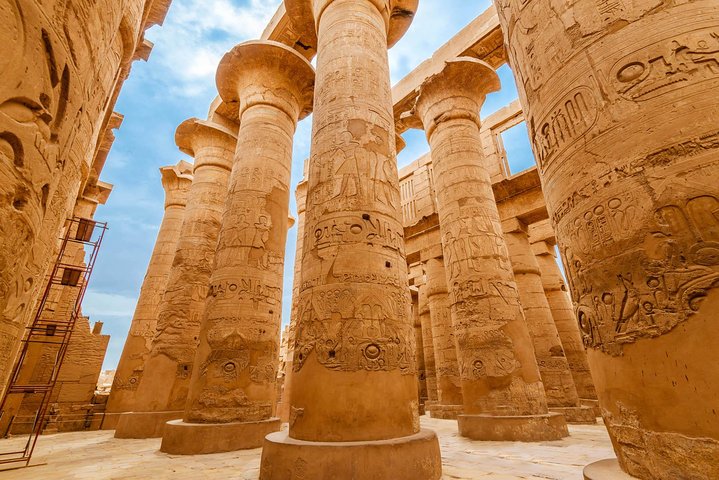
Embark on a captivating private car day tour from Luxor to Aswan, with a visit to the unique Kom Ombo Temple. Explore ancient temples, witness mesmerizing landscapes, and discover the historical significance of Aswan.
Embark on a captivating private car day tour from Luxor to Aswan, with a visit to the unique Kom Ombo Temple. Explore ancient temples, witness mesmerizing landscapes, and discover the historical significance of Aswan.
-
Luxor - At 6:00 am, a licensed tour guide will pick you up from your hotel or Nile cruise in Luxor. You will then be transported in a private air-conditioned vehicle to begin your tour.
Around 3:00 pm, you will be transferred back to your hotel in Luxor, or to Aswan if you plan to stay there instead of returning to Luxor. - Temple of Philae -…
- Luxor - At 6:00 am, a licensed tour guide will pick you up from your hotel or Nile cruise in Luxor. You will then be transported in a private air-conditioned vehicle to begin your tour.
Around 3:00 pm, you will be transferred back to your hotel in Luxor, or to Aswan if you plan to stay there instead of returning to Luxor.
-
Temple of Philae - Philae (/ˈfaɪli/; Greek: Φιλαί, Arabic: فيله Egyptian Arabic: [fiːlæ], Egyptian: p3-jw-rķ’ or ‘pA-jw-rq; Coptic: ⲡⲓⲗⲁⲕ, ⲡⲓⲗⲁⲕⲭ[1]) is an island located in the reservoir of the Aswan Low Dam, downstream of the Aswan Dam and Lake Nasser, Egypt. Originally situated near the First Cataract of the Nile in Upper Egypt, it was the site of an Egyptian temple complex. Since the construction of the Aswan Low Dam in 1902, the area has experienced various levels of flooding. The temple complex was dismantled and relocated to nearby Agilkia Island as part of the UNESCO Nubia Campaign project, which aimed to protect this and other complexes before the completion of the Aswan High Dam in 1970. The hieroglyphic reliefs of the temple complex are being studied and published by the Philae Temple Text Project of the Austrian Academy of Sciences, Vienna (Institute OREA).
-
Aswan High Dam - The Aswan Dam, more specifically known as the Aswan High Dam since the 1960s, is an embankment dam built across the Nile in Aswan, Egypt, between 1960 and 1970. Its importance has largely overshadowed the earlier Aswan Low Dam, which was completed in 1902 downstream. Following the Egyptian Revolution of 1952, the construction of the High Dam became a key government objective due to its ability to better control flooding, provide increased water storage for irrigation, and generate hydroelectricity. The High Dam has had a significant impact on Egypt’s economy and culture, similar to the earlier dam.
-
Temple of Horus - The Temple of Edfu is an Egyptian temple located on the west bank of the Nile in Edfu, Upper Egypt. During the Hellenistic period, the city was known as Koinē Greek: Ἀπόλλωνος πόλις and Latin Apollonopolis Magna, named after the chief god Horus, who was identified as Apollo under the interpretatio graeca. It is one of the best-preserved shrines in Egypt. Constructed in the Ptolemaic Kingdom between 237 and 57 BC, the inscriptions on its walls provide valuable information on language, myth, and religion during the Hellenistic period in Egypt. The temple’s inscribed building texts offer details about its construction and preserve information about the mythical interpretation of this and other temples as the Island of Creation. Additionally, there are important scenes and inscriptions of the Sacred Drama, which depict the age-old conflict between Horus and Seth, translated by the German Edfu-Project.
-
Temple of Kom Ombo - The Temple of Kom Ombo is a unique double temple located in the town of Kom Ombo in Aswan Governorate, Upper Egypt. Constructed during the Ptolemaic dynasty, 180–47 BC, with some additions made during the Roman period, the building is distinctive due to its ‘double’ design, which includes duplicated courts, halls, sanctuaries, and rooms for two sets of gods. The southern half of the temple was dedicated to the crocodile god Sobek, the god of fertility and creator of the world, along with Hathor and Khonsu. Meanwhile, the northern part of the temple was dedicated to the falcon god Haroeris (“Horus the Elder”), along with Tasenetnofret (the Good Sister, a special form of Hathor or Tefnet/Tefnut) and Panebtawy (Lord of the Two Lands). The temple is notable for its perfect symmetry along the main axis. The texts and reliefs in the temple refer to cultic liturgies similar to those from that time period.

- Lunch at local restaurants (Local Egyptian Food)
- Tour guide
- Hotel pickup and drop-off
- Entry fees
- All Transfers by Private A/C Vehicles Newest Model
- Bottle of water
- Lunch at local restaurants (Local Egyptian Food)
- Tour guide
- Hotel pickup and drop-off
- Entry fees
- All Transfers by Private A/C Vehicles Newest Model
- Bottle of water
- Personal Items
- Tipping
- Personal Items
- Tipping
Set off on an enchanting day trip from Luxor to Aswan in a private car, with a visit to the distinctive Kom Ombo Temple en route. Experience the stunning Egyptian landscapes as you travel to Aswan, a city steeped in historical importance.
Discover the dual sanctuary of Kom Ombo Temple, dedicated to both the crocodile god Sobek and the falcon god Horus….
Set off on an enchanting day trip from Luxor to Aswan in a private car, with a visit to the distinctive Kom Ombo Temple en route. Experience the stunning Egyptian landscapes as you travel to Aswan, a city steeped in historical importance.
Discover the dual sanctuary of Kom Ombo Temple, dedicated to both the crocodile god Sobek and the falcon god Horus. Admire its detailed reliefs and architecture that narrate ancient stories.
Proceed with your journey to Aswan, where you’ll explore renowned landmarks such as the High Dam, the Unfinished Obelisk, and the splendid Philae Temple.
- Entrance fees -Depending on the Tour Options Chosen
For a full refund, cancel at least 24 hours before the scheduled departure time.
For a full refund, cancel at least 24 hours before the scheduled departure time.