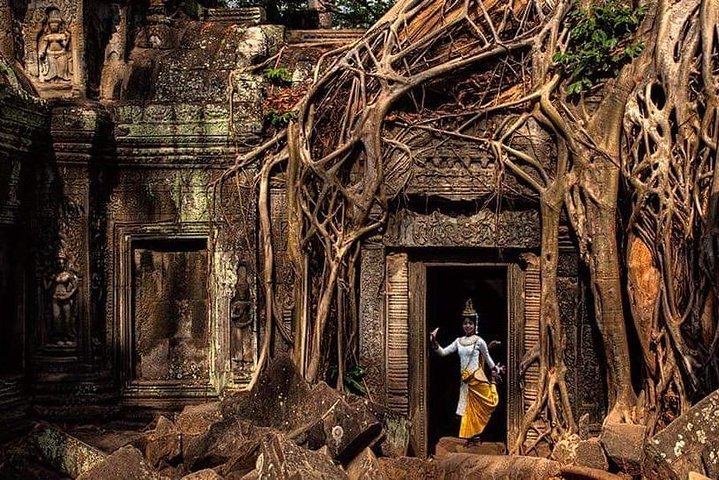
Experience the awe-inspiring sunrise at Angkor Wat, the world’s largest religious building. Don’t miss the chance to witness the extravagant beauty of the temples of Angkor, a source of inspiration and national pride in Cambodia.
Experience the awe-inspiring sunrise at Angkor Wat, the world’s largest religious building. Don’t miss the chance to witness the extravagant beauty of the temples of Angkor, a source of inspiration and national pride in Cambodia.
- Angkor Thom South Gate - The Angkor Thom North Gate, also known as Dei Chhnang Gate, is one of the five entrances (gopura) to Angkor Thom.
- Preah Khan - Preah Khan is a magnificent and expansive ancient temple located in Angkor Archaeological Park, Siem Reap. Constructed in the 12th century during the reign of King Jayavarman VII (1181-1218…
- Angkor Thom South Gate - The Angkor Thom North Gate, also known as Dei Chhnang Gate, is one of the five entrances (gopura) to Angkor Thom.
- Preah Khan - Preah Khan is a magnificent and expansive ancient temple located in Angkor Archaeological Park, Siem Reap. Constructed in the 12th century during the reign of King Jayavarman VII (1181-1218 AD), it was dedicated to his father, while the nearby Ta Prohm was built in honor of his mother. It is a must-see temple in Angkor.
- Banteay Prei - This site, only partially restored, offers a serene and natural atmosphere, often remaining very quiet. Nearby is the small Prei Temple.
- Neak Pean - Enjoy a walk to the center of the Jayataka Baray to discover this small and unique temple. Just north of here is another smaller temple, Krol Ko, which is also worth visiting.
- Ta Som - With its distinctive lintels and a sense of a lost temple, Ta Som is definitely worth a visit and won’t take much time.
- East Mebon - The East Mebon is a 10th-century temple constructed during the reign of King Rajendravarman (944 to 968 AD) at the center of the vast reservoir, Yasodharatataka Baray. Known today as the East Baray, it has been dry for many centuries, but originally, this temple was an island accessible only by boat, with its reflections shimmering on the water from afar.
- Pre Rup - A 10th-century site that combines brick, laterite, and sandstone, offering beautiful views over the surrounding countryside.
- Banteay Samre - Banteay Samre, or Banteay Samrae, is one of the most exquisite smaller ancient temple sites, almost rivaling the popular Banteay Srei site. Built in the early 11th century as a Hindu temple during the reign of King Suryavarman II (1113 – c.1150 AD) and later completed by King Yasovarman II (1160 – 1166 AD) in the early 12th century, it is located about 10 km northeast of Angkor Wat, near the eastern edge of the ancient East Baray.
- Banteay Srei - Banteay Srei Temple (or Prasat Banteay Srey) is one of the most stunning ancient temples in Asia, set amidst charming villages and farmlands just below the Kulen Mountain range. It features exquisite and well-preserved bas-reliefs and ornate decorations from a time when craftsmanship in the ancient empire was at its peak.
The site is situated in Angkor Archaeological Park, approximately 35 km north of Siem Reap city and 30 km from Angkor Wat. Dating back to the 10th century, it was dedicated to the Hindu god Shiva.

- Hotel pick up & Drop Off
- Professional English speaking tour guide
- In-vehicle air conditioning
- Cold water during tour
- Hotel pick up & Drop Off
- Professional English speaking tour guide
- In-vehicle air conditioning
- Cold water during tour
- Admission fees
- Beverage and food
- Travel Insurance
- Appreciated tips
- Admission fees
- Beverage and food
- Travel Insurance
- Appreciated tips
The optimal path to explore all the significant temples of Angkor, with minimal hassle, is known as the Small Circuit and the Grand Circuit. These can be completed in two days, or longer if you wish to delve into more details and discover the seemingly endless hidden marvels. If time is constrained, the Small Circuit can be finished in a single day and…
The optimal path to explore all the significant temples of Angkor, with minimal hassle, is known as the Small Circuit and the Grand Circuit. These can be completed in two days, or longer if you wish to delve into more details and discover the seemingly endless hidden marvels. If time is constrained, the Small Circuit can be finished in a single day and includes the two most significant sites, Angkor Wat and Angkor Thom (including Bayon), along with smaller sites of your choice.
The Grand Circuit is a tour route within Angkor Archaeological Park that expands on the Small Circuit route and includes the lesser-known temples outside the central cluster.
For a full refund, cancel at least 24 hours before the scheduled departure time.
For a full refund, cancel at least 24 hours before the scheduled departure time.