
Experience a customizable 2-day private taxi tour of Jeju Island, with options to explore the East, West, and South. Create your perfect itinerary and make your Jeju tour unforgettable.
Experience a customizable 2-day private taxi tour of Jeju Island, with options to explore the East, West, and South. Create your perfect itinerary and make your Jeju tour unforgettable.
- Saryeoni Forest Path - This forest trail is recognized as one of Jeju’s top 31 hidden gems and is renowned for its preservation. It is a favorite among tourists who love hiking and nature.
- Seongeup Folk Village - This traditional village on Jeju Island has been maintained as it was in ancient times, with impressive stone piles designed to…
- Saryeoni Forest Path - This forest trail is recognized as one of Jeju’s top 31 hidden gems and is renowned for its preservation. It is a favorite among tourists who love hiking and nature.
- Seongeup Folk Village - This traditional village on Jeju Island has been maintained as it was in ancient times, with impressive stone piles designed to protect roofs from the wind. The buildings are designated as important folk relics because these castles and homes, built to prevent a Japanese invasion, have remained intact since the Joseon Dynasty.
Folk Village is optional. You can choose the Jeju Folk Village Museum.
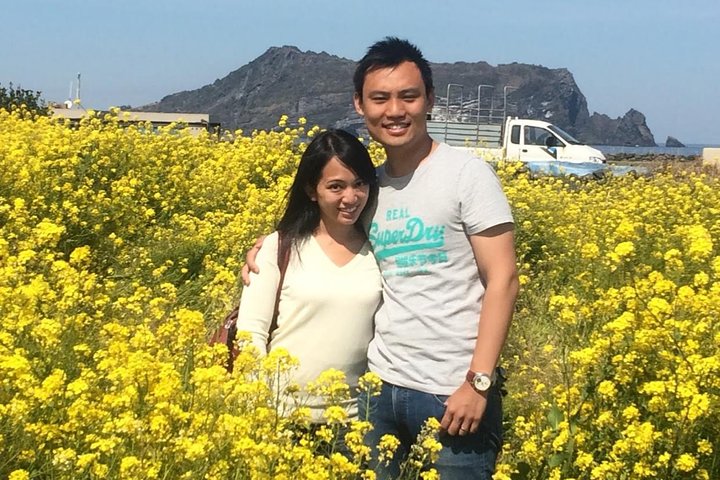
- Seopjikoji - Seopjikoji is located at the eastern tip of Jeju Island and offers stunning scenery, especially in April when yellow canola flowers are in full bloom. “Seopji” is the area’s old name, and “Koji” is a Jeju dialect term meaning a sudden bump on land.
Seopjikoji can be replaced with Sangumburi in October and November.
- Seongsan Ilchulbong - Including Women Diver Show
Seongsan Ilchulbong, also known as ‘Sunrise Peak’, is a classic tuff cone formed by hydrovolcanic eruptions on a shallow seabed about 5,000 years ago. Located on Jeju Island’s eastern coast, it resembles a massive ancient castle. This tuff cone stands 182 meters high, has a preserved bowl-like crater, and showcases diverse inner structures from the sea cliff.
- Sangumburi Crater - October, November: Sangumburi Crater
Instead of Seopjikoji
The best times to visit are October and November.
- Woljeongri Beach - Woljeongri Beach is famous for its picturesque scenery, serene white sand, and beautiful emerald ocean. Nearby, a stretch of cozy and charming cafes lines the streets.
- Haenyeo Museum - In case of the closure of Manjanggul Lava Tube (the first Wednesday of every month)
Jeju Haenyeo Museum will be an alternative tour course.
“Haenyeo” refers to the female divers who work underwater in Korea. They collect seaweed, abalone, octopus, clams, sea urchins, and other sea products. This term holds a special meaning, reflecting their life beyond just a job. Nowadays, they can only be seen on Jeju Island, an hour’s flight from Seoul, Korea’s capital.
- Hallim Park - Hallim Park is a renowned tourist attraction in Jeju, hosting monthly flower-related events. A highlight during spring is the Hallim Park Tulip Festival, featuring various tulip species like Apeldoorn, Shirley, Kees Nelis, Barcelona, Pink Diamond, and more. Additionally, visitors can enjoy bibimbap garnished with colorful tulips.
- O’sulloc Tea Museum - The Osulloc Tea Museum, located on Jeju Island, opened in 2001 as Korea’s first tea museum. In 2013, Osulloc Tea Stone was built next to the museum, offering visitors various tea experiences and cultural activity programs.
- Sanbangsan Mountain - Sanbangsan, rising to 395 meters, is a typical dome-shaped, craterless volcano. Its name, Sanbang, comes from a natural stone cave in the mountain’s middle. Inside the cave, called Sanbanggulsa Temple, there is a Buddha statue. According to legend, water drops from the cave ceiling are the tears of love shed by the goddess who protects Sanbangsan’s stone walls.
- Yongmeori Coast - Yongmeori Coast is a volcanic beach formed by ash emitted during violent explosions when hot magma from underground met cold seawater. Descending the narrow path to the beach, visitors can also see a sandstone cliff. Its name, Yongmeori (meaning a dragon’s head), comes from its resemblance to a dragon ready to dive into the sea. Entrance may be restricted during rising tides or bad weather. If Yongmeori Coast is closed, Mt. Songaksan will be an alternative tour course.
- Cheonjeyeon Falls - Cheonjeyeon Falls, known as “The Pond of God,” consists of three sections. Around the falls, a variety of plant life thrives, including the rare ‘solimnan’ reeds. To the east, a cave releases cold water from the ceiling, creating the first waterfall. The water gathers into a pool and then falls two more times, forming the second and third waterfalls, which flow into the sea.
- Daepo Haean Jusangjeolli Cliff - The columnar joints in the Jungmun Tourism Complex were designated as Natural Monument #433 on December 27, 2004. They resemble a large folding screen with black hexagonal stone pillars. Visitors are mesmerized by nature’s grandeur as they watch the ocean waves crash against the columnar joints.
Stop: 50 minutes - Admission included
- Teddy Bear Museum Jeju - Since its opening in 2001, teddy bear enthusiasts have found another place to visit and enjoy the world’s most iconic plush toys! The museum offers a wide range of themed exhibits, including Seoul History, 100 Years of Modern History, Arts, World Travel, and many more.
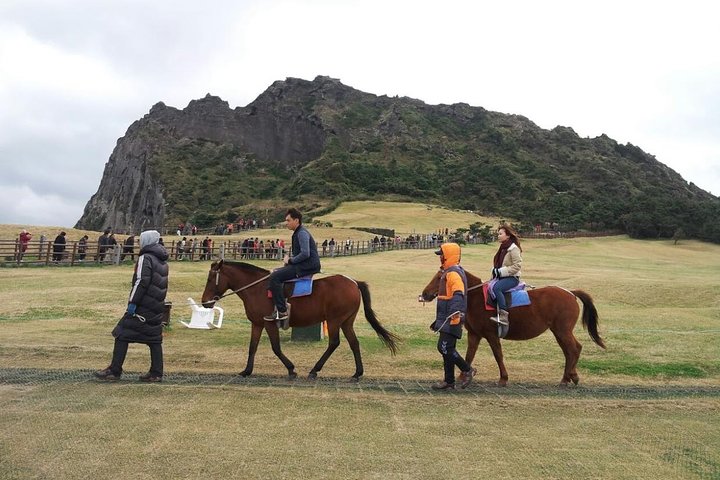
- The Ma Park - As the world’s first horse-themed park, Raon The Ma Park features a permanent horse-riding performance, “Empire of Thousand Years. Oh! Goguryeo Dynasty,” based on the life of Jumong, the founder of the Goguryeo Dynasty. It also offers high-quality horse-riding facilities for all skill levels. Visitors can enjoy various horse-related activities.
- Alive Museum - A Tricky Theme Park Made of Five Optical Illusion Experience Themes: Trick Art, Digital Art, Sculpture Art, Provence Art. Visitors will have a special and exciting experience and story through five unique themes.
- Songaksan Mountain - If Yongmeori Coast is closed (due to rising tides or bad weather), Mt. Songaksan will be an alternative tour course.
-
Manjanggul Cave - UNESCO Heritage Manjang Cave [UNESCO World Heritage] is currently closed for construction to prevent falls. It is scheduled to reopen in August 2025. During the construction phase, it will be replaced by either ‘Jeju Stone Park’ or ‘Eco Land Theme Park’.
If Manjanggul Lava Tube is closed (the first Wednesday of every month), Jeju Haenyeo Museum will be an alternative tour course.
- English, Chinese, and Japanese speaking guides included
- English-speaking coordinator for the activity
- Fuel and parking fees included
- Transportation by private vehicle
- Hotel pickup and drop-off in Jeju City downtown
- English, Chinese, and Japanese speaking guides included
- English-speaking coordinator for the activity
- Fuel and parking fees included
- Transportation by private vehicle
- Hotel pickup and drop-off in Jeju City downtown
- Personal Expenses / Food and drinks
- Addmission fees per person
- pickup&drop-off outside of downtown Jeju City, there will be an additional charge 40,000~120,000KRW
- Extra charges for mileage restriction over 130km(per day) : 15,000~20,000won/10km(pay to driver)
- Personal Expenses / Food and drinks
- Addmission fees per person
- pickup&drop-off outside of downtown Jeju City, there will be an additional charge 40,000~120,000KRW
- Extra charges for mileage restriction over 130km(per day) : 15,000~20,000won/10km(pay to driver)
The main goal is to ensure a fantastic and flawless Jeju tour or holiday by offering competitive prices and providing all the necessary information.
Feel free to customize your itinerary to suit your preferences.
Basic Itinerary: East
- Manjanggul Cave
- Woljeongri Beach
- Seongsan Ilchulbong (Lunch) with Woman Diver Show
- Seopjikoji
- From…
The main goal is to ensure a fantastic and flawless Jeju tour or holiday by offering competitive prices and providing all the necessary information.
Feel free to customize your itinerary to suit your preferences.
Basic Itinerary: East
- Manjanggul Cave
- Woljeongri Beach
- Seongsan Ilchulbong (Lunch) with Woman Diver Show
-
Seopjikoji
- From September to December, choose between Sangumburi Crater and Ecoland, with the option to skip Seopjikoji.
- Seongeup Folk Village or Jeju Folk Village Museum
Please note, Manjang Cave [UNESCO] is temporarily closed for construction to prevent falling hazards. During this time, ‘Jeju Stone Park’ will be the alternative.
Basic Itinerary: West
- Hallim Park or The Ma Park
- Osulloc Tea Museum
- Lunch (Local food)
- Sanbangsan Mountain
- Yongmeori Coast
- Teddy Bear Museum, Alive Museum, or Cheonjeyeon Waterfall (choose one)
Additionally, explore the West and South of Jeju Island.
- The price is fixed per vehicle
- For each additional hour, it costs 30,000 KRW (regular taxi) to 40,000 KRW (jumbo taxi). Payment is made directly to the driver
- If Manjanggul Lava Tube is closed (on the first Wednesday of every month), Jeju Haenyeo Museum will be offered as an alternative tour
- Pickup and drop-off outside of downtown Jeju City will incur an extra charge of 30,000 to 120,000 KRW
- For each additional hour, it costs 50,000 KRW(Van) to 70,000 KRW(Mini-bus). Payment is made directly to the guide
- Please note that if you exceed the tour time, an additional fee will be charged for every 30 minutes. The fees are as follows: Regular taxi - 15,000 won, Jumbo taxi - 20,000 won, Van - 25,000 won, Minibus - 35,000 won per 30 minutes.
- When selecting the east or west/south route, the distance will not exceed 130 kilometers.
For a full refund, cancel at least 24 hours before the scheduled departure time.
For a full refund, cancel at least 24 hours before the scheduled departure time.


