




Embark on an unforgettable 11-day private tour from Casablanca to Marrakech, discovering Morocco’s imperial cities, majestic mountains, and enchanting desert.
Embark on an unforgettable 11-day private tour from Casablanca to Marrakech, discovering Morocco’s imperial cities, majestic mountains, and enchanting desert.
Day 1: Morning in Casablanca, afternoon in Rabat
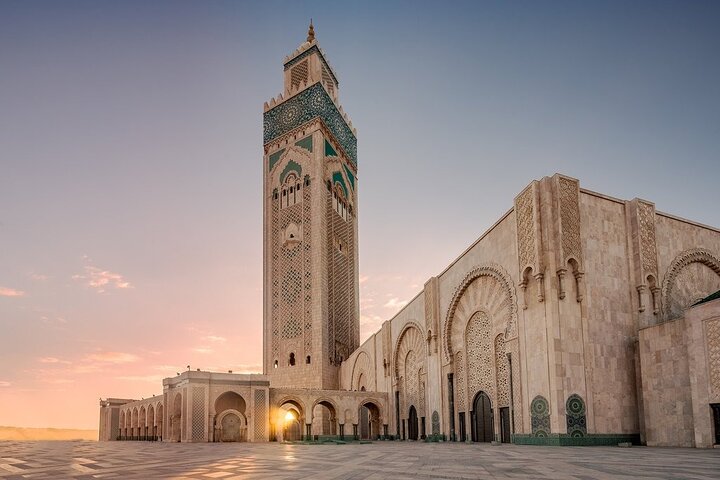
Casablanca - Welcome to Casablanca! If there’s one place to visit in Casablanca—the commercial hub of Morocco—make it the Hassan II Mosque. Located picturesquely by the ocean, its 690-foot (210 m) minaret is the tallest in the world.
Rabat - Head north to Rabat, the imperial city and current…
Day 1: Morning in Casablanca, afternoon in Rabat
Casablanca - Welcome to Casablanca! If there’s one place to visit in Casablanca—the commercial hub of Morocco—make it the Hassan II Mosque. Located picturesquely by the ocean, its 690-foot (210 m) minaret is the tallest in the world.
Rabat - Head north to Rabat, the imperial city and current capital. Discover the medieval fortifications of the Chellah Necropolis and explore the Roman and Islamic ruins. Enter through the grand door of the Kasbah des Oudaias into Rabat’s old city center. From there, visit the 20th-century Andalusian Gardens and enjoy the peaceful space away from the crowds. Discover the Hassan Tower, a minaret of the unfinished mosque and Mausoleum of Mohamed V. A 12th-century project that was left incomplete, leaving behind the minaret and around 200 columns—intended as support structures for the mosque.
The Blue City of Chefchaouen
Akchour - Travel north to the stunning blue city of Chefchaouen in the Rif Mountains. Before reaching Chefchaouen, take a hike (2-3 hours) through lush vegetation and small pools to enjoy the Cascades d’Akchour (Waterfalls of Akchour)—a hidden treasure.
Chefchaouen - Relax in the charming city of Chefchaouen. Largely unchanged since the 15th century, Chefchaouen offers a laid-back atmosphere with some of the friendliest locals in the country and is renowned for its blue-tinted buildings in its historic medina (old quarter). Explore its narrow streets and alleyways that cling to the northern hillside of the mountains. Discover Plaza Outa el-Hammam, the main square named for the numerous hammams (public baths) that once surrounded it. Find a restaurant or café for a meal, before browsing the many shops offering traditional goods. Visit the Grand Mosque and kasbah (old fortress or fortification) and tour the kasbah’s garden, museum, and even some of its old prison cells.
Day 3: Roman ruins at Volubilis and imperial cities of Meknes and Fes
Fes - Rise early to capture photos of the empty streets before heading to Fes. Stop along the way at the UNESCO-protected Volubilis ruins—the Roman’s farthest reach in Africa. Explore the complex, discovering merchant homes with still-intact heating systems, temples, and many mosaics in situ. Continue to the smaller, less crowded version of Fes, Meknes, for an introduction to your second historic imperial city. The two main attractions are the Ville Impériale (Imperial City) and the medina. Be sure to visit the Bab al-Mansour gate, the Mausoleum of Moulay Ismail, and the Royal Stables.
Continue east to your third imperial city, Fes. With its impressively large (and somewhat confusing) old medina, Fes is a city worth getting lost in. Before venturing into the medina, drive up the hill to visit the Merenid Tombs located just north of the city and enjoy the panoramic view of historic Fes and the surrounding area.
Day 4: Exploring the medieval medina and Imperial City of Fes
Fes - Fes is the oldest of the four Imperial Cities in Morocco and perhaps the most fascinating and exciting to explore. It boasts the most complete medina in the Arab world and remains relatively untouched since its founding over 1000 years ago. Often considered the country’s cultural capital, it consists of three parts: two medina quarters, Fes el Bali and Fes el Jdid, and the more modern, French colonial influenced, Ville Nouvelle. Meet your guide and spend a half-day learning about the history and culture as you navigate the narrow streets of the medinas.
Start in Fes el Bali at the Bab Boujeloud gate and enter the main thoroughfare of Talâa Kebira. Notice the Spanish and Tunisian influenced architecture as you pass by shops and souks (markets). Visit the Chouara Tannery and marvel at the many dye-filled stone pots and the men at work still using centuries-old techniques.
Day 5: Middle Atlas: Erfoud, Merzouga & the Sahara
Merzouga - Begin your day early and travel south toward Merzouga. Along the way, ascend the Col du Zad pass (7,146 feet or 2,178 m) through the cedar forests of the Middle Atlas mountains. Enjoy sightings of the local Barbary Macaque monkeys before stopping for lunch in Midelt (the “apple city”), savoring the nearby Moulouya River. Continue over the Tizi n’Talremt pass and into the Ziz Valley, known for its hidden oases and palm tree clusters. Along the road, you will see many fortified houses known as ksars—built to protect valuable goods, including gold, salt, and spices.
Continue to Erfoud, known for its date festival and fossil mining. Here you can visit a local collective to learn more about the process and meet some local artisans. Continue to Erg Chebbi, an extensive sea of sand dunes covering an area of 13.5 square miles (35 square km).
Day 6: Desert towns, lush oases & film-worthy landscapes
Ouarzazate - Catch the sunrise before renting a sandboard to test your skills. Leave the dunes and head to Khemliya to experience a traditional Saharan village—its people are originally from Mali. Continue west to pass through a dramatic gate into Rissani. A market town, Rissani holds a livestock auction and is home to a “donkey parking lot”, a site worth experiencing! Make your way to the desert town of Tinerhir before reaching the 984-foot (300 m) deep Todra Gorge. You will have time to explore the gorge and relax in the cool water of the shallow Todra River.
Travel through the Valley of a Thousand Kasbahs. Though many are now in disrepair, local families still live in some of them. You may even come across nomads herding their animals. Head west to Kelâat M’Gouna. Known for its Festival des Roses, here you can see extensively cultivated farmland bordered with fragrant rose bushes. Continue west to Ouarzazate, a gateway to the Sahara Desert made popular by the film industry.
Day 7: Aït Benhaddou Kasbah and Tizi n’Tichka Pass over the High Atlas to Marrakech
Marrakech - Travel to nearby Aït Benhaddou. A UNESCO World Heritage site, Aït Benhaddou is believed to date from the 11th century during a time when it held an important position along the trans-Saharan trade route between Marrakech, Ouarzazate, and the southern desert. Follow the narrow streets up to the Granary for a view of the surrounding landscapes. From there, ascend the High Atlas mountain range and look out for the highest peak, Mount Toubkal (13,671 feet or 4,167 m). Stop near the top of the Tizi n’Tichka pass (7,415 feet or 2,260 m) to enjoy the views over the mountain range.
As you descend the High Atlas, you will notice a dramatic change in the climate and landscape. Soon you will be immersed in the vibrant atmosphere of your final imperial city, Marrakech. After a long day on the road, settle into your hotel and spend the rest of the afternoon as you like. In the early evening, the main square, Jemaa el-Fna, comes alive with musicians, performers, snake charmers, games, and food stalls.
Day 8: Marrakech: Exploring the Red City
Marrakech - Known as the “Red City” for its red sandstone walls and buildings, Marrakech was once a significant trading capital for Atlas mountain tribes and remains an exciting former imperial city. Located north of the Atlas mountain foothills, Marrakech is home to Africa’s busiest square, Jemaa el-Fna. Begin exploring Marrakech’s ancient medina, starting with the Koutoubia Mosque and Gardens. Though the mosque cannot be entered by non-Muslims, it’s worth checking out its 12th-century foundations and 253-foot (77 m) minaret. Visit the fountains and pools in the adjoining garden.
Indulge your senses as you explore the intricate labyrinth of souks, tucked behind ordinary restaurants and shops. Check out Souk el Attarin, Souk Chouari, and Souk Smata for a selection of spices, woodwork, and babouche (traditional Moroccan slippers). Visit Souk des Teinturiers or the dyers’ souk to see how cloth and yarn are dyed using traditional methods.
Day 9: Day hike through the Atlas foothills and hillside villages
Marrakech - Today you will venture south of Marrakech to the small town of Amizmiz in the foothills of the High Atlas mountains (about one hour away). Spend time exploring the modest market in the old town before joining your mountain guide to trek the narrow roads and mule paths in the surrounding hills. Hike between small Berber villages and observe the local farmers and shepherds as they tend to their animals and the landscape. You may even see children on their way to or from school, which are typically shared between a few nearby villages.
Stop and enjoy lunch with a local family and gain insight into their daily lives as you learn how to make homemade bread. Continue hiking into the afternoon as you please. Here you will have the option of returning to Marrakech or staying in the foothills to share dinner with another local Berber family and stay the night in their home.
Day 10: Depart
Marrakech - If you stayed overnight in Amizmiz, have breakfast with your hosts before saying goodbye and heading out on the trail. Continue to explore the local scenery and other nearby towns before returning to Marrakech.
Upon arriving in Marrakech, and depending on your flight details, explore the kasbah area south of Jemaa el-Fna and check out the Saadian Tombs and discover the 500-year-old craftsmanship that went into its construction. Visit the sunken gardens of the 17th-century El Badi Palace as you work your way through the mellah and to the 19th-century Bahia Palace. If there’s time, you may wish to check out the Dar Di Said Museum (also known as the Museum of Moroccan Arts) to see exhibits of clothing, antiques, jewelry, and beautifully carved Hispano-Moorish decorations of carved cedarwood.

- 9 Night accommodation
- Breakfast
- Dinner
- Camel Ride
- Local Guides
- In-vehicle air conditioning
- 9 Night accommodation
- Breakfast
- Dinner
- Camel Ride
- Local Guides
- In-vehicle air conditioning
- Lunches
- Tips
- Lunches
- Tips
Embark on a comprehensive 10-day journey through Morocco, starting from Casablanca and concluding in Marrakech. Discover the ancient medinas of Fes and Marrakech, tour the contemporary cities of Casablanca and Rabat, and engage in historical caravan trails in the desert. Allocate a day towards mountain trekking in the lower ranges of the High Atlas mountains before wrapping up your adventure in Marrakech.
Embark on a comprehensive 10-day journey through Morocco, starting from Casablanca and concluding in Marrakech. Discover the ancient medinas of Fes and Marrakech, tour the contemporary cities of Casablanca and Rabat, and engage in historical caravan trails in the desert. Allocate a day towards mountain trekking in the lower ranges of the High Atlas mountains before wrapping up your adventure in Marrakech.
If you cancel at least 6 full day(s) before the scheduled departure time, you will receive a full refund.
If you cancel between 2 and 6 day(s) before the scheduled departure time, you will receive a 50% refund.
If you cancel within 2 day(s) of the scheduled departure, you will receive a 0% refund.
If you cancel at least 6 full day(s) before the scheduled departure time, you will receive a full refund.
If you cancel between 2 and 6 day(s) before the scheduled departure time, you will receive a 50% refund.
If you cancel within 2 day(s) of the scheduled departure, you will receive a 0% refund.


