



Experience the best of Busan in this 3-day private tour. Explore historic streets, modern skyscrapers, and local markets. Discover hidden gems like fishing coast villages, UNESCO temples, and hot springs. Perfect for small groups.
Experience the best of Busan in this 3-day private tour. Explore historic streets, modern skyscrapers, and local markets. Discover hidden gems like fishing coast villages, UNESCO temples, and hot springs. Perfect for small groups.
Pick-up at Busan Hotel or Busan KTX Train Station/Airport - Busan East - Busan Hotel Check-in
Haedong Yonggungsa - Located on the northeastern coast of Busan, Haedong Yonggungsa Temple is a unique attraction as it is one of the few temples in Korea situated by the sea, with most being in the mountains. Established in 1376 by the esteemed Buddhist…
Pick-up at Busan Hotel or Busan KTX Train Station/Airport - Busan East - Busan Hotel Check-in
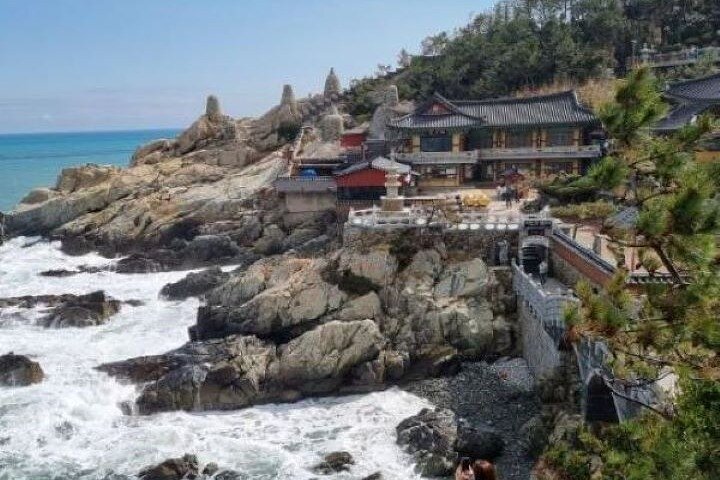
Haedong Yonggungsa - Located on the northeastern coast of Busan, Haedong Yonggungsa Temple is a unique attraction as it is one of the few temples in Korea situated by the sea, with most being in the mountains. Established in 1376 by the esteemed Buddhist teacher Naong during the Goryeo dynasty, the temple features the Seawater Great Goddess Buddha, the Daeungjeon Main Sanctuary, Yongwangdang Shrine, Gulbeop Buddhist Sanctum (housed in a cave), and a three-story pagoda with four lions overlooking the ocean. Many visit on New Year’s Day to make wishes as the sun rises. April is particularly beautiful with cherry blossoms, and the temple is illuminated with lanterns during Buddha’s birthday in the fourth lunar month.
Daebyeon Port Entrance - Recognized as one of the 100 beautiful fishing villages by the Ministry of Oceans and Fisheries, Daebyeon Port hosts the anchovy festival. Anchovies, a Gijang specialty, swim in shoals. The Anchovy Theme Square, the festival’s main venue, features iconic towers and stunning sculptures with lighting, music, and fountains. Visitors can also enjoy abalone porridge with fresh seafood and shop for dried seafood.
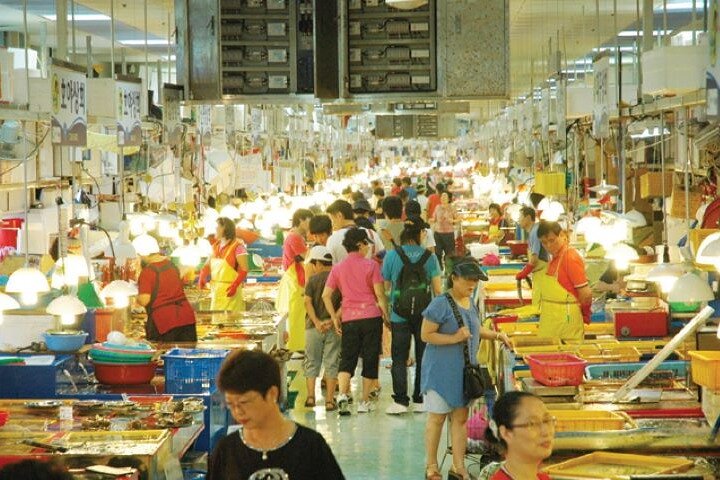
Gijang Market - Gijang Market is an outdoor market offering a variety of products, including fishery and agricultural goods. It showcases seasonal fishery items, with seaweed and anchovy in spring and cutlassfish in autumn. The cutlassfish, especially popular around Chuseok (Korean Thanksgiving), are renowned nationwide for their exceptional taste. Visitors can also savor live King crabs at the market.
Haeundae Dalmaji-gil Road - Known as Busan’s Montmartre, Dalmaji-gil Road is celebrated for its views of the blue ocean, white sandy beach, Camellia forest, and pine tree forest, making it one of Busan’s eight scenic sites. Haeundae Dalmaji Hill and the moon viewed from Cheongsapo add to the scenic beauty.
Songjeong Beach - Songjeong Beach spans 1.2 kilometers with a width of 30 to 60 meters. Its white sandy beach is perfect for families with young children due to its shallow waters. The beach is a popular spot for pre-wedding photoshoots. Nearby, Jukdo Park at the entrance to Songjeonghang Port features white and red lighthouses, a favored photo location, and offers views from Songiljeong Pavilion at Jukdo Park’s peak. The path leads through a grove of evergreens, and fishermen often line the breakwaters to the lighthouses.
Haeundae Beach - Haeundae Beach is Busan’s most famous beach. The white sand stretches 1.5 kilometers over a 30- to 50-meter wide area, creating a stunning coastline before a shallow bay, ideal for swimming. Every summer, crowds flock to Haeundae Beach. The area offers a range of accommodations from luxury hotels to private guesthouses, making it a perfect summer destination. Haeundae Beach is also known for various cultural events and festivals throughout the year. Nearby attractions include Dongbaekseom Island, Busan Aquarium, a yachting dock, BEXCO, driving courses, and more.
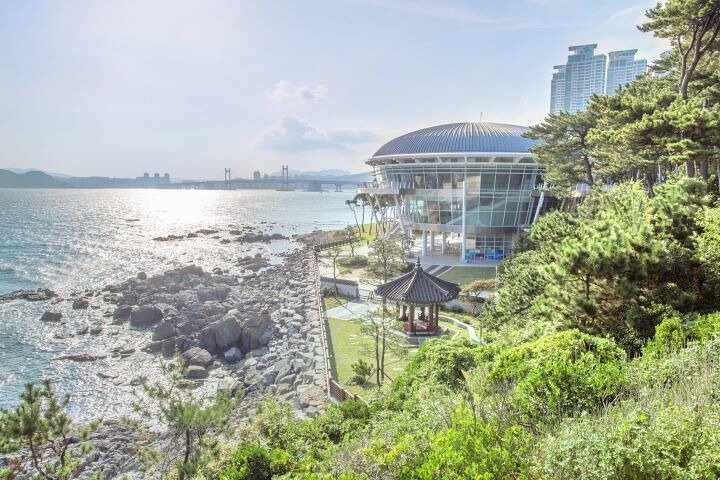
Dongbaekseom - Situated on Dongbaekseom Island, known for its beautiful natural landscape with dense camellia and pine trees, Nurimaru APEC House serves as a memorial hall and prestigious international conference venue since the APEC summit meeting. The three-story building is a modernistic interpretation of “jeongja,” a traditional Korean pavilion, with a roof symbolizing Dongbaekseom Island’s ridgeline. Its interior showcases Korea’s creative traditional culture. The terrace, designed with a Korean wooden floor concept, overlooks Oryukdo Island, Gwangan Bridge, and Dallmaji Hill. Close to Haeundae Beach, it offers a spectacular view of the beach and serves as a reputable international conference hall blending modern and natural beauty.
Shinsegae Centum City Spaland - Shinsegae Centum City Department Store holds the Guinness World Record as the largest shopping complex globally, offering a wide range of entertainment options, including an ice rink, movie theater, golf range, and spa. The store features 21 designer brands and 622 renowned brands. As Korea’s first department store, Shinsegae reflects decades of retail expertise in this flagship location. Designed by globally acclaimed experts like Italian architect Claudio Silvestrin and American architecture and design firm Callison, Centum City embodies the “golden sea” concept. The department store has become a defining landmark in Busan.
Busan South - West - Busan Hotel
Oryukdo Island - Oryukdo Islets, celebrated as one of Busan’s most beautiful islands, comprise a group of rocky islands off Yongho-dong, Nam-gu, Busan. Designated as Busan National Geopark for its geological significance, the islands feature rock formations from volcanic activities 80 million years ago. It is also a marine sanctuary for protected marine species and a state-designated cultural heritage site. The emerald sea, where the East Sea and the South Sea converge, reveals five or sometimes six islands on the brilliant blue expanse. The coastal waters of Oryukdo Islets captivate visitors.
UN Memorial Cemetery - The UN Memorial Cemetery in Korea commemorates UN soldiers from 16 countries and UN aids from five countries who perished during the Korean War from 1950-1953. It is the world’s only memorial cemetery dedicated to UN soldiers. Initially holding up to 11,000 graves, most soldiers were repatriated at their families’ request, leaving 2,300 graves. The serene park spans 135,000 square meters of grassy plains. Notable sites and memorials include the Memorial Service Hall, Memorabilia Hall, two Turkish Monuments, Greek Monument, Australian Monument, British Commonwealth Monument, and two ponds.
Taejongdae - Taejongdae Cliffed Coast was formed by layers of rock compressed beneath a lake during the Cretaceous period, later eroded by the sea. The coast features various geological formations, including sea caves and uniquely shaped rocks. Visitors can enjoy walking on forested paths or take the train course to easily access Taejongdae Observatory and Yeongdo Coastal Culture Space.
Huinnyeoul Culture Village - Huinnyeoul village is a quaint village preserving the history and pain of refugees after the Korean War. Resembling Greece’s Santorini, it is built on sea cliffs. Huinnyeoul-gil consists of 14 alleys, cozy cafés, workshops, and independent bookstores. The ocean breeze flows through the leisurely alleys, and the greenery between rocks adds tranquility to daily life. A must-visit spot on Huinnyeoul-gil is Huinnyeol Jeomppang, where visitors can enjoy the best ramen noodles while gazing at the vast ocean, bringing a moment of peace after a long day of walking.
Songdo Beach - Opened in 1913, Songdo Beach is Korea’s first beach. After its golden era in the 1960s and 1970s, the beach became deserted. Efforts to restore its former beauty have made it even more stunning than in its heyday. With its pristine sandy beach, clear water, cloud trails, and an overwater cable car, Songdo Beach is once again a popular tourist destination, attracting over five million visitors annually.
Busan Gamcheon Culture Village - Gamcheon Culture Village is a labyrinthine and picturesque village in Busan, also known as “Korea’s Santorini” or “Lego Village.” It is densely packed with small, vibrant-colored houses adorned with charming artworks like mural paintings and quirky sculptures. Ascending the steep hill, visitors encounter the statue of The Little Prince and his fox, peacefully overlooking the village. During the Korean War, Gamcheon served as a refuge as Busan was one of the few areas free from conflict. The village was also the headquarters of Taegeukdo members, who believed in the “yin and yang” philosophy. Consequently, the village is designed so no house blocks another, allowing everyone to thrive.
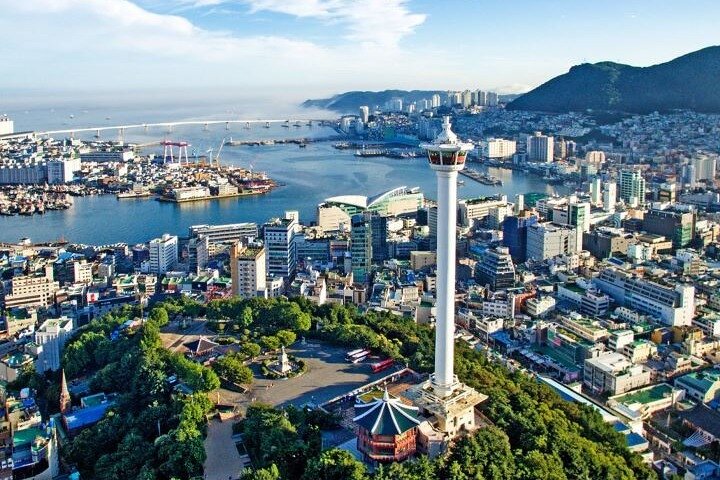
Yongdusan Park - Mt. Yongdusan Park (alt. 49 m) in downtown Busan is one of the city’s three famous mountains. Initially named Songhyeonsan Mountain, meaning a mountain with a sea view through dense pine forests, it was later renamed Yongdusan Mountain due to its dragon-head-like peak, protecting the area from overseas invaders. Busan Tower, a symbol of Busan, stands proudly at 69 meters above sea level, reaching a height of 120 meters. The park offers a stunning view of Busan Port and the surrounding scenery.
Gukje Market - Gukje Market is one of Korea’s largest markets. Its alleyways are lined with stalls selling diverse goods, particularly machinery tools, kitchenware, and clothing. To the market’s right is an alleyway with charity stores, and to the left is Kkangtong Market. Following the Korean War, refugees who fled to Busan set up stalls to make a living by selling smuggled or imported products, which evolved into today’s Gukje Market (gukje meaning “international” in Korean).
Nampodong Street (Theater District) - Nampodong Street is renowned for some of the best food in Busan, South Korea. The neighborhood is a major hub for street food in Busan (pojangmacha) and is well-known nationwide. Accessible via Busan Subway, Line 1, visitors will find a delicious selection of Korean food. A walk through this vibrant neighborhood offers a glimpse into the lively atmosphere and may inspire a journey for local cuisine.
Busan North - East - Busan Hotel or Drop-off Busan KTX Train Station / Airport
Beomeosa Temple - Beomeosa Temple is located on the eastern side of Geumjeongsan Mountain, a renowned mountain in Busan. Founded by monk Uisang in 678, during the 18th year of King Munmu (r. 661-681) of the Silla Kingdom, it is one of the three most famous temples in the Yeongnam region, alongside Haeinsa Temple and Tongdosa Temple. Most of the original Beomeosa Temple site was lost during the Imjin War (1592-1598) but was restored in 1613 and remains today. Daeungjeon Hall is considered one of the most exquisite architectures of the Joseon dynasty. Other significant sites include Iljumun Gate, a three-story pagoda with four pillars from the 9th century, pavilions, gates, and eleven hermitages. Beomeosa Temple also offers a temple stay program for visitors to learn about Buddhist culture and self-discovery.
Tongdosa Temple - Tongdosa Temple is one of Korea’s five “Palace of the Jewel of Nirvana” temples, where Buddha’s relics substitute for a statue. Precept Master Jajang brought the relics, including part of Buddha’s robes, from China and enshrined them in 646 C.E. The temple represents the Buddha of Korea’s Three Jewel Temples and is a Full Monastic Training Temple with Yeongchuk Monastery. Mt. Yeongchuk surrounding the temple resembles Mt. Grdhrakatu, where Buddha delivered the Lotus Sutra, and Tongdo, the temple’s name, means “Pass through (to) Enlightenment.” All monks must pass through the Diamond Precept Platform (Geumganggyedan) at the temple, where ordinations occur. Many ancient buildings appear as they did in the past. Numerous small hermitages are scattered around the temple grounds. The river valley and forest near Tongdosa are ecological paradises.
Eonyang-eup - Bulgogi, a classic Korean dish enjoyed worldwide, is one of Korea’s most famous exports. Made with thinly sliced prime beef marinated in sugar, soy sauce, sesame oil, garlic, and pepper, Bulgogi is beloved by Koreans and easy for foreigners new to Korean cuisine due to its mild flavor. Originating from Eonyang, west of Ulsan city at the Yeongnam Alps’ foot, Eonyang Bulgogi is renowned for its preparation. Freshness is key, with meat from cows calved fewer than three times, served within 24 hours of butchering. Unlike regular charcoal or pan frying, Eonyang Bulgogi is cooked over white coals (created by covering coals heated inside a charcoal kiln).
OSIRIA Station - A grand theme park is set to open in Gijang-gun’s Osiria Tourism Complex in May. Lotte World Magic Forest, under construction since May 2019, will soon welcome Busanites. With an arboreal theme, the park features cute animal mascots and over 30 rides and attractions. At 107,920 square meters, Lotte World Magic Forest rivals Lotte World Adventure in Seoul. Lotte World Magic Forest is one of many attractions at the Osiria Tourism Complex. In 2014, Lotte Premium Outlet, Asia’s largest outlet retailer, opened. In 2015, the Busan National Science Museum began operations, and IKEA followed in 2020, receiving great acclaim from Busanites.
Haeundae Marine City - Start Night Tour: Marine City
When the lights illuminate after sundown, Marine City’s nightscape rivals world-famous locations like Hong Kong and Shanghai. With various restaurants, cafes, and bars along the street, it is a popular destination for all ages.
Hwangnyeongsan Mountain - For a panoramic night view of Busan city, the Bongsudae of Hwangnyeongsan Mountain is the ideal spot. Located in the heart of Busan, the mountain spans Busanjin-gu, Nam-gu, and Suyeong-gu Districts. It is the second-highest mountain in the Geumnyeon Mountain Range, offering easy access to Busan city’s stunning night view. The bongsudae (beacon fire station) atop the mountain communicated with bongsudae on Haeundae’s Ganbiosan Mountain (east), Gubongsan Mountain (west), and Beomeosa Temple and Gyemyeongsan Mountain (north).
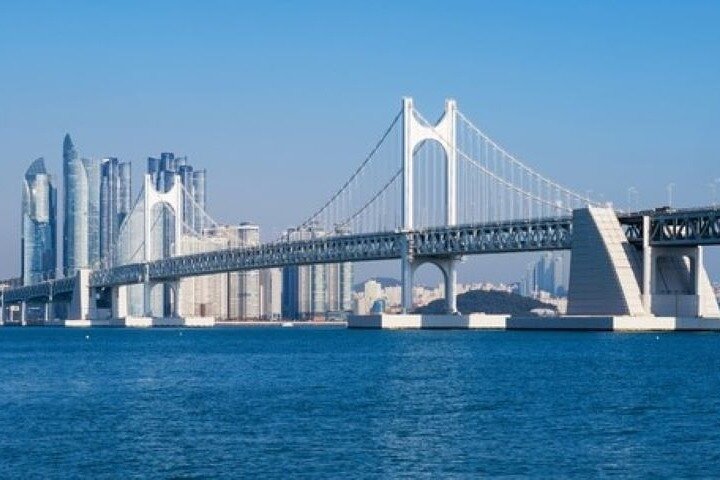
Gwangalli Beach - Gwanganli Beach is a popular tour destination. From Busan Station, visitors can reach Gwanganlli Beach in about 45 minutes. There, they can admire one of Busan’s most famous landmarks, the Gwangan Bridge. Completed in 2002, the “Diamond Bridge” and its nightly light show are must-sees for all.

- Private transportation
- Busan Airport pick-up or drop-off
- Night tour
- Guide + driver or driving guide
- Busan KTX bullet train station pick-up or drop-off
- Gas, toll, and parking fees
- Private transportation
- Busan Airport pick-up or drop-off
- Night tour
- Guide + driver or driving guide
- Busan KTX bullet train station pick-up or drop-off
- Gas, toll, and parking fees
- Meals
- Hotel, Airbnb, Accommodation
- Entrance fees
- Meals
- Hotel, Airbnb, Accommodation
- Entrance fees
Busan city is many charms. A short day is not enough to fully enjoy in Busan. If you want a diverse experience and a comfortable trip, it seems that there will be no problem in discovering for 3 days. To the south, there is a traditional old street and understand the history of Busan, hidden alley market, to the east, you can see the new town forest of…
Busan city is many charms. A short day is not enough to fully enjoy in Busan. If you want a diverse experience and a comfortable trip, it seems that there will be no problem in discovering for 3 days. To the south, there is a traditional old street and understand the history of Busan, hidden alley market, to the east, you can see the new town forest of tall buildings, as night view Gwanganli beach, Mt. Hwangnyeongsan observatory, Marine City, as well as adding to a hidden fishing coast village, UNESCO temple, outlet markets, hot springs, traditional rice winery, etc, more enjoy local popular can be found it.
it is for small- Groups with private trips only
- Please advise any specific dietary requirements at the time of booking
- Minimum 2 people numbers apply. There is a possibility of cancellation after confirmation if there are not enough passengers to meet the requirements. In the event of this occurring, you will be offered an alternative or full refund
- Meet up point: Customers are requested on time and location and we will pick- your up in front of the exit gate with your name picker.
- Please let me know your total travel luggage before arriving at the airport and train station if you can possible.
For a full refund, cancel at least 24 hours before the scheduled departure time.
For a full refund, cancel at least 24 hours before the scheduled departure time.