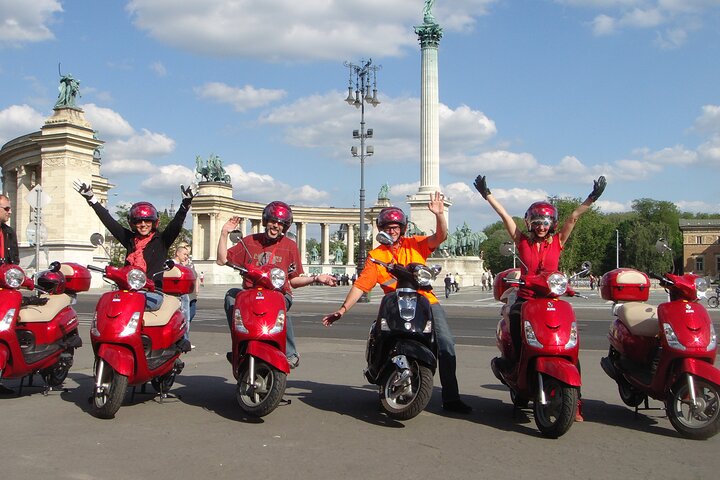
Explore Budapest’s iconic sights on a Vespa night tour. Discover history, culture, and breathtaking views in a unique, thrilling way.
Explore Budapest’s iconic sights on a Vespa night tour. Discover history, culture, and breathtaking views in a unique, thrilling way.
- Vámház körút - TOUR START/FINISH Begin your adventure with a brief riding lesson, then set off to explore the Pest side of the city, celebrated for its sophisticated 19th-century architecture. Journey along the stunning Danube riverbanks and bridges, and the refined Andrassy Avenue, admiring the Opera House and grand 19th-century palaces. Visit…
- Vámház körút - TOUR START/FINISH Begin your adventure with a brief riding lesson, then set off to explore the Pest side of the city, celebrated for its sophisticated 19th-century architecture. Journey along the stunning Danube riverbanks and bridges, and the refined Andrassy Avenue, admiring the Opera House and grand 19th-century palaces. Visit Heroes’ Square to gain insights into Hungarian history, then wander through the delightful City Park, home to the Zoo, the Great Circus, Széchenyi Bath, and Vajdahunyad Castle. Be amazed by St Stephen’s Basilica and the Parliament Building, then cross the Danube to explore the Buda side, renowned for its medieval castle and breathtaking hilltop views. Stroll through the cobblestone streets of the historic Buda Castle District, visit the Royal Palace and the iconic Matthias Church, and enjoy the spectacular view from Fisherman’s Bastion, Budapest’s most famous lookout. Finally, ascend to the Citadel and Liberty Statue atop Gellert Hill to admire the unmatched view of Budapest.
- Central Market Hall - The Great Market Hall, located on the Pest side of Liberty Bridge, is Budapest’s largest and most beloved market hall. This 150-meter-long, three-story brick building, supported by a cast-iron frame, was constructed in 1896 by Hungarian architect Samu Pecz. The historicist main facade is adorned with Zsolnay ceramic tiles. The market hall is a paradise for food enthusiasts. Hungarian sausage and salami, goose liver, and sweet paprika powder are just a few of the many Hungarian delicacies available here. In its numerous food outlets, visitors can sample traditional Hungarian dishes like goulash soup or lángos (scone) and even purchase souvenirs. The Great Market Hall is a must-visit tourist attraction, recognized by CNN as the best market hall in Europe.
- Liberty Bridge (Szabadsag hid) - Liberty Bridge, connecting Pest Small Boulevard with Buda, was the third road bridge in Budapest and the first designed by a Hungarian engineer. The city’s shortest bridge was completed for the Millennial celebrations in 1896, commemorating the 1000th anniversary of the Magyar tribes’ Conquest of Hungary, reflected in its ornamentation. The pylons are adorned with historic Hungarian coats of arms and falcon-like mythical Turul birds cast in bronze, perched on gilded orbs with spread wings. Originally named after Austrian Emperor and Hungarian King Franz Joseph I, who attended the opening ceremony and personally hammered the last silver rivet into the iron structure, the bridge was renamed Liberty Bridge after WWII, following its reconstruction.
- Castle Garden - Admire the Castle Garden Bazaar, a stunning 19th-century structure that closes the Castle Gardens on the Danube riverfront.
- Andrassy Avenue - This elegant avenue, famous for the Opera House and grand 19th-century palaces, is often referred to as Budapest’s Champs-Elysées. It was created to link the city center with City Park, which hosted the Millennium Exhibition in 1896, expecting 5 million visitors. The Millennium Underground, running along Andrassy Avenue, transported visitors to the exhibition and was the first subway line in mainland Europe, opened in 1896. Andrassy Avenue and the Millennium Underground were declared World Heritage sites in 2002.
- Hungarian State Opera House (Magyar Allami Operahaz) - The Neo-Renaissance Hungarian State Opera House is Budapest’s most prestigious music hall and is renowned for its exceptional acoustics in Europe. Built in 1884 to the designs of Miklos Ybl, a leading architect of the era who also designed St Stephen’s Basilica, its exterior features statues of world-famous composers. Highlights of its interior include 24-carat gold plating, a lavish bronze chandelier weighing 2 tonnes, and frescoes by the most esteemed Hungarian artists.
- Heroes’ Square - Heroes’ Square, the largest square in Budapest, has been a national landmark for over a century. Located at the end of Andrassy Avenue and surrounded by City Park, Budapest’s largest public park, the square’s centerpiece is the Millennium Monument, a national pantheon of great Hungarian kings and chieftains commemorating the Conquest of Hungary in 896 and the 1000-year Hungarian history. The square is framed by two Neo-Classical palaces: the Museum of Fine Arts, boasting Hungary’s richest painting collection, and the Kunsthalle (Hall of Arts), hosting contemporary art exhibitions. Heroes’ Square, along with Andrassy Avenue, was declared a World Heritage site in 2002.
- City Park - Budapest City Park is the largest and most visited park in Budapest and one of the world’s first public parks. In the Middle Ages, it was King Matthias’s private hunting ground, then in the 16th century, the trees were cut down, and the area was used as pastureland. In the 1700s, Empress Maria Teresa ordered thousands of new trees to be planted, marking the birth of City Park. The park is home to some of the city’s most popular attractions, such as the City Park Boating Lake and Ice Rink, The Zoo, the Great Circus, the iconic Széchenyi Bath, and the fairy-tale Vajdahunyad Castle. Currently, the park is undergoing a comprehensive renewal, involving the renovation of its historic architecture, the construction of new museum buildings like the National Gallery, the Museum of Ethnography, the House of Hungarian Music, the complete rehabilitation of the park’s green area, and the development of its infrastructure.
- Budapest Zoo & Botanical Garden - One of Europe’s oldest zoos, opened in 1866 with 500 animals, partly donated by Emperor Franz Joseph I himself. It features the 34-meter high Big Rock, home to polar bears, the secessionist Elephant House, and an over 100-year-old wooden roller coaster preserved from the former Amusement Park that closed down. The Zoo is currently undergoing a large-scale enlargement, including the creation of a new garden section covering 5 hectares called Pannon Park, showcasing the flora and fauna of the Carpathian Basin. Its central facility is the Biodome, a large indoor park covering 1.7 hectares where visitors can discover wildlife by walking along its paths or cruising along its water canals by boat. A state-of-the-art marine aquarium will evoke the fauna of the Pannon Sea, which once occupied a significant area of the Carpathian Basin.
- Capital Circus of Budapest - The Great Circus, home to acrobatic shows, evolved from the temporary side shows and entertainment facilities operating in City Park since the early 1800s. The first permanent circus opened in 1889, and the current building was constructed in 1971.
- Szechenyi Baths and Pool - One of Budapest’s iconic baths, opened in 1913 in City Park following the discovery of a hot spring beneath the park. The building, resembling a grand Baroque palace, is adorned with remarkable artwork, including statues, mosaics, and fountains. Originally, the bath was divided into men’s and women’s sections, but since the 1980s, it has been mixed. The outdoor pools, added in 1927, were extended in the late 1990s with new features such as a whirling corridor, underwater effervescence production, neck shower, water beam back massage, and more. During the day, elderly men play chess in the pool, reminiscing about the good old times, while at night, massive dance parties entertain the young. Today, the bath boasts 18 pools in total: 15 indoor and 3 outdoor pools, making it the largest public bath in Europe. The water temperature of the pools ranges from 18 to 40 Celsius. Finnish saunas, steam baths, massage, and beauty treatments are also available.
- Vajdahunyad Castle (Vajdahunyadvar) - The castle, located on a small island surrounded by the Boating Lake, is a dominant feature of City Park and one of the most romantic places in Budapest. Originally made of wooden planks and cardboard designs, it was intended as a temporary structure for the Millennial Exhibition of 1896 to showcase Hungarian architecture. The Hungarians loved the castle so much that after the exhibition closed, it was rebuilt in stone. Designed by Hungarian architect Ignác Alpár, it blends the most characteristic details of 21 well-known historic buildings from all over Hungary into a composite fairy-tale castle. The most striking element is the replica of the Transylvanian Castle of Vajdahunyad, once called the King of Castles, now found in Romania. Locals named the entire castle after this part, Vajdahunyad Castle, a name that eventually stuck.
- Varosligeti Mujegpalya Es Csonakazoto - The boating lake surrounding the fairy-tale Vajdahunyad Castle was one of City Park’s first attractions. It is still in use today, with modern pedal boats replacing the old-school rowing boats. Since 1870, the lake has been transformed into an ice rink every winter, making it the oldest ice skating rink in Europe.
- Four Seasons Hotel Gresham Palace Budapest - The Secession-style palace, built in 1906, served as the office building and staff residence for the London-based Gresham Insurance Company. After WWII, the building became state property, and the suites were converted into smaller flats. In 2004, the government sold the building, which was transformed into a luxury hotel.
- Hungarian Academy of Sciences - The Hungarian National Academy of Sciences was founded in 1825 at the initiative of Count István Széchenyi, a renowned Hungarian aristocrat and statesman, who offered a one-year income from his estates for its establishment. The Neo-Renaissance building, inaugurated in 1865, stands on Széchenyi Square, overlooking Széchenyi Chain Bridge, both named in his honor.
- Szechenyi Lanchid - Széchenyi Chain Bridge (Széhenyi Lánchíd) is Budapest’s first permanent bridge, a national landmark, and a legacy of a remarkable period in Hungarian history when Hungary experienced great economic and cultural prosperity, and Budapest developed into a flourishing European metropolis. Built in 1849 at the initiative of renowned Hungarian aristocrat and statesman Count Istvan Széchenyi and designed by Englishman William Tierney Clark, the Scottish engineer Adam Clark supervised its construction and later designed the Tunnel on the Buda side of the bridge. After the bridge’s construction, the formerly separate cities of Pest and Buda were unified and renamed Budapest. The famous lion sculptures adorning the bridgeheads were added in 1852. Legend has it that the lions lack tongues because the sculptor forgot to create them, and he was so criticized that he committed suicide.
- Buda Castle Tunnel - The 350-meter-long tunnel running across Castle Hill was built in 1857 to provide easier access to the Chain Bridge without climbing the hill. Designed by Scottish engineer Adam Clark, who also supervised the Chain Bridge’s construction, the square framed by the Tunnel and the Chain Bridge bears his name in his honor. The Zero Kilometer Stone, marking Budapest’s official center from where major national roads start and distances are measured, stands on the square. The Tunnel’s rooftop terrace is a good vantage point and a popular spot for romantic couples.
- Budapest Castle Hill Funicular - The historic cable car, carrying passengers from the foot of Castle Hill to the hilltop, was completed in 1870. It was created to provide faster access to the Court Theater and government offices on Castle Hill, which could not be reached by other public transport means. Its lower terminal was placed near the Chain Bridge, a major traffic junction for horse-drawn trams and omnibuses, and the upper terminal was built near the Royal Palace. It can carry 24 passengers in each of its two cars, running parallel upwards and downwards on the 95-meter-long track. The funicular was destroyed by a bomb attack in WWII and dismantled after the war. In 1986, it was reopened with modernized engineering, and in 1987, it was declared a World Heritage site.
- Matthias Church - Matthias Church is one of Budapest’s most famous national landmarks and one of its oldest historic monuments. King Bela IV, who built Buda Castle after the Mongol invasion, founded the Romanesque church in 1270. King Matthias, who held both his weddings in the church, built the 76-meter-high main steeple in 1470, giving the church its commonly used name, Matthias Church. In 1541, Buda Castle was taken by the Turks, and the church was turned into a mosque for 145 years. Following the recapture of Buda Castle from the Turks in 1686, it was rebuilt in Baroque style. In 1867, Austrian Emperor Franz Joseph I and Empress Elizabeth were crowned king and queen of Hungary here, marking the Austro-Hungarian Empire’s beginning. The church regained its original Gothic character following a major reconstruction led by Frigyes Schulek between 1867 and 1896. The last king of Hungary, Charles IV, was crowned here in 1916.
- Fisherman’s Bastion - Fisherman’s Bastion is Budapest’s most famous lookout. The building, reminiscent of a fairy tale castle adorned with towers, terraces, staircases, and archways, was built in 1902 to the designs of Frigyes Schulek, who led Matthias Church’s reconstruction. By his concept, the outdated walls behind the church were replaced by a new yet medieval-looking Neo-Romanesque structure. Even Emperor Franz Joseph I, who visited the lookout in 1903, was stunned by the view, which was very different from what he saw 35 years earlier when he was crowned king in Matthias Church. By this time, Budapest had developed into a flourishing metropolis, and nearly all its famous landmarks can be seen from here: the Parliament Building, St Stephen’s Basilica, the Chain Bridge, Gellert Hill with the Citadel and Liberty Statue, Margaret Island, and many more. Its name honors the brave fishermen who defended this stretch of the wall during sieges.
- Church of Saint Mary Magdalene - One of Budapest’s oldest churches, built around Buda’s foundation in the 1240s. During the Turkish occupation in the 16th century, it remained the last functioning place of Christian worship, shared by Catholics and Protestants. The church was badly damaged in WWII and was demolished after the war, except for its 15th-century tower, the only medieval monument in the Buda Castle District maintained in its original form.
- Gellert Hill Cave - The cave houses the Cave Church, built by the Pauline fathers in 1926, modeled after the Lourdes Grotto, a similar rock construction in France. In the Middle Ages, the cave was known as “Saint Ivan’s Cave,” named after a hermit who lived there and healed the sick with the magical hot spring. In the 19th century, a poor family inhabited it, building a small shed at the cave’s mouth used as an animal yard. By the early 1900s, the cave was abandoned, and in 1926, the Pauline fathers erected a chapel inside. In 1931, the cave was enlarged by controlled blasting and later extended with a monastery. In 1951, communist authorities dissolved the Pauline Order and sealed the cave’s entrance with a concrete wall. The church reopened after the communist regime’s fall in 1989.
- St. Gellert Thermal Bath and Swimming Pool - Budapest is known as the City of Baths, and Gellert Bath, located at Gellert Hill’s foot, is one of the most famous. The first bath was established here by King Andrew II in the 13th century, where his daughter Saint Elisabeth healed the leprous. The “magical healing spring” healed the sick for centuries, but the bath remained modest. Following Liberty Bridge’s construction, the city decided to replace the old bath with an upscale spa hotel. The Grand Hotel Gellert and Bath was completed in 1918 and soon became Budapest’s flagship hotel. Among its guests were celebrities like Dutch Queen Juliana, Cardinal Pacelli (later Pope Pius XII), and American President Richard Nixon. The bath is famous for its secessionist interior, featuring stained glass windows, mosaic floors, and ceramic ornaments by the renowned Zsolnay porcelain factory. The outdoor wave pool, producing artificial waves, is also a popular attraction.
- Citadel - The military fort atop Gellert Hill was built in 1854 by Austrian general Haynau after crushing the Hungarian War of Independence in 1849. It was built not to defend but to threaten the Hungarians, earning the locals’ nickname “the Bastille of Budapest.” Following the Compromise with Austria in 1867, Austrian troops abandoned the fortress, and it became city property. Its demolition was considered, but the city lacked funds, so it remained. During WWII, Nazi German troops used it as an air defense base, and after the war, it served as a hotel, restaurant, casino, and even a dance club. Currently, it is undergoing a large-scale reconstruction, involving the creation of a new lookout terrace, a museum, new catering facilities, and a cable car construction is also planned. The terrace in front of the Citadel is one of the city’s most famous lookouts, offering an unparalleled view of Budapest.
- Liberty Statue - The 40-meter-tall Liberation Monument was erected atop Gellert Hill in 1947 to commemorate the Soviet liberation of Hungary, ending WWII and marking the beginning of communist rule. It represents a female figure holding a palm leaf symbolizing liberty. Two smaller bronze statues at the base depict a man holding a torch symbolizing progress and a man fighting a dragon symbolizing victory over fascism. During the 1956 anti-Soviet uprising, rebels tried to topple it but only managed to remove the 6-meter-tall statue of the Soviet soldier, which stood on the lower pedestal. The statue was restored and stood there until the communist regime’s fall in 1989 when it was relocated to Memento Park among 42 giant statues that decorated the city during the communist dictatorship. In 1990, after the last Soviet troops left Hungary, the monument was renamed Liberty Statue.
- Elisabeth Bridge - Completed in 1902, Elisabeth Bridge was named after Queen Elisabeth, assassinated by an Italian anarchist in Geneva in 1899. Until 1926, it was the world’s longest chain bridge, spanning the Danube with a single 290-meter span. In 1945, retreating German troops blew up the bridge, destroying the Buda side pylon and causing the bridge to collapse. However, the Pest side pylon remained intact and stood as a war memento until the bridge’s reconstruction began in 1960. After lengthy discussions, in 1959, the decision was made to replace the former chain bridge with a new cable bridge in the same location, utilizing its original abutments. The new Elisabeth Bridge was completed in 1964, designed by Hungarian engineer Pál Sávoy, who preserved the former bridge’s silhouette in a modern shape. Elisabeth Bridge was the only bridge in Budapest not restored to its original form after the war.
- Hungarian National Museum - Admire the classical-style palace of the Hungarian National Museum, the city’s oldest museum.

- Certified English-speaking guide
- Easy-to-ride scooter with automatic gear
- Intercom radio with a headset to listen to your guide during riding
- Fuel
- Third party liability insurance
- Safety helmet
- Certified English-speaking guide
- Easy-to-ride scooter with automatic gear
- Intercom radio with a headset to listen to your guide during riding
- Fuel
- Third party liability insurance
- Safety helmet
- Hotel pick up-drop off
- Meals, drinks are not included
- Gratuities
- Hotel pick up-drop off
- Meals, drinks are not included
- Gratuities
Join the Budapest Night Vespa Tour for a unique and relaxed exploration of the city on a Vespa. This remarkable 3-hour evening tour allows participants to discover Budapest’s renowned attractions and breathtaking views while gaining insights into Hungarian history and culture.
TOUR HIGHLIGHTS
» Experience Budapest on an extraordinary evening Vespa…
Join the Budapest Night Vespa Tour for a unique and relaxed exploration of the city on a Vespa. This remarkable 3-hour evening tour allows participants to discover Budapest’s renowned attractions and breathtaking views while gaining insights into Hungarian history and culture.
TOUR HIGHLIGHTS
» Experience Budapest on an extraordinary evening Vespa tour
» Discover the scenic Danube riverbanks and bridges of Budapest
» Cruise along the World Heritage Andrassy Avenue, the city’s most famous boulevard, and admire the Opera House
» Visit the grand Heroes Square and delve into Hungary’s 1000-year history
» Explore the delightful City Park
» Tour the World Heritage Buda Castle District, featuring the iconic Matthias Church, and enjoy the stunning views from Fisherman’s Bastion, the city’s most famous lookout
» Be amazed by the beautiful view of illuminated Budapest from Gellert Hill, the highest point in the city, topped with the Citadel and the Liberty Statue
- Regular driver’s licence is required a must be presented at check-in
- Drivers under 18 years of age must be accompanied by an adult
- No previous scooter riding experience required but a good bicycle riding skill is essential. Don’t worry if you have never ridden a scooter before. We will start the tour with a short practice before we hit the roads
- Motorcycle licence is required if you want to ride a 125 cc scooter with passenger (optional)
For a full refund, cancel at least 24 hours before the scheduled departure time.
For a full refund, cancel at least 24 hours before the scheduled departure time.