Embark on a 13-day private guided tour of Romania from Bucharest and immerse yourself in a rich sensory experience. Explore medieval sites, venture into the wilderness, and indulge in delicious traditional foods. Discover the beauty of Romania with a local guide!
Embark on a 13-day private guided tour of Romania from Bucharest and immerse yourself in a rich sensory experience. Explore medieval sites, venture into the wilderness, and indulge in delicious traditional foods. Discover the beauty of Romania with a local guide!
Bucharest City Tour - Overnight in Bucharest
Palace of Parliament - During a day trip to Bucharest, explore one of the world’s most debated administrative buildings. This private tour of The Palace of Parliament, also known as the People’s House, offers insights into the dangers and destruction a totalitarian regime like communism can inflict on…
Bucharest City Tour - Overnight in Bucharest
Palace of Parliament - During a day trip to Bucharest, explore one of the world’s most debated administrative buildings. This private tour of The Palace of Parliament, also known as the People’s House, offers insights into the dangers and destruction a totalitarian regime like communism can inflict on a nation. Standing before one of the largest constructions globally, you’ll feel dwarfed by the extravagant opulence and megalomania that “the sleep of reason” can produce.
Capturing a selfie up-close might be challenging, as you’ll be attempting to photograph the second-largest administrative building on Earth, after the Pentagon, creating a memorable experience to share with future generations.
Muzeul National al Satului “Dimitrie Gusti” - On this private tour, visit The Bucharest National Village Museum, where Romanian traditions come to life. Discover how Romanian villagers created an ecological and sustainable environment in their backyards, and gain insight into their simple, modest lifestyle, living in social and spiritual harmony with nature.
Ateneul Roman - Next, your private tour takes you to the Romanian Athenaeum, a symbol of Romanian culture and often considered an emblem of Bucharest.
Piata Revolutiei - Planning a city break in Bucharest? Don’t miss The Revolution Square, a site of immense historical importance. Here, you can step back in time to when dictator Ceausescu was overthrown, leaving behind secrets of a vast fortune and controversies surrounding the state security service and his offshore accounts.
As mentioned earlier, upon reaching the Senate Palace, you’ll see the building that once housed the Central Committee of the Romanian Communist Party, where the December 1989 Revolution began, a pivotal historical event that led to Ceausescu’s permanent removal from power.
Old Town - On a Bucharest day trip, experience the charm of the past through a blend of mystery and contrasts in the Historical City Centre, starting with Hanul lui Manuc, a massive fortified inn that served as a cultural and economic hub in its time. Built around 1806 by Manuc Bei, one of the wealthiest landowners in the Balkans, it was a gathering place for merchants passing through Bucharest, part of the vibrant crowd that filled the historic inn.
In this historical and cosmopolitan area, with your private guide’s assistance, you’ll discover not only Bucharest’s most popular restaurants but also museums, old and spectacular churches, and an experiential library where you can purchase books, music, and other souvenirs, ensuring an unforgettable experience for you and your loved ones.
Curtea de Arges Monastery; Poienari Castle and Transfagarasan Highway - Overnight in Sibiu
Curtea de Arges Monastery - Did you know Curtea de Arges is unique for its significant royal tombs? It’s well-known that truly good, beautiful, and enduring things come only through sacrifice, which becomes evident when you visit the old town of Curtea de Arges. With a rich and eventful history, this is where you can see the ruins of the Wallachian princely court, the 13th-century Royal Church, and the famous Arges Monastery, an important historical monument with a fascinating yet somber story.
Poienari Castle - The ruins of Poienari Fortress stand high on a cliff overlooking the Arges River, at the foothills of the Carpathian Mountains. Built at the beginning of the 13th century by the first Wallachian rulers, the castle changed names and residents several times over the decades; eventually, it was abandoned and left in ruins.
Recognizing the location’s potential, upon taking the throne, he ordered the structure to be repaired and fortified, transforming it into one of his main fortresses. When the Turks attacked and captured the castle in 1462, Vlad escaped through a secret passageway leading north through the mountains.
Transfagarasan Highway - Spanning over 150 kilometers, the Transfagarasan Highway is Romania’s most spectacular and renowned road, gaining fame from its appearance on BBC’s Top Gear in 2009, making it one of the country’s most popular tourist attractions. Fully open only from June to October, the road’s highest point is at 2042 meters: the tunnel linking the northern and southern sides at Lake Balea (Balea Lac).
Big Square (Piata Mare) - If you’re in Transylvania, Sibiu is a must-visit travel destination with a 900-year history. A city tour will help you understand why Sibiu was chosen as the European Capital of Culture, including the Evangelical Cathedral, the Sibiu Old City Center, and the town itself, which are among Romania’s most visited tourist attractions, catering to every taste and providing a wonderful travel experience for even the most discerning tourists.
For those who love authentic cultural experiences, whether romantic or adventurous, here you’ll find everything needed to relax and enjoy yourself, leaving everyday stress behind for a fun and memorable trip.
The beauty of this ancient citadel, having received record-breaking recognition, stems from its architecture, street layout, cultural and artistic heritage, and stunning natural scenery, as the town is flanked on two sides by the Fagaras and Lotru mountains.
Corvin Castle / Densus Church / Sarmisegetusa Regia - Overnight in Sibiu
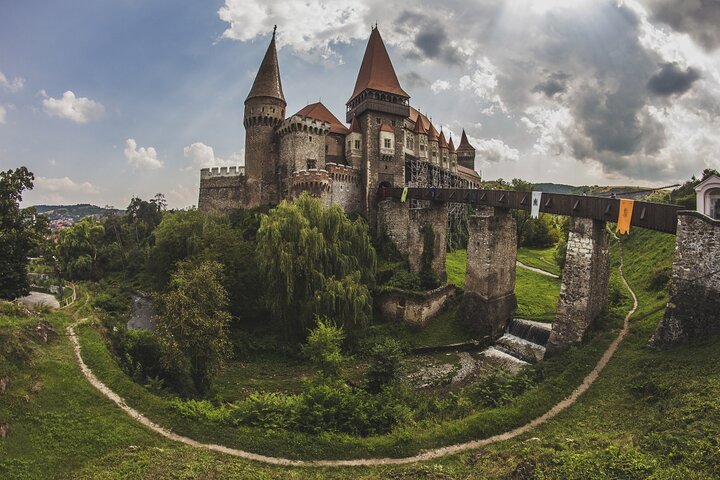
Castelul Corvinilor - Corvin Castle, also known as Hunyadi Castle or Hunedoara Castle (Romanian: Castelul Huniazilor or Castelul Corvinilor; Hungarian: Vajdahunyadi vár), is a Gothic-Renaissance castle in Hunedoara, Romania. It is one of Europe’s largest castles and is featured as one of the Seven Wonders of Romania.
Densus Church - The Densuș Church (also known as St Nicholas’ Church) in the village of Densuș, Hunedoara County, is the oldest stone church in Romania.
Built in its present form in the 13th century on the site of a 2nd-century Roman temple, with some materials from the Dacian Sarmizegetusa fortress, it has a stone tower above the naos. Inside the church, there are 15th-century mural paintings depicting Jesus in Romanian traditional clothes, created by artist Ștefan. In the 18th century, more paintings were added by Simion de Pitești.
Sarmizegetusa Regia - Sarmizegetusa Regia, also known as Sarmisegetusa, Sarmisegethusa, Sarmisegethuza, Ζαρμιζεγεθούσα (Zarmizegethoúsa), or Ζερμιζεγεθούση (Zermizegethoúsē), was the capital and most important military, religious, and political center of the Dacians before the wars with the Roman Empire. Erected on top of a 1200 m high mountain, the fortress, comprising six citadels, was the core of a strategic defensive system in the Orăștie Mountains.
Biertan Fortified Church / Turda Gorge Hiking / Alba Iulia City Tour - Overnight in Alba Iulia
Biertan Fortified Church - The Biertan Fortified Church, a historical monument of breathtaking beauty, was one of the first Transylvanian Saxon settlements in Ardeal, and today it is a UNESCO World Heritage site. Hundreds of tourists visit each year, and upon arrival, you’ll discover what makes this place special.
Located in a small town dating back to 1224, the church impresses with its stunning scenery and unique construction – built on a hillock in the town center, surrounded by three defensive walls and seven bastions.
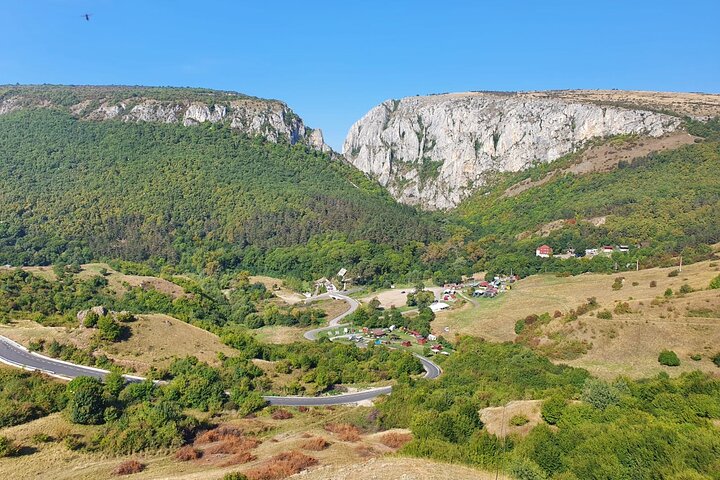
Cheile Turzii - Cheile Turzii, as it’s known in Romanian, is a natural reserve roughly 40 kilometers south of Cluj-Napoca, Transylvania’s capital city. Compared to the dramatic mountains elsewhere in Romania, the terrain around Cluj is relatively uneventful, with long expanses of soft, rolling hills making up the countryside.
Unlike some of the more intense, multi-day hikes found in Romania, hiking Turda Gorge is relatively easy for the average person. There are several routes to choose from, varying in distance and difficulty. The easiest is simply walking through the bottom of the gorge itself.
Follow the cool path alongside a tranquil stream, flanked by steep stone walls. Several small bridges and steel cables in certain spots make any tricky areas passable by almost any able-bodied person. The hike from one end to the other takes roughly 1 1/2 hours, more or less depending on how much you take in the scenery.
Cetatea Alba Iulia - The Alba Carolina Citadel (Romanian: Cetatea Alba Carolina, Hungarian: Gyulafehérvári vár) is a star-shaped fortress located in Alba Iulia. Construction began on November 4, 1715, during Habsburg rule in Transylvania, and was completed in 1738. 20,000 serfs were involved in its construction, estimated to have cost around 3 million guldens. The citadel was built on the site of two other fortifications: the legionary fortress of Legio XIII Gemina (known as Apulum) and the medieval Balgrad citadel.
The citadel’s shape, an iconic element of Vauban architecture, influenced the design of Alba Iulia’s city logo when the city adopted city branding in 2014. The city received 47.5 million lei in 2009 for the restoration and conservation of the citadel.
The citadel is named after Charles VI, known as Carol VI in Romanian, who was the Holy Roman Emperor at the time of its construction.
Turda Salt Mine / Cluj Napoca City Tour (Botanic Garden) / Surdesti Wooden Church - Overnight in Sighetul Marmatiei
Salina Turda - Turda Salt Mine is likely one of the most fascinating places to visit in Transylvania. If you have the opportunity to spend your vacation in Romania, it would be a shame not to explore one of its most beautiful sites, the Turda Salt Mine.
This location is a feast for the eyes and the body, as the purifying saline air is especially beneficial for those with respiratory issues, such as allergies or asthma.
Gradina Botanica “Alexandru Borza” - If you pass through Transylvania during your trip to Romania, a Cluj Napoca City Tour should definitely be on your itinerary. Get your camera ready, as the Old City Center features numerous unique historical and architectural monuments, Baroque, Renaissance, and Gothic-style buildings, the oldest dating back to the 17th century, along with friendly and welcoming people.
Not to mention the restaurants and delicious local cuisine, which are so popular that you might have to wait in line before you can get a table and enjoy your meal.
Surdesti Wooden Church - Nothing compares to the characteristic warmth that wooden constructions exude, but the Surdesti church has much more to offer. Visitors are often so awe-struck they tip their hats – not exactly a joke, considering the church’s tower measures an impressive 54 meters.
Imagine the kind of artwork and craftsmanship that must have gone into this 72-meter high wooden gem, a challenging task even with modern technology, and when you consider it was built in 1721, you can understand why it is considered an architectural masterpiece.
Explore Maramures all day (local market) / Merry Cemetery / Sighet Memorial Museum - Overnight in Sighetul Marmatiei
Merry Cemetery - This trip to Romania promises not only history, culture, and adventure but also fun.
The Dacians, our brave and wise ancestors who worshiped the god Zalmoxis, would laugh at funerals and cry when babies were born.
In Maramures, traces of historical continuity can still be found, most notably in Sapanta, home of the one and only Merry Cemetery.
The crosses and tombstones, each a skillful and colorful work of art, bear humorous poems about the deceased that will have you in stitches.
Memorial of the Victims of Communism and of the Resistance - To understand why the Romanian people fought so hard to escape communist oppression, visit the Memorial Museum for the Victims of Communism, and you’ll begin to comprehend the damage the totalitarian regime caused and the pain and suffering it brought in such a short time.
A day for yourself - Barbeque and Romanian Folk Show included
Maramures County - Enjoy Maramures County and admire the nature!
Barsana Monastery / Borgo Pass Road / Ciocanesti village - Overnight in Gura Humorului
Barsana Monastery - One of the tallest wooden churches in Romania (57m height)
Just as you feel the eternal, primordial connection with the earth when walking barefoot through the grass, you’ll experience a spiritual connection with the sky and God as you step into the courtyard of Romania’s most beautiful wooden monastery, the Barsana Monastery.
If you think you’ve seen astonishing places before, of such divine beauty that they felt like a piece of heaven on earth, this trip to Maramures might make you reconsider.
With its fairytale scenery and timeless history, this magical place has fascinated both tourists and locals for hundreds of years.
Tihuța Pass - Tihuța Pass (Romanian: Pasul Tihuța, also called Pasul Bârgău; Hungarian: Borgói-hágó or Burgó) is a high mountain pass in the Romanian Bârgău Mountains (Eastern Carpathian Mountains) connecting Bistrița (Transylvania) with Vatra Dornei (Bukovina, Moldavia).
The pass gained fame from Bram Stoker’s novel Dracula, where, referred to as “the Borgo Pass,” it served as the gateway to Count Dracula’s realm. Stoker likely found the name on a contemporary map; he never actually visited the area.
Today, the pass is home to Hotel “Castel Dracula”; located at an elevation of 1,116 m (3,661 ft), the hotel was built in 1976 and adopted its current name after 1989. The hotel has become quite an attraction due to its architectural style of a medieval villa, as well as its connection to the novel. In 2018, the property was put up for sale.
Voronet Monastery / Humor Monastery / Sucevita Monastery/ Moldovita Monastery - Overnight in Gura Humorului
Manastirea Voronet - The Voroneț Monastery is a medieval monastery in the Romanian village of Voroneț, now part of the town Gura Humorului. It is one of the famous painted monasteries from southern Bukovina, in Suceava County. The monastery was constructed by Stephen the Great in 1488 over a period of 3 months and 3 weeks to commemorate the victory at the Battle of Vaslui. Often known as the “Sistine Chapel of the East,” the frescoes at Voroneț feature an intense shade of blue known in Romania as “Voroneț blue.”
Did you know that Voronet Monastery was founded by Stephen the Great?
Dubbed the “Sistine Chapel of the East,” it attracts tens of thousands of tourists from around the world every year, boasting at least three unique elements that make it a highlight of your trip through Moldavia and Bucovina.
The most impressive aspect of the church’s artwork, both inside and outside, is the exceptional background color – the famous Voronet blue!
Humor Monastery - To understand the importance of religion to our people, you must tour Romania and see the sheer number of houses of worship built and destroyed by enemies throughout history.
Striving to protect their spiritual treasures, people erected churches away from the world’s eyes, some hidden in the depths of the woods, others nestled within rock caves at high altitudes.
Humor Monastery, built approximately 500 years ago, is an example of a fortified monastery that has endured over the centuries.
After the first church here, built around 1400, was destroyed, the second one, built in 1530 with thick river rock walls, was meant to be a place of worship that would withstand the test of time.
Sucevita Monastery - Sucevita and Voronet are two of the most beautiful Romanian Monasteries, part of the international cultural and spiritual patrimony, which is why they should be included in any trip to Romania and northern Moldavia.
Even if you haven’t read the Bible, or the Book of Books, the biblical scenes and icons painted on the walls of the Sucevita Monastery will provide stunning and vivid visual support in understanding the history of Christianity.
The fortified church is like an open book for anyone who enters its doors, and only once you see it in person will you truly understand why it was included on the UNESCO World Heritage list of cultural landmarks.
Moldovita Monastery - If you want to embark on a spiritual journey to a place that still echoes with the fervent prayers of the hundreds of thousands of people who have found solace here over the course of history, take your adventure through the Carpathians and Balkans to one of Romania’s oldest monastic settlements, built in 1532, home of the Moldovita Monastery.
The fortified church combines elements of Byzantine, Gothic, and Moldavian style, but what truly impresses visitors is its unique mural artwork, both inside and outside this beautiful house of worship.
Lucia Condrea - egg painted museum / Nicolae Popa Museum / Bicaz Gorges - Overnight Stay in Sighisoara
Muzeul International al Oualor Lucia Condrea - Starting in the summer of 1993, artist Lucia Condrea opened a museum in Moldovita (Bukovina, Suceava- Romania) that bears her name, unique in Romania and possibly the world, considering the artistic value of the exhibits. The museum contains over 5500 exhibits, artistically arranged across two levels of the building in 56 display cases.
The Popa Museum - Located 12 kilometers from Targu Neamt, in Tarpesti, Neamt County, you can visit an interesting and notable sight, the Nicolae Popa Museum. Founded in the ‘70s by local sculptor Nicolae Popa, in his own house.
After being wounded in World War II, imprisoned by the communists for opposing the regime, and left with only his house, Nicolae Popa decided to stand up for Romanian values. With hard work and dedication, driven by a strong natural inclination for art, he became one of Romania’s most valued and appreciated naive sculptors and a true creator of folklore.
Bicaz Canyon - What could be more beautiful than a walk along the banks of a river that has carved its way through the mountains and virgin forests of Romania?
Sighisoara City Tour/ Viscri Village / Rupea Fortress - Overnight stay in Brasov
Viscri Fortified Church - Viscri is best known for its white fortified church, first mentioned in 1400 as Alba Ecclesia. Like most monuments of the time, the church underwent different construction phases. The local Szekler population was the first to build a small church on the site in the early 12th century. Decades later, German colonists took control of the land and started a new chapter in its history.
During the 13th century, they built the main tower on the west side and enlarged the church’s nave towards the east. Its fortification began later, during the 15th century, and is partially preserved today. Parts of its fortification elements were demolished after the Ottoman threat disappeared or were repurposed for more peaceful uses like storage rooms and kindergarten space.
Cetatea Rupea - Rupea Fortress (Romanian: Cetatea Rupea, German: Burg Reps, Hungarian: Kőhalmi vár) is a medieval fortress built by Transylvanian Saxons and first mentioned in a 1324 document. It is situated on a 120 m high basalt cliff, west of the Transylvanian town of Rupea in Romania. The fortress is located on DN13, 70 km from Brașov, on the road to Sighișoara. It was restored in 2010–2013 and as of 2014, it was visited each month by more than 10,000 tourists.
Brasov City Tour (Black Church) / Bran Castle / Dracula’s Castle / Peles Castle - Overnight stay in Brasov
Black Church (Biserica Neagra) - Next, journey to the beautifully-preserved medieval town of Brasov, in the foothills of the Carpathian Mountains. Your guide will lead you on a walking tour of the Old Town, where you’ll discover the Black Church, the Old Town square, and city walls built in the Middle Ages. You’ll have free time to absorb the unparalleled atmosphere in one of Brasov’s many charming cafés.
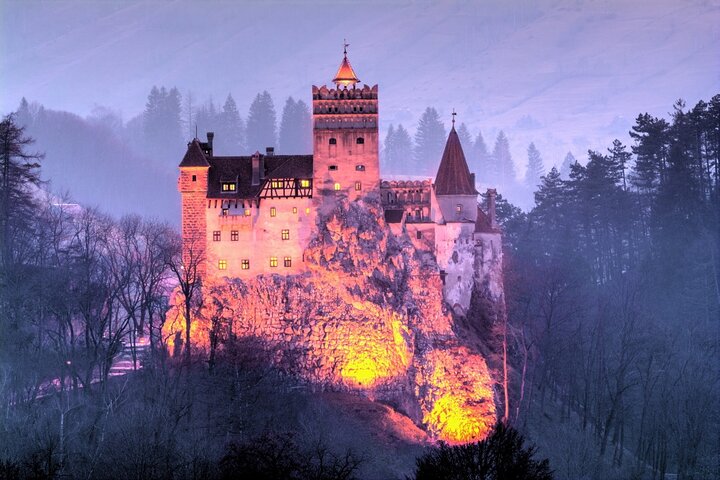
Bran Castle (Dracula’s Castle) - Bran Castle, between myth and history.
Because his fictional portrayal of Dracula’s castle matches Bran so closely, it is widely believed that Bram Stoker must have used descriptions of it to create the fictitious home of Count Dracula.
Outside the castle, you’ll have the chance to try an array of traditional foods: handmade cheeses, pálinka (plum and pear brandy), and traditionally-produced ham and sausages.
Peles Castle - Once upon a time, there was a beautiful castle…
If you have decided to write your memoirs or want to boast about having seen the most beautiful castles in Europe, the Romanian royal family’s summer residence is, by far, one of the most important tourist attractions in Romania and Europe, and you will soon understand why.
Every year, thousands of important figures and hundreds of thousands of tourists book tours of Romania for this attraction alone, to admire its beauty and, at least for a few hours, feel like royalty.
Prejmer Fortified Church / Muddy Volcanoes / Snagov Monastery - Back to Bucharest
Peasant Fortified Church at Prejmer - The Prejmer fortified church (Romanian: Biserica fortificată din Prejmer; German: Kirchenburg von Tartlau) is a Lutheran fortified church in Prejmer (Tartlau), Brașov County, in the Transylvania region of Romania and the ethnographic area of the Burzenland. The church was founded by the Germanic Teutonic Knights and was eventually taken over by the Transylvanian Saxon community. Initially Roman Catholic, it became Lutheran following the Reformation. Together with the surrounding village, the church forms part of the villages with fortified churches in Transylvania UNESCO World Heritage Site.
Vulcanii Noroiosi (Muddy Volcanoes) - The Berca Mud Volcanoes (Romanian: Noroioși de la Pâclele Mici) is a geological and botanical reservation located in Scorțoasa commune close to Berca in Buzău County in Romania. Its most spectacular feature is the mud volcanoes, small volcano-shaped structures typically a few meters high caused by the eruption of mud and natural gases.
As the gases erupt from 3000 meters deep towards the surface, through the underground layers of clay and water, they push up underground salty water and mud, so that they overflow through the mouths of the volcanoes, while the gas emerges as bubbles. The mud dries off at the surface, creating a relatively solid conical structure resembling a real volcano. The mud expelled by them is cold, as it comes from inside the Earth’s continental crust layers, and not from the mantle.
Snagov Monastery - Romanians have often been amused that a work of fiction made The Tomb of Dracula/Vlad Tepes (the Impaler) and Bran Castle two of the most visited tourist attractions in Romania. To this day, the myth continues to fascinate any tourist visiting Romania, even those not particularly interested in vampires…
Everyone knows the legend of Dracula, which has traveled the world through its many portrayals in literature and cinema.
Imagine how many likes a picture of you in front of Dracula’s tomb would get. We guarantee it will make all your friends, if not jealous, at least terribly curious.
Taking this trip will not only leave you with beautiful memories from Romania, but it will also give you the satisfaction of having uncovered the mysteries of Dracula.

- Private car (Tourism or Minibus) only for you and your friends/family
- Accommodation, meals and entrance fees for the guide
- A private, licensed English-speaking guide/driver, available throughout the tour
- All car expenses, such as gasoline, parking and road tolls
- Complimentary wireless internet access in a comfortable car
- Great flexibility…
- Private car (Tourism or Minibus) only for you and your friends/family
- Accommodation, meals and entrance fees for the guide
- A private, licensed English-speaking guide/driver, available throughout the tour
- All car expenses, such as gasoline, parking and road tolls
- Complimentary wireless internet access in a comfortable car
- Great flexibility regarding changes to the daily itinerary even after the start of the tour
- Accommodation, meals and beverages
- Entrance fees as per the itinerary
- Accommodation, meals and beverages
- Entrance fees as per the itinerary
Embark on a remarkable 13-day journey through Romania! Our carefully curated itinerary promises a medley of delightful experiences, taking you from historical medieval locales to the untouched beauty of dense forests, vibrant array of wildflowers, and rejuvenating mountain air (depending on the season). The journey extends to contemporary exhibits,…
Embark on a remarkable 13-day journey through Romania! Our carefully curated itinerary promises a medley of delightful experiences, taking you from historical medieval locales to the untouched beauty of dense forests, vibrant array of wildflowers, and rejuvenating mountain air (depending on the season). The journey extends to contemporary exhibits, punctuated by the tantalizing local cuisine, infused with traditional herbs and spices, sampled in every medieval town we visit.
Experience a unique exploration of Romania and its people – through a 13-day Private Tour led by a local guide. Come, join us!
For a full refund, cancel at least 24 hours before the scheduled departure time.
For a full refund, cancel at least 24 hours before the scheduled departure time.