
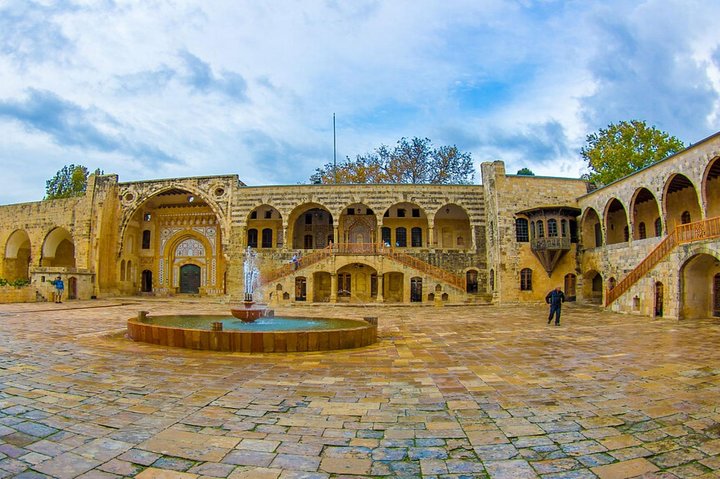


Embark on a guided private tour to Beiteddine Palace, Deir el Qamar, and Cedars Forest. Explore the rich history and architectural beauty of Beiteddine Palace, visit the former capital of Mount Lebanon at Deir el Qamar, and take a scenic trek through the majestic cedar trees at Barouk nature reserve.
Embark on a guided private tour to Beiteddine Palace, Deir el Qamar, and Cedars Forest. Explore the rich history and architectural beauty of Beiteddine Palace, visit the former capital of Mount Lebanon at Deir el Qamar, and take a scenic trek through the majestic cedar trees at Barouk nature reserve.
- Beiteddine Palace - Known as the ‘House of Faith,’ Beiteddine Palace is a 19th-century architectural marvel located in Beiteddine, Lebanon. It is the venue for the annual Beiteddine Festival and houses the Beiteddine Palace Museum. Constructed by Emir Bashir Chehab II, who later ruled the Mount Lebanon Emirate, the palace was built between 1788…
- Beiteddine Palace - Known as the ‘House of Faith,’ Beiteddine Palace is a 19th-century architectural marvel located in Beiteddine, Lebanon. It is the venue for the annual Beiteddine Festival and houses the Beiteddine Palace Museum. Constructed by Emir Bashir Chehab II, who later ruled the Mount Lebanon Emirate, the palace was built between 1788 and 1818. Post-1840, it served as a government building under Ottoman rule and later as a local administrative office during the French Mandate. In 1943, it was designated as the official summer residence of the president. Although it suffered significant damage during the Lebanese Civil War, parts of the palace are now open to the public, while the remainder continues to serve as the president’s summer residence.
- Deir el Qamar - Deir al-Qamar, translating to “Monastery of the Moon,” is a charming village situated southeast of Beirut, just five kilometers from Beiteddine Palace in the Chouf District of Mount Lebanon. It was the first village in Lebanon to establish a municipality in 1864 and is the birthplace of numerous notable figures, including artists, writers, and politicians. The village was home to people of various religious backgrounds and featured a mosque, synagogue, and Christian churches. In 1860, Deir al-Qamar was devastated during the civil war between Druze and Christians, during which the town was set on fire. Napoleon III dispatched a French contingent to rebuild it, reaffirming France’s historical role as protector of Christians in the Ottoman Empire, as established by a treaty in 1523. In 1864, Deir el-Qamar elected the first municipality in the Arab provinces of the Ottoman Empire. The village maintains a stunning picturesque appearance with its traditional stone houses and red-tiled roofs.
- Fakhreddine’s Mosque - Fakhreddine Mosque, featuring an octagonal minaret, is located in Deir el Qamar, Lebanon. Originally built in 1493 and restored in the 16th century by Fakhreddine I, it stands as the oldest mosque in Mount Lebanon.
- Saydet El Talle Church - The Church of Saidet et Tallé, also known as Our Lady of the Hill, is a significant historical and religious landmark in Deir el Qamar, dating back to the 15th century. Monk Nicolas Smisaati constructed a church on this site over the remnants of an ancient Phoenician temple dedicated to the goddess Astarte, which was later destroyed by an earthquake in 859. According to the Maronite Heritage website, a legend tells of a Druze Emir in Baakline who, upon seeing a light emanating from the hill of Dar El Kamar, instructed his soldiers to dig there. He directed them to build a mosque if they found an Islamic symbol and a church if they found a Christian symbol. The soldiers discovered a rock with a cross on it, beneath which were the moon and Venus, indicating that the site was once a temple dedicated to the moon and Venus, which later became a church.
- Barouk Cedar - The Barouk Cedar Nature Reserve is one of Lebanon’s largest nature reserves, located in the Chouf District on the slopes of Barouk Mountain, covering an area of 550 km². It is a favored destination for hiking and trekking, offering trails suitable for all fitness levels. Bird watching, mountain biking, and snowshoeing are also popular activities. The reserve is home to 32 species of wild mammals, 200 species of birds, and 500 species of plants.

- Private transportation
- Tour Leader
- Hotel Pick up & Drop off
- In-vehicle air conditioning
- Private transportation
- Tour Leader
- Hotel Pick up & Drop off
- In-vehicle air conditioning
- Lunch
- Gratuities
- Lunch
- Gratuities
Discover Beiteddine palace, a masterpiece of the early 19th century Lebanese architecture built by Emir Bechir Chehab II around a small Muslim-Druze hermitage. Visit Deir el Qamar, which was the capital of Mount Lebanon from the 16th to 18th centuries and a regional stronghold for the Ottoman Emirs.
Enjoy a short trek among the stunning cedar trees at Barouk nature reserve.
Discover Beiteddine palace, a masterpiece of the early 19th century Lebanese architecture built by Emir Bechir Chehab II around a small Muslim-Druze hermitage. Visit Deir el Qamar, which was the capital of Mount Lebanon from the 16th to 18th centuries and a regional stronghold for the Ottoman Emirs.
Enjoy a short trek among the stunning cedar trees at Barouk nature reserve.
For a full refund, cancel at least 24 hours before the scheduled departure time.
For a full refund, cancel at least 24 hours before the scheduled departure time.


