






Experience the best of Aswan and Luxor in just 3 days and 2 nights with this travel package. Visit top attractions, including the High Dam, Philae Temple, Abu Simbel, Luxor and Karnak Temples, Valley of the Kings, and more. Enjoy comfortable accommodation, private transfers, and expert guidance from your personal Egyptologist. Book now!
Experience the best of Aswan and Luxor in just 3 days and 2 nights with this travel package. Visit top attractions, including the High Dam, Philae Temple, Abu Simbel, Luxor and Karnak Temples, Valley of the Kings, and more. Enjoy comfortable accommodation, private transfers, and expert guidance from your personal Egyptologist. Book now!
Journey from Cairo to Aswan by Air and Explore the Temple of Philae and Aswan High Dam
Temple of Philae - Philae is an island situated in the reservoir of the Aswan Low Dam, downstream from the Aswan Dam and Lake Nasser in Egypt. Originally located near the expansive First Cataract of the Nile in Upper Egypt, Philae was home to an Egyptian temple…
Journey from Cairo to Aswan by Air and Explore the Temple of Philae and Aswan High Dam
Temple of Philae - Philae is an island situated in the reservoir of the Aswan Low Dam, downstream from the Aswan Dam and Lake Nasser in Egypt. Originally located near the expansive First Cataract of the Nile in Upper Egypt, Philae was home to an Egyptian temple complex. Since the initial construction of the Aswan Low Dam in 1902, these rapids and the surrounding area have experienced various levels of flooding. The temple complex was dismantled and relocated to nearby Agilkia Island as part of the UNESCO Nubia Campaign project, which aimed to protect this and other complexes before the Aswan High Dam’s completion in 1970. The hieroglyphic reliefs of the temple complex are being studied and published by the Philae Temple Text Project of the Austrian Academy of Sciences, Vienna (Institute OREA).
Aswan High Dam - The Aswan Dam provides significant benefits to Egypt by controlling the annual floods of the Nile River, preventing damage along the floodplain. The Aswan High Dam supplies about half of Egypt’s power and has enhanced navigation along the river by maintaining a consistent water flow.
Train to Luxor and Explore Luxor Temple, Karnak Temple, Valley of the Kings, Temple of Hatshepsut
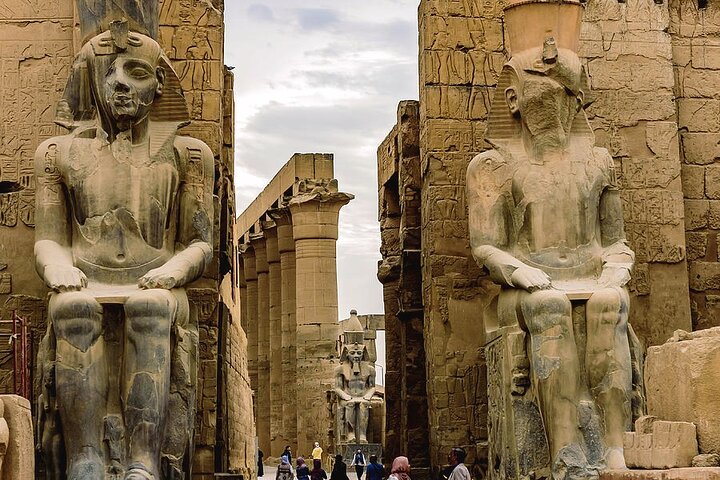
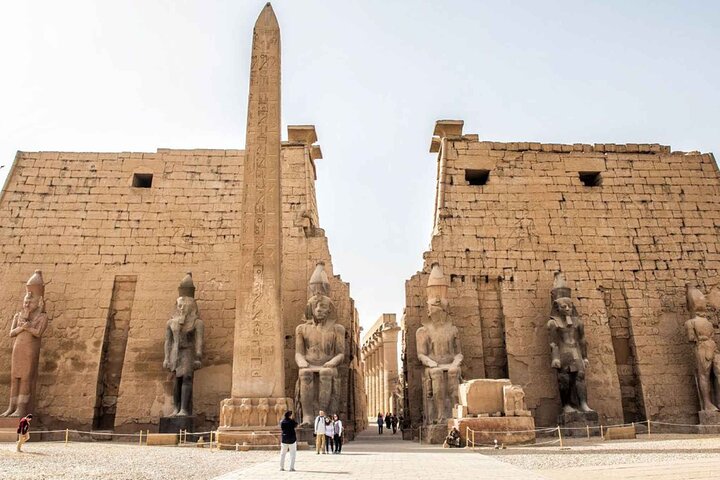
Luxor Temple - Luxor Temple is a large ancient Egyptian temple complex located on the east bank of the Nile River in the city now known as Luxor (ancient Thebes), constructed around 1400 BCE. In the Egyptian language, it is called ipet resyt, “the southern sanctuary.” Luxor boasts several great temples on both the east and west banks. Four major mortuary temples visited by early travelers include the Temple of Seti I at Gurnah, the Temple of Hatshepsut at Deir el Bahri, the Temple of Ramesses II (also known as the Ramesseum), and the Temple of Ramesses III at Medinet Habu. The two primary cult temples on the east bank are Karnak and Luxor. Unlike other temples in Thebes, Luxor Temple is not dedicated to a cult god or a deified version of the pharaoh in death. Instead, it is dedicated to the rejuvenation of kingship and may have been where many pharaohs of Egypt were crowned, either in reality or conceptually (as in the case of Alexander the Great).
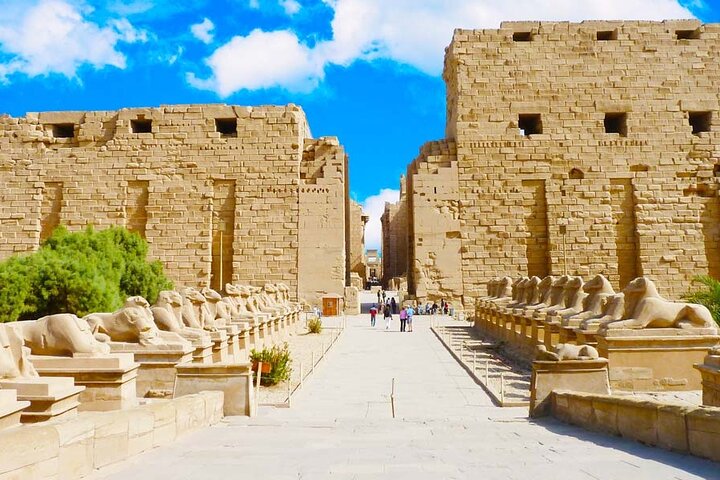
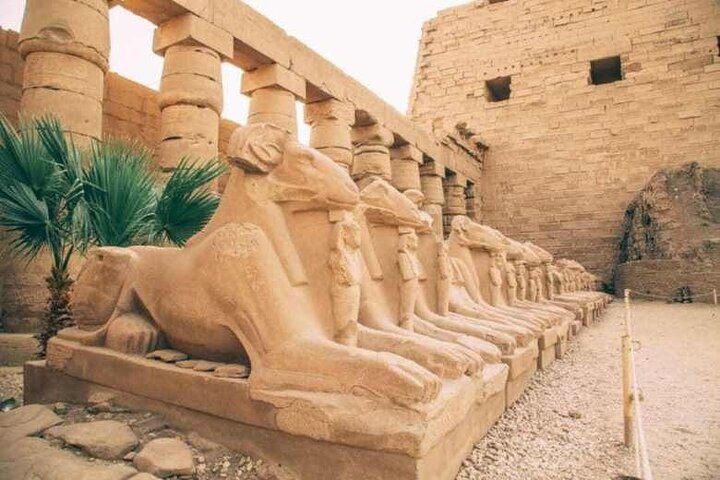
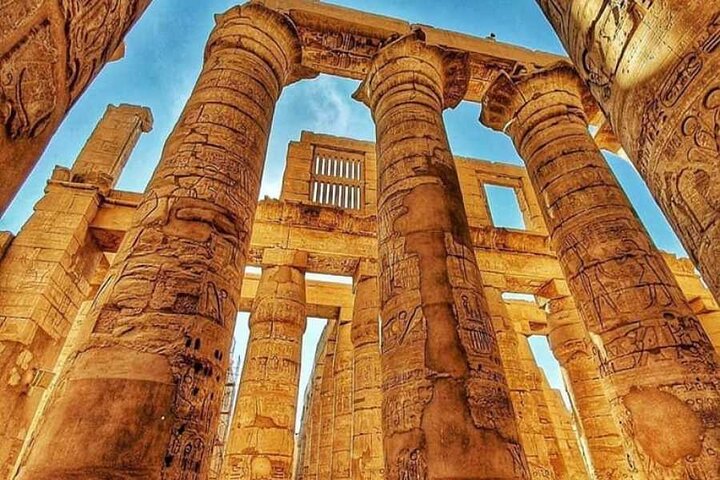
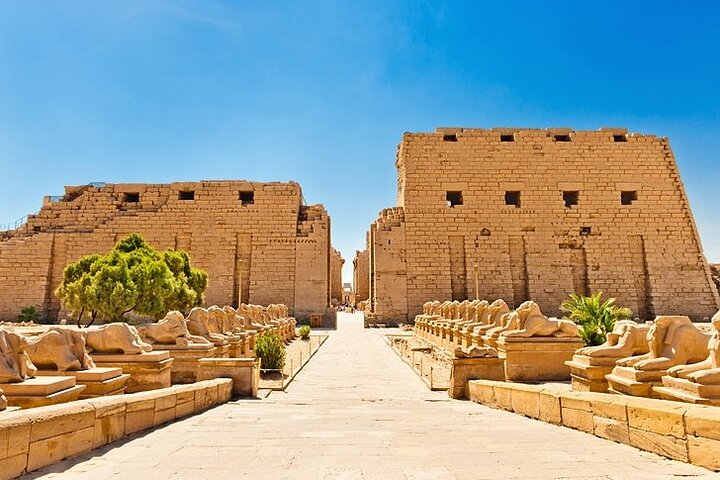
Temple of Karnak - The Karnak Temple Complex, commonly referred to as Karnak (from the Arabic Khurnak, meaning “fortified village”), is a vast mix of decayed temples, chapels, pylons, and other buildings near Luxor, Egypt. Construction at the complex began during the reign of Senusret I in the Middle Kingdom and continued into the Ptolemaic period, although most of the existing buildings date from the New Kingdom. The area around Karnak was the ancient Egyptian Ipet-isut (“The Most Selected of Places”) and the main place of worship for the eighteenth dynasty Theban Triad, with the god Amun as its head. It is part of the monumental city of Thebes. The Karnak complex lends its name to the nearby modern village of El-Karnak, located 2.5 kilometers (1.6 miles) north of Luxor.
Valley of the Kings, Temple of Hatshepsut, and Colossi of Memnon
Valley of the Kings - The Valley of the Kings, also known as the Valley of the Gates of the Kings, is a valley in Egypt where, for nearly 500 years from the 16th to 11th century BC, rock-cut tombs were excavated for the pharaohs and powerful nobles of the New Kingdom (the Eighteenth to the Twentieth Dynasties of Ancient Egypt).
The valley is located on the west bank of the Nile, opposite Thebes (modern Luxor), within the heart of the Theban Necropolis. The wadi consists of two valleys: East Valley (where the majority of the royal tombs are situated) and West Valley.
With the 2005 discovery of a new chamber and the 2008 discovery of two further tomb entrances, the valley is known to contain 63 tombs and chambers (ranging in size from KV54, a simple pit, to KV5, a complex tomb with over 120 chambers).
Temple of Hatshepsut at Deir el Bahari - The Mortuary Temple of Hatshepsut, also known as Djeser-Djeseru (Ancient Egyptian: ḏsr ḏsrw “Holy of Holies”), is a mortuary temple of Ancient Egypt located in Upper Egypt. Built for the Eighteenth Dynasty pharaoh Hatshepsut, it is situated beneath the cliffs at Deir el-Bahari on the west bank of the Nile near the Valley of the Kings. This mortuary temple is dedicated to Amun and Hatshepsut and is located next to the mortuary temple of Mentuhotep II, which served both as an inspiration and later, a quarry. It is considered one of the “incomparable monuments of ancient Egypt.”
The Polish Academy of Sciences in Warsaw is responsible for the study and restoration of the temple’s three levels. As of early 1995, the first two levels were nearly complete, and the top level was still under reconstruction.
Colossi of Memnon - The Colossi of Memnon are two massive stone statues of Pharaoh Amenhotep III, who reigned in Egypt during the Eighteenth Dynasty. Since 1350 BCE, they have stood in the Theban Necropolis, located west of the River Nile from the modern city of Luxor.

- Dinner
- All Taxes and Service Charge
- Bottled water
- Round-trip flights Cairo/Aswan & Luxor/Cairo
- Breakfast mentioned twice - combine into one
- 2 nights accommodation included
- All transfers in Cairo, Aswan, & Luxor
- Qualified Egyptologist guide
- Dinner
- All Taxes and Service Charge
- Bottled water
- Round-trip flights Cairo/Aswan & Luxor/Cairo
- Breakfast mentioned twice - combine into one
- 2 nights accommodation included
- All transfers in Cairo, Aswan, & Luxor
- Qualified Egyptologist guide
- Entrance Fees
- Gratuities.
- Entrance Fees
- Gratuities.
Visit Best of Luxor & Aswan in 2 Days 1 Night Covers top attractions that includes High dam,Philae Temple,Abu Simbel,Luxor and Karnak Temples,Valley of the kings,Hatshepsut Temple,Colossi of Memnon,Private Tour package includes all hotel accommodation,all transfers,Sightseeing trips,Flight tickets from Cairo to Aswan and from Luxor to Cairo
Highlights…
Visit Best of Luxor & Aswan in 2 Days 1 Night Covers top attractions that includes High dam,Philae Temple,Abu Simbel,Luxor and Karnak Temples,Valley of the kings,Hatshepsut Temple,Colossi of Memnon,Private Tour package includes all hotel accommodation,all transfers,Sightseeing trips,Flight tickets from Cairo to Aswan and from Luxor to Cairo
Highlights
See the sights of Aswan, Luxor, and Abu Simbel in just two days from Cairo
Learn the history at a pace that suits you from your personal Egyptologist
Spend the night in Aswan at a 4-star hotel, with breakfast
Skip the stress: Package includes private transfers direct from your door
For a full refund, cancel at least 24 hours before the scheduled departure time.
For a full refund, cancel at least 24 hours before the scheduled departure time.


