Embark on a private 2-day highlight tour in Luxor and explore the magnificent temples on the Eastern and Western banks. Discover the wonders of Luxor and Aswan, accompanied by an Egyptologist tour guide. Book now!
Embark on a private 2-day highlight tour in Luxor and explore the magnificent temples on the Eastern and Western banks. Discover the wonders of Luxor and Aswan, accompanied by an Egyptologist tour guide. Book now!
Explore Karnak and Luxor Temples
Luxor - Arrival in Luxor. • ISIS BEST TOURS staff will greet and assist you at your hotel, Luxor airport, or Luxor train station. • Transfer to board the Nile Cruise before lunch • Enjoy lunch on board • Visit the East Bank to see Karnak and Luxor Temples • Experience a Belly Dance Show.
Temple of Karnak - The…
Explore Karnak and Luxor Temples
Luxor - Arrival in Luxor. • ISIS BEST TOURS staff will greet and assist you at your hotel, Luxor airport, or Luxor train station. • Transfer to board the Nile Cruise before lunch • Enjoy lunch on board • Visit the East Bank to see Karnak and Luxor Temples • Experience a Belly Dance Show.
Temple of Karnak - The Karnak Temple Complex includes several temples, chapels, and other structures resembling a village, which is why it is named Karnak, meaning ‘fortified village’ in Arabic. Located in Karnak, Luxor Governorate, in southern Egypt on the east bank of the Nile River, the Karnak Temple dates from around 2055 BC to about 100 AD. It was constructed as a cult temple dedicated to the gods Amun, Mut, and Khonsu. As the largest religious building ever constructed, the Karnak Temple was referred to as the “most select of places” by ancient Egyptians.
Luxor Temple - Known as Ipet‑resyt or “Southern Sanctuary” to the ancient Egyptians, Luxor Temple was named for its location in ancient Thebes (modern Luxor). Situated approximately three kilometers south of Karnak Temple, it was once connected by a processional way lined with sphinxes. The earliest evidence of this temple dates back to the Eighteenth Dynasty (c.1550–1295 BC). Unlike most other ancient Egyptian temples, Ipet‑resyt is not aligned on an east‑west axis but is oriented towards Karnak. Luxor Temple was the main site for one of the most significant ancient Egyptian religious festivals, where the cult images of Amun, his wife Mut, and their son, the lunar god Khonsu, were transported from their temples in Karnak to Luxor Temple in a grand procession to visit the god residing there, Amenemopet, during the Opet Festival.
Luxor Museum - The Luxor Museum is a significant archaeological site in Egypt, located in an area that contains two-thirds of the country’s antiquities.
Mummification Museum - This museum aims to educate visitors about the ancient art of mummification. The Ancient Egyptians used embalming techniques on various species, not just humans. Mummies of cats, fish, and crocodiles are displayed in this unique museum, where visitors can also learn about the tools used.
The West Bank of Luxor / Valley of The Kings and Hatshepsut Temple / Hot Air Balloon Optional
Hot Air Balloons Luxor - Optional Hot Air Balloon tour to witness the sunrise over the west bank of Luxor.
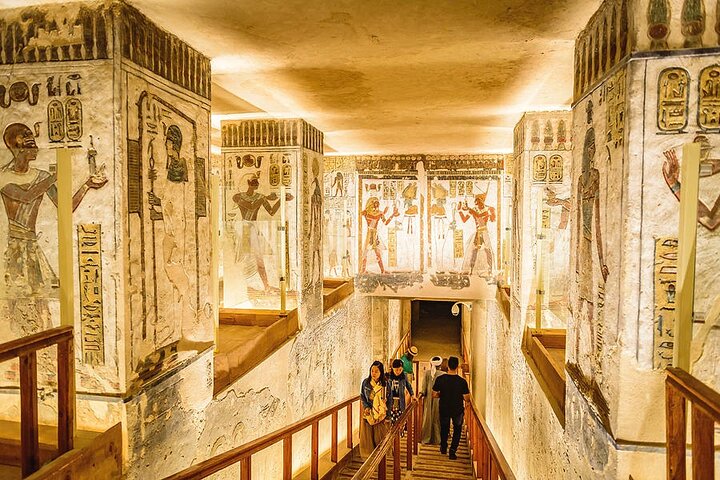
Valley of the Kings - During the New Kingdom period of ancient Egypt (1539-1075 B.C.), the Valley of the Kings served as the primary burial site for most royal pharaohs. Notable pharaohs buried there include Tutankhamun, Seti I, and Ramses II.
Temple of Hatshepsut at Deir el Bahari - This temple was constructed to honor the achievements of the great Queen Hatshepsut (18th Dynasty) and served as her funerary temple and a sanctuary for the god Amon Ra. In the 7th century AD, it was named after a Coptic monastery in the area, known as the “Northern Monastery.”
Colossi of Memnon - Visit the Colossi of Memnon, the two largest ancient statues in Egypt, dating back to the era of King Amenhotep III.
Temple of Medinat Habu - The Medinet Habu Temple, built by Pharaoh Ramses III and dedicated to the god Amon, is one of the ancient Egyptian temples in Luxor. Medinat Habu is considered one of the best temples on the West Bank and can be easily combined with other nearby sites in Egypt, such as the Valley of the Queens or Hatshepsut Temple.
Valley of the Queens - The Valley of the Queens (Arabic: Wādī al Malekāt) is an Egyptian site where the wives of pharaohs were buried in ancient times. It was known as Ta-Set-Neferu, meaning “the place of beauty,” and is renowned for being the burial site of many pharaohs’ wives.
Tomb of King Tutankhamun (Tut) - Although Tutankhamun was not a particularly significant king, his tomb was the only royal burial found intact in modern times. The tomb’s discovery allowed archaeologists to document what an Egyptian king’s tomb looked like and gain insights into ancient Egypt.

- Hotel pickup and drop-off in Luxor
- Private A/C vehicle for all transfers
- Professional Egyptologist guide
- Lunch included
- Hotel pickup and drop-off in Luxor
- Private A/C vehicle for all transfers
- Professional Egyptologist guide
- Lunch included
- entry fees
- entry fees
Enjoy a two-day adventure in Luxor. Discover the top attractions, including the grand Karnak Temples, the magnificent Luxor Temple, the Valley of the Kings, the Temple of Hatshepsut, and the Colossi of Memnon. Your journey will be guided by an Egyptologist, with mineral water provided during visits and transportation included. We look forward to welcoming you to Luxor soon.
Enjoy a two-day adventure in Luxor. Discover the top attractions, including the grand Karnak Temples, the magnificent Luxor Temple, the Valley of the Kings, the Temple of Hatshepsut, and the Colossi of Memnon. Your journey will be guided by an Egyptologist, with mineral water provided during visits and transportation included. We look forward to welcoming you to Luxor soon.
For a full refund, cancel at least 24 hours before the scheduled departure time.
For a full refund, cancel at least 24 hours before the scheduled departure time.